Hyderabad Registers 1,604 Road Accidents in last 5 Months: Police

A specific analysis of victims under the age of 18 years from January to May 2026 revealed that 128 children became casualties of road mishaps
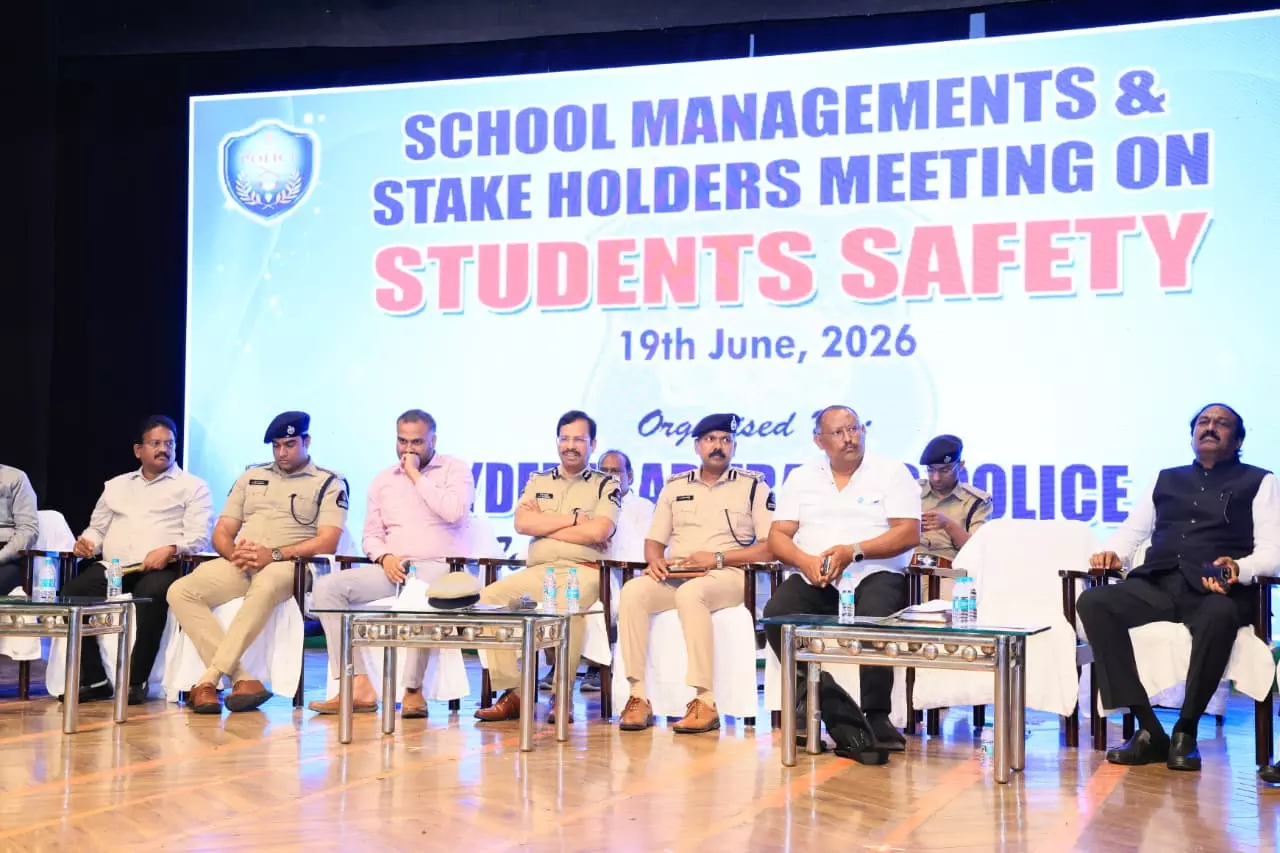
Hyderabad: The city recorded a total of 1,604 road accidents. Of them, 141 were fatal accidents while 86 accidents resulted in causing grievous injuries, and 1,377 accidents led to minor injuries.
A specific analysis of victims under the age of 18 years from January to May 2026 revealed that 128 children became casualties of road mishaps. Among these young victims, seven children lost their lives in fatal accidents, four suffered grievous injuries, and 117 sustained minor injuries.
Statistics show that 94 per cent of children who died in two-wheeler mishaps were not wearing helmets.
It was noted with deep concern that Road Traffic Injuries (RTIs) have become the leading cause of death among children and young adults aged between five and 19 years. On a national scale, approximately 45 children lose their lives daily in road accidents, with nearly two lakh children dying across India between the years 2011 and 2025.
This was stated by the Hyderabad Joint Commissioner of Police, Traffic, Joel Davis while delivering a detailed audio-visual presentation during a crucial joint stakeholder coordination meeting organized by the Hyderabad Traffic Police on school student road safety at Ravindra Bharathi here on Friday.
The meeting brought together school managements, administrators, and senior officials from various government departments to address the safety challenges faced y school children during transit.
Presenting the demographic and vehicular statistics of Greater Hyderabad for the year 2026, he noted that the city spans an area of 717.45 square kilometers with a total road length of 8,088 kilometers.
The current human population stands at 70.11 lakhs, while the total number of registered vehicles has reached 92.96 lakhs. Alarmingly, Hyderabad continues to witness the registration of approximately 1,500 new vehicles every single day.
To enhance student safety upon the reopening of schools in the second week of June, the Hyderabad traffic police issued an explicit list of appeals and actionable directives to school administrations including commute plan database, deployment of traffic marshals, adherence to GHMC parking rules, overcrowded auto-rickshaws
The Hyderabad traffic police appealed to the public to exhibit civic courtesy by halting vehicles to let school children cross roads safely. To mitigate heavy traffic congestion in areas dense with multiple educational institutions—such as Abids, Dilsukhnagar, Banjara Hills, and Vijayanagar Colony—school managements, nearby junior colleges, and private coaching institutes are instructed to stagger their operational timings.
Implementing a minimum variance of 15 minutes between the opening and closing hours of adjacent institutes will ensure a smoother traffic flow, Davis said.
Speaking on the occasion, Transport Commissioner Dr. K. Ilambarithi expressed deep concern over the severity of road accidents, pointing out that Telangana currently ranks 9th or 10th nationally in road accident mortality rates.
The state loses nearly 7,000 lives annually to road mishaps, with a vast majority of victims belonging to the highly productive 35-to-45 age demographic, which severely impacts the nation's economic framework. He noted that children constitute 10 per cent to 15 per cent of these tragic fatalities.
Hyderabad Police Commissioner V C Sajjanar stated that the twin goals of the meet were absolute road safety and the total protection of school children. He noted that the Hyderabad police jurisdiction encompasses approximately 3,500 to 3,800 schools, housing over 12 lakh students who represent the future of the nation.
He emphasized that establishing a safe school environment is a collective team effort involving schools, police, the GHMC, and the Education Department. He directed schools to seamlessly integrate five to 10 minutes of safety briefings into their regular morning prayers and official school functions.
The Commissioner asserted that an educational institution's success must not be evaluated solely through academic ranks, marks, or scholarships. He urged schools to adopt new Key Performance Indicators (KPIs), where a school can proudly declare that none of its students fell victim to road accidents, fell prey to cyber frauds, or got involved in illicit activities like drugs or minor driving.
Enforcing a 'Zero Tolerance' policy, the Commissioner stated that the police would directly report minor driving violations to the respective schools, and urged school authorities to award 'Negative Marks' to such students to instill regulatory discipline.
He expressed deep concern over instances where drivers of reputed schools were caught operating buses under the influence of alcohol. He warned that if any school driver is caught drunk during random police checks in the future, the department will publicly disclose the name of the defaulting school.
The Commissioner clarified that school managements cannot absolve themselves of liability by claiming that an accident occurred outside their gates; schools are responsible for the student from the moment they leave their home until they return safely.
Every school must mandatorily designate a dedicated 'Transport Manager' to track student transits and check the overcrowding of autos in coordination with parents during PTMs. Schools must utilize their institutional funds to establish internal vigilance cells, install extensive perimeter CCTV networks, and sponsor traffic volunteers through the HCSC rather than relying solely on government resources, he added.
GHMC Commissioner R. V. Karnan, UNICEF Representative Dr. Zelalem Birhanu Taffesse and others also spoke.
80 % Schools Lacked Official School Zone Warning Boards
Hyderabad: A recent field survey assessing school zones across Telangana revealed severe infrastructural gaps that require immediate rectification. The data showed that 80 per cent of schools lacked official 'School Zone' warning boards, and 90 per cent lacked mandated speed-limit signs.
Additionally, 70 per cent of connecting roads lacked zebra crossings, and 70 per cent of school gates lacked speed breakers to slow down approaching traffic. The survey also found that 60 per cent of school areas lacked proper sidewalks, while 20 per cent had highly restricted or narrow footpaths.
Furthermore, 70 per cent of schools lacked dedicated pick-up and drop-off zones, 80 per cent lacked a structured accident-reporting protocol, and zero per cent of the surveyed locations possessed traffic enforcement cameras to monitor violations.
In response to these findings, UNICEF has sponsored and successfully developed safe school-zone infrastructure for 12 selected schools in Hyderabad, serving as a model that private school managements are urged to replicate using their own funds.