Hyderabad Prof Wins Global Recognition For Mosquito Control Study

Prof. M. Madhavi honoured in China for developing eco-friendly mosquito-killing nanoparticles using Indian medicinal plants.
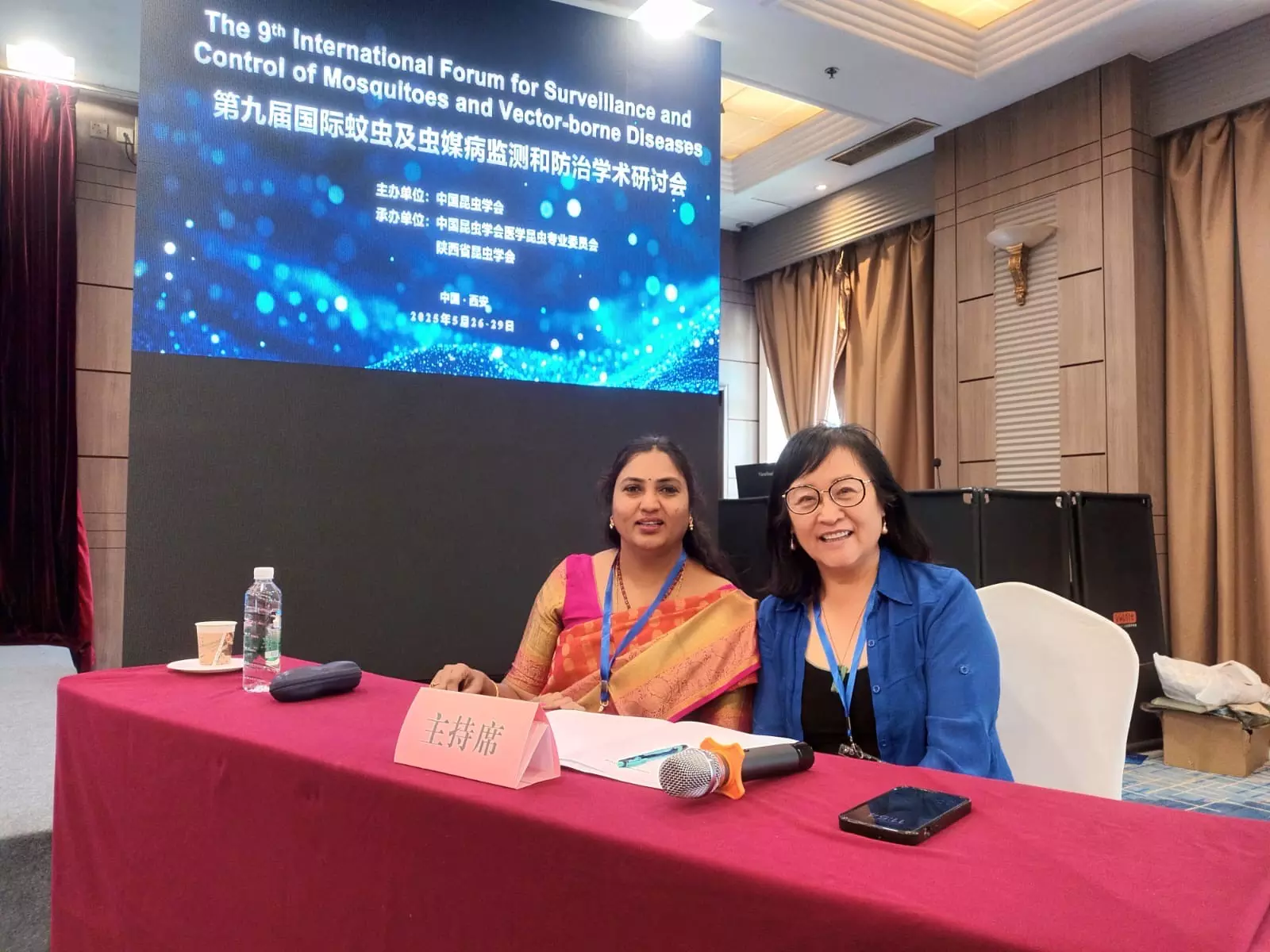
Hyderabad: Prof. M. Madhavi, former head of Osmania University’s department of zoology, was recognised at an international forum in Xi’an, China, for her work using Indian medicinal plants to develop zinc oxide nanoparticles that proved effective in killing mosquito species responsible for spreading dengue and chikungunya.
At the International Forum for Surveillance and Control of Mosquitoes and Vector-borne Diseases, held from May 26 to 29 and organised by the Entomological Society of China, she was awarded two certificates of honour and appreciation. The forum drew researchers from over ten countries, including the US, China, Switzerland, France, and Thailand.
Prof. Madhavi’s research focused on synthesising zinc oxide nanoparticles (ZnONPs) from the leaves of two indigenous plants—‘Calotropis procera’ and ‘Catharanthus roseus’. “We used plant extracts as a base for the nanoparticle synthesis and then carried out detailed phytocharacterisation,” she said.
When they were tested on Aedes aegypti and Aedes albopictus, the sibling mosquito species that spread dengue and chikungunya, the results were striking, Prof. Madhavi said. “We observed 100 per cent mortality, both in larval and adult stages,” she said.
She explained that this method could offer a safer, plant-based alternative to synthetic insecticides.
“Nanoparticles synthesised from medicinal plants may be less toxic to humans and the environment, while still being effective against mosquito vectors. This could make them especially useful in areas where chemical resistance is becoming a problem,” she added.
Prof. Madhavi also chaired a technical session on vector control and insecticide resistance at the forum. She used the platform to highlight ongoing research from India and explore collaborations with international experts. “I had meaningful discussions with researchers like Dr Florence Fouque from WHO Geneva, Dr Ruide Xue from Florida, and Dr Wu Dai of the Entomological Society of China. We’re now looking into possible joint research and faculty or student exchange programmes.”
