Hyderabad Plan To Supply Treated Wastewater to Industry Hits Storage and Quality Hurdles Ahead of Nov 1 Rollout

Separately, a Hyderabad pharmaceutical manufacturer has sought permission to bring municipal sewage through a six-kilometre pipeline to its factory, treat it and replace as much as 75 per cent of its freshwater requirement.
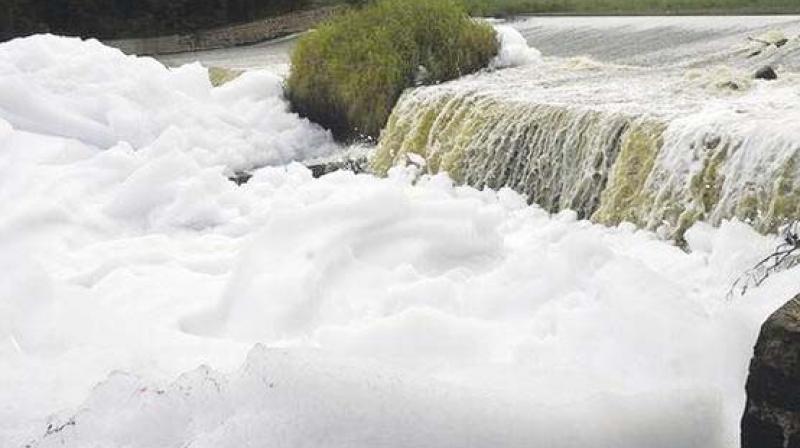
HYDERABAD: The plan to supply treated wastewater from gated communities in the city to industries and construction sites from November 1 faces difficulties even before the water reaches potential buyers. Residents' associations say surplus treated water is being discharged into drains because complexes lack storage facilities and buyers, while wastewater operators say many private sewage treatment plants (STPs) are failing to produce water suitable for reuse.
Separately, a Hyderabad pharmaceutical manufacturer has sought permission to bring municipal sewage through a six-kilometre pipeline to its factory, treat it and replace as much as 75 per cent of its freshwater requirement.
"We have approached the Pollution Control Board for permission to take drainage water into our factory, treat it and use it. After that, I have to approach various departments, including the collector, commissioner and roads and buildings, to lay the pipeline to my factory. A lot of government permissions are required to do this," said M. Narayana Reddy, managing director (technical) of Virchow Laboratories. The proposed collection point is about six kilometres from the factory and the sewage would have to be pumped upstream through a new pipeline. Reddy said treatment costs were manageable but transportation and regulatory clearances remained obstacles.
Unlike HMWS&SB's plan to collect water already treated at residential STPs, Virchow proposes to treat municipal sewage at its factory. Both depend on water meeting the standards required for its eventual use but experts question whether complexes should first reduce their own freshwater demand before sending surplus treated water outside.
"The problem is that even when societies want to supply treated water for public use, nobody is taking it. They do not have large storage facilities, so the treated water is being discharged into the drainage system," said B.T. Srinivasan, general secretary of Uferwas (United Federation of Resident Welfare Associations), Greater Hyderabad, and a representative of the pan-India CoRWA (Confederation of Resident Welfare Associations).
Wastewater operators added that the condition of private STPs varied considerably. "Most societies are either not treating enough wastewater for reuse or are treating it to very poor quality. They use treated water for gardening and freshwater for flushing. I know societies that are not treating even 10 per cent of their water," said Vishal Murarka, CEO and executive director of Banka Bio.
Murarka estimated that several residential and commercial STPs were not functioning as required, although he did not provide survey data supporting the figure. He attributed the problem partly to repair costs and difficulties in finding reliable operators.
Bengaluru's experience offered a comparison of how residential communities can reduce dependence on outside water supplies. Dr Chandrashekar Hariharan, a Bengaluru-based water expert. who represents World of Water, said residential buildings could substantially reduce dependence on municipal supplies, borewells and private tankers through wastewater reuse and rainwater harvesting. He cited a residential development near Yelahanka that had reportedly become independent of all three sources.
Dr Hariharan estimated that around 40 per cent of residential water requirements could be met with recycled water for flushing and landscaping. "Karnataka is one of the most progressive states when it comes to regulations for water management. However, the lack of compliance among water users has been a major challenge," he said.
Dr B.V. Subba Rao, a Hyderabad-based water resources expert, made a similar case. "High-rise buildings should have their own treatment systems. We are treating water and using it for landscaping, but the treated water should also be utilised for flushing toilets. The same practices should be introduced in government departments," he said and suggested common storage facilities connected through pipelines could allow complexes to pool surplus treated water.