Hyderabad-based FDDI Enters Strategic Partnership With NIDAP To Foster Academic Excellence

The landmark agreement establishes a framework for comprehensive cooperation between the two institutes
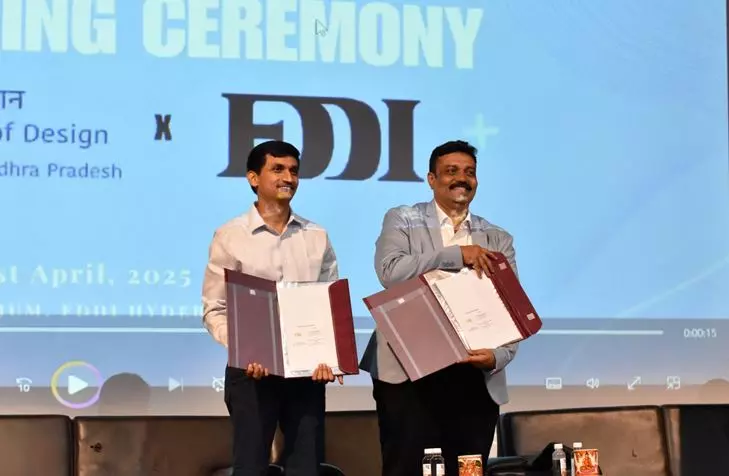
Hyderabad: The Footwear Design and Development Institute (FDDI), Hyderabad, has entered into a strategic partnership with the National Institute of Design in Andhra Pradesh (NID AP) through a formal Memorandum of Understanding (MoU) with an aim to foster academic excellence, industry-aligned research, and cross-institutional engagement.
The landmark agreement establishes a framework for comprehensive cooperation between the two institutes, leveraging their respective strengths in design education and innovation with a focus on academic synergies through faculty and student exchange programs, joint research initiatives in emerging design disciplines.
It will also focus on shared infrastructure utilization, including laboratories and specialized facilities and industry-aligned projects to enhance employability and entrepreneurship. The partnership encompasses multiple design disciplines including industrial and communication design, textile and apparel design, footwear design and production technologies, among others.
“The collaboration represents a significant step forward in creating an ecosystem where design innovation meets industry requirements. By combining our academic rigor with FDDI Hyderabad's specialized expertise, we aim to set new benchmarks in design education.” stated Dr. Bhaumik Nagar, Director, NID AP.
Dr. Narsimhugari Tej Lohit, a retired IAS officer and Executive Director, FDDI Hyderabad, emphasized, “Our partnership with NID AP will foster cross-disciplinary learning and create opportunities for students to engage with cutting-edge design concepts and industry practices. This aligns perfectly with our mission to develop globally competent design professionals.”
The MoU will remain in effect for an initial period of three years, with provisions for extension. Implementation will be overseen by designated nodal officers from both institutions, with biannual reviews to assess progress.
