Hyd to Witness Rare Blue Micromoon on May 31

A Blue Moon occurs in the astronomical season between spring equinox and summer solstice
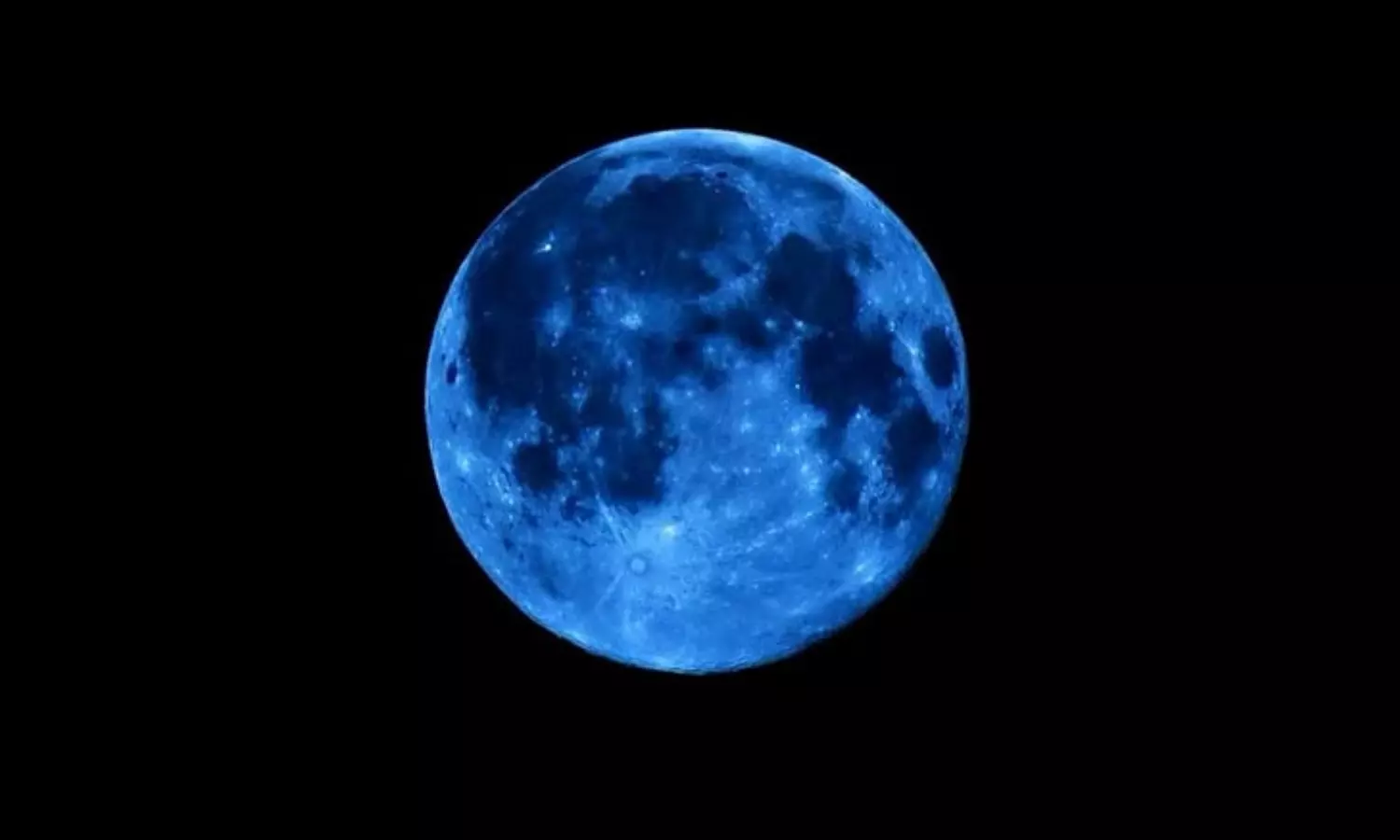
HYDERABAD: As most people in the city relax on Sunday evening, the rising Moon will mark both a ‘Blue Moon’ and a ‘Micromoon.’ The full moon will be visible on Sunday, May 31, between 6.30 pm and 7.30 pm, when experts recommend the best viewing.
A Blue Moon occurs in the astronomical season between spring equinox and summer solstice. This month features two full moons the first on May 1 and the second on May 31. Because the Moon will be near apogee, its farthest point from Earth, it will appear about 7 per cent smaller and 14 per cent dimmer than an average full moon.
No arrangements are being made by astronomical centres in the city for the public to enjoy the event with family and friends.
Speaking to Deccan Chronicle, Mrunalinee Ramanja, scientific officer at Birla Planetarium, Hyderabad, said, “Every 2.6 to 3 years, a single calendar month gets squeezed tightly enough to fit two full moons. This month, the first full moon (the Flower Moon) occurred on May 1. Blue Moon is purely a quirk of our calendar geometry. The Moon reaches its peak astronomical full phase during daylight hours for India (2.15 pm IST).”
She added, “To observe this Blue Moon, you don’t need expensive equipment your eyes are the best tool. Catching the moon right as it clears the eastern horizon is highly rewarding. Due to a psychological trick called the Moon Illusion, your brain compares the rising moon to distant buildings and trees, making it appear larger and more dramatic than when it is high in the sky. Find an open area with an unobstructed eastern horizon. A basic pair of binoculars will beautifully reveal the ray systems of craters like Tycho and Copernicus along the terminator line where daylight meets shadow.”
Experts said that after May, the next standout event is a spectacular planetary encounter in early June the Venus‑Jupiter conjunction on June 8–9, 2026. Just over a week after the Blue Moon, the two brightest planets will appear a fraction of a degree apart low on the western horizon shortly after sunset. The event will be brilliantly visible to the naked eye, even from light‑polluted urban spaces, offering a striking target for amateur astrophotography.
