Himayatsagar Gate Ops Aimed At Safety: Board

According to the Hyderabad Metropolitan Water Supply and Sewerage Board (HMWS&SB), these operations are determined entirely by water inflow, outflow and rainfall patterns, not by how long the gates have been open.
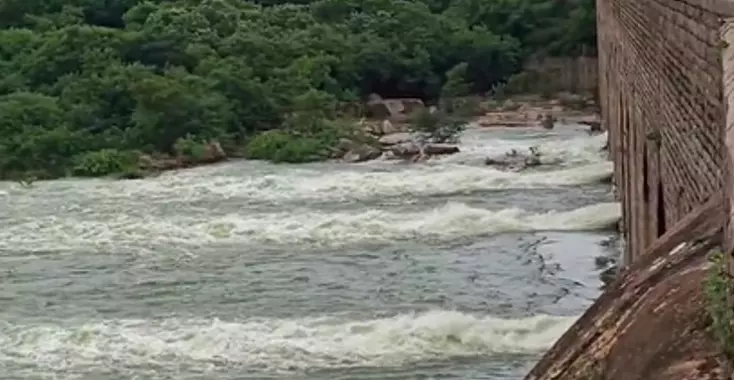
Hyderabad:Over the past few days, the gates of Himayatsagar reservoir have been opened and closed several times within hours — at times, one or two gates are opened, then shut, only to be reopened a few hours later.
According to Hyderabad Metropolitan Water Supply and Sewerage Board (HMWS&SB) officials, these operations are determined entirely by water inflow, outflow and rainfall patterns, not by how long the gates have been open.
On Wednesday, the gate operations were as follows: at 6 am, one gate opened to 3 feet, releasing 964 cusecs; at 9 am, two gates were opened to 3 feet each, discharging 1,927 cusecs. The release was then increased to around 3,000 cusecs with a third gate opened at 10 am. By 11 am, three gates were open at 3 feet each, with an outflow of 2,891 cusecs, and by 6 pm, four gates were open at 3 feet each, releasing 3,854 cusecs.
“It may look like we are opening and closing gates without a plan, but every move is calculated to protect both the city’s water security and the reservoir’s safety,” an official said.
The official noted that if the gates are kept open for long periods when there is no rain and inflows reduce, water levels drop, affecting storage. Conversely, keeping the gates closed for too long during heavy inflows could put pressure on the infrastructure. The water board adjusts the gates according to the situation. “The aim is to maximise water storage for the city, minimise wastage and ensure the safety of the infrastructure,” officials said. The board monitors rainfall, upstream inflows and reservoir levels round the clock.
“Gate operations are entirely dependent on inflows. We monitor reservoir levels every hour and aim to maintain them close to the full tank level of 1,763.50 feet. We avoid keeping the gates open unnecessarily to prevent wastage, because if water is lost now and inflows drop later, it could lead to scarcity,” said D. Sudarshan, director (transmission), HMWS&SB.
“Releases are made gradually, not all at once, to ensure safety and avoid problems for downstream areas. That is why we keep checking and releasing water on an hourly basis — so it neither affects storage nor leads to wastage. Our aim is to maximise water storage for the city, minimise wastage, and ensure the safety of the infrastructure,” he added.
The water board continues to closely monitor rainfall, upstream inflows and reservoir levels throughout the day. Based on these, decisions are taken every few hours on how many gates to open and to what height.
