High-Rise Builders Must Buy 10% TDR for 10+ Floor Projects

The TDR provides additional built-up area to the landowner upon relinquishing or surrendering land without cost for public purposes and was introduced in the state in 2012.
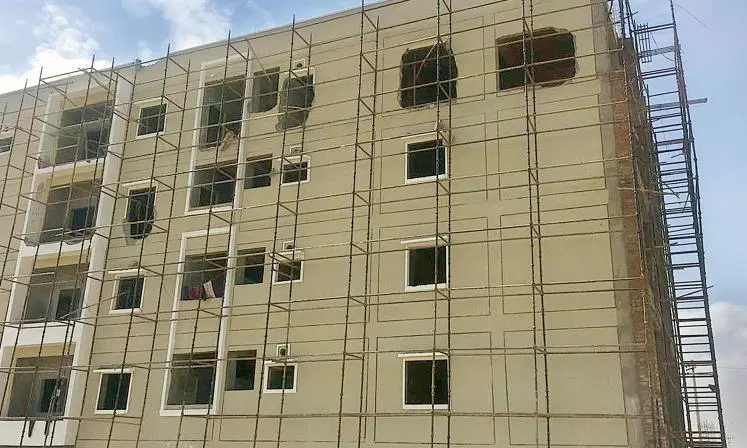
Hyderabad: The Telangana government has made it compulsory for high-rise buildings above 10 floors to use transferable development rights (TDR). As per the new rule, these buildings will be required to use TDR for 10 per cent of additional floors above the 10th floor.
The decision, taken as a part of recent amendments, is aimed at strengthening the TDR market and ensuring better compensation for landowners affected by public projects.
The TDR provides additional built-up area to the landowner upon relinquishing or surrendering land without cost for public purposes and was introduced in the state in 2012. As the name indicates, the TDR is transferable.
Officials stated that the rule applies only to the area constructed over and above the 10th floor. Floors up to the 10th level will not require compulsory TDR usage.
The government said the move was intended to create steady demand for TDR and encourage landowners to accept TDR voluntarily when their land parcels are acquired for lake protection, river development or nala and drainage works. By ensuring regular usage of TDR in large projects, authorities are looking towards improving market confidence and liquidity.
Real estate experts said that the new system will give government control over high rises. Credai-Hyderabad general secretary V. Rajashekar Reddy said: “The new TDR rule will bring control over the exponential growth of high rises. Overall, the cost component might not increase in terms of additional floors, but the ambiguity between landowners and developers might create a little confusion in the initial days. In the long term, this is a good decision.”
The government had earlier announced TDRs for landowners whose built-up structures fall under the full tank level (FTL), maximum flood level (MFL) and buffer zones of lakes and rivers within the city’s Core Urban Region (CURE). Land owners within the FTL of lakes and MFL of rivers can get 200 per cent TDR on built-up area, while land within the buffer zones will be compensated with 300 per cent of TDR. Land percels which fall outside the buffer zone but are needed for the development of lakes, river or nalas will get 400 per cent TDR compensation.
Musi River Development Corporation Limited (MRDCL) managing director E.V. Narasimha Reddy said: “It gives better options for those owning land parcels falling either in river bed or buffer zones, which are essentially non-development zones as per norms Central Water Commission guidelines. They cannot put them to any of their use although they have property rights. It gives good TDR with marketability as per the new GO.”
He said the GO would help the MRDCL in expediting the process of development by duly taking possession of the buffer zones by extending TDR, legitimately. “It is a transparent and fair way of compensating”, Narasimha Reddy said.