Heavy Rain Over Hyderabad? City Partly to Blame

A lesser known but a serious contributor to the rainfall events is the air pollution in Hyderabad, particularly dust pollution that typically rises way above the 2 km to 5 km height band from the ground in which rain bearing clouds normally form.
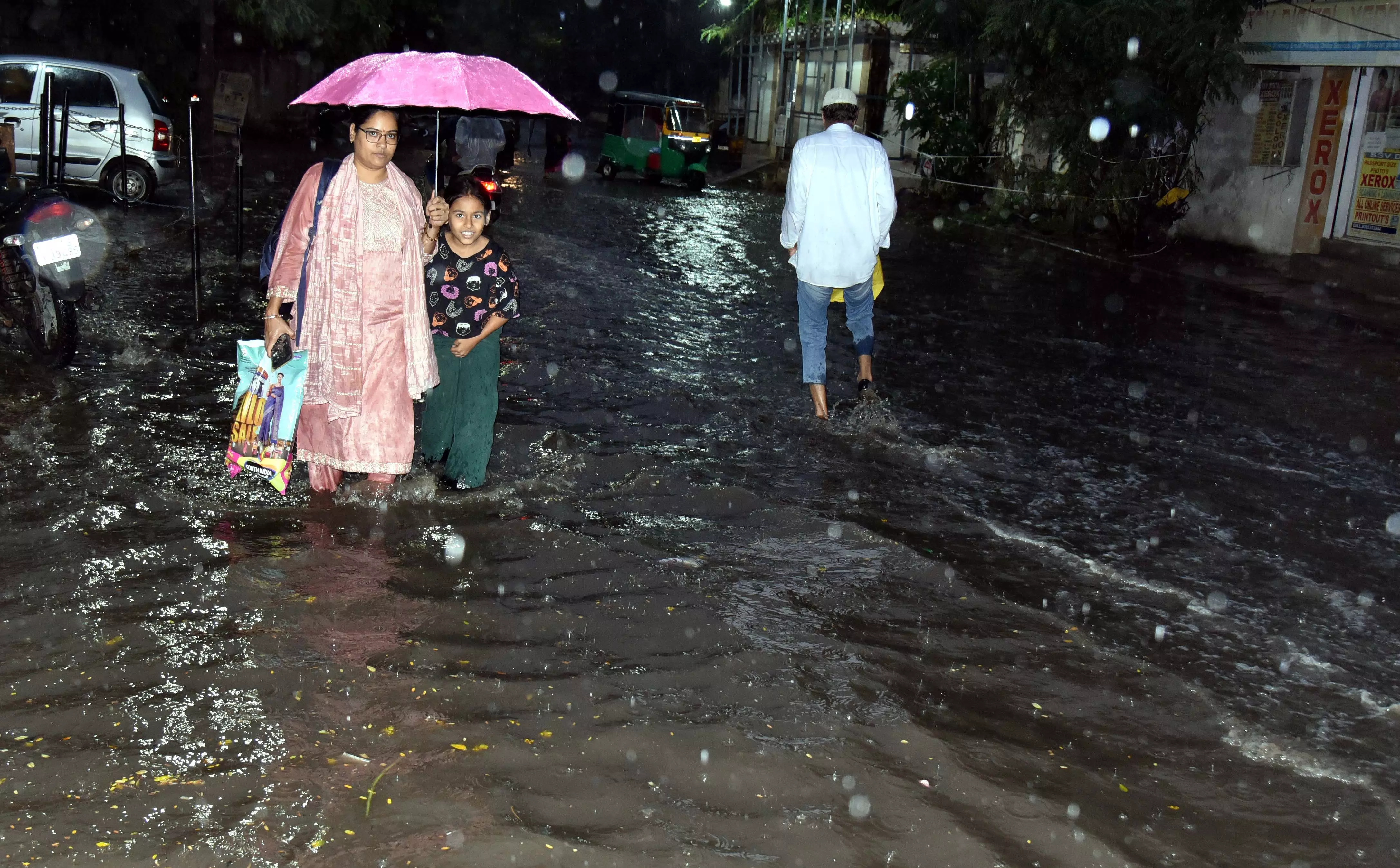
Hyderabad: Hyderabad, which has been experiencing pounding spells of cloudbursts and heavy rain, may do well to prepare for more of the same in the years to come with the city itself being a major contributor to the phenomenon.
Among the ‘culprits’ in the city that are playing a role in Hyderabad turning into a punching bag for rain events are the rapidly increasing number of glass clad buildings, and non-stop concretization, turning Hyderabad into perfect heat island that acts like a magnet for dragging moisture from around the city, enveloping the sky with clouds that eventually empty themselves out on to the streets, homes, and people.
A lesser known but a serious contributor to the rainfall events is the air pollution in Hyderabad, particularly dust pollution that typically rises way above the 2 km to 5 km height band from the ground in which rain bearing clouds normally form. Though the Telangana Pollution Control Board’s air pollution data typically points to air pollutants below or well below the accepted levels, the TPCB has only around 14 air quality monitoring stations which are woefully inadequate for a city spread over 750 square kilometres.
“Dust particles can act as the nuclei around which water molecules coalesce and can form rain drops. The burning of fossil fuels like petrol, diesel, large scale construction activity, and concrete buildings with glass facades, all contribute to such rain events because they turn the city into a heat island,” Dr Akashapu Dharma Raju, a scientist with the Indian Meteorological Department said.
Glass for example, retains heat and releases it slowly. Same with concrete. When the heat in and over the city is higher than the surrounding areas, the cooler air rushes in, and if there is moisture, the air brings that in too, which gets added to the evaporation from within the city. All these factors are behind what the city is seeing these days, he explained.
Even as this year has already seen a handful of intense rain events over the city, according to a study by IMD Hyderabad scientists published in the Journal of Earth System Sciences this July, found that the city has been on an upward trend in rainfall, and Hyderabad must prioritize its flood management infrastructure.
“Even a 2 cm rain in a short spell can result in flooding in many parts of the city. And Hyderabad has been witnessing anywhere between 10 cm and 15 cm of rain in a matter of a few hours. The normal average rain for Hyderabad from the start of the monsoon season till September 16 is 56 cm. This year, we have seen it leap to 81 cm. The jump is also across the state. The average rain for the season so far should be 63 cm but this year we already got 83 cm,” Dharma Raju said.
Rain bearing Cumulonimbus clouds
Usually form between 500-2,000 metres (1,600-6,500 feet) above ground level;
At the top, they can extend up to 12-18 km (40,000-60,000 feet) in tropical regions;
Most intense activity in these occurs between 2-8 km (6,500-26,000 feet);
Their actual height depends on local topography, season and weather patterns, atmospheric stability, temperature and humidity conditions.
Past top 10 rainfall events in Hyderabad*
Year – Month/Date – Rain**
2000 – August 24 – 241.5
1989 – July 24 – 140.5
2009 – August 18 – 133.7
2008 – August 9 – 121.9
2012 – July 21 – 115.1
2001 – June 12 – 114.6
1978 – August 15 – 113.8
2017 – August 26 – 113.7
2006 – July 27 – 106.8
1991 – August 3 – 98.0
*Till August 2025
**in mm
It used to rain, now it pours in Telangana
JJAS (June, July, August, September) monsoon season
Year – Ext* - VHvy** - Hvy*** - Total
2015 – 1- 8 – 35 - 44
2016 – 3 – 18 – 55 - 76
2017 – 0 - 5 – 44 – 49
2018 – 3 – 10 – 35 – 48
2019 – 3 – 12- 48 – 63
2020 – 2 – 28 – 64 – 94
2021 – 5 – 28 – 72 – 105
2022 – 6 – 29 – 69 – 104
2023 – 5 – 18- 46 – 69
2024 – 2 – 21 – 66 – 89
*Extreme rain event days
**Very heavy rain event days
***Heavy rain event days
