Golden-Backed Frog’s Range Extended To Telangana’s Eastern Ghats

Researchers recorded the species at Saleswaram waterfall in the Nallamala Hills, marking its first authenticated record in the Eastern Ghats.
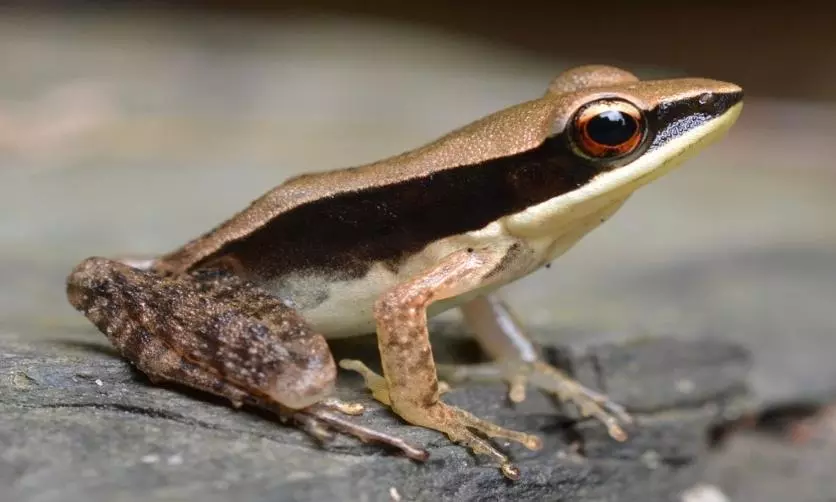
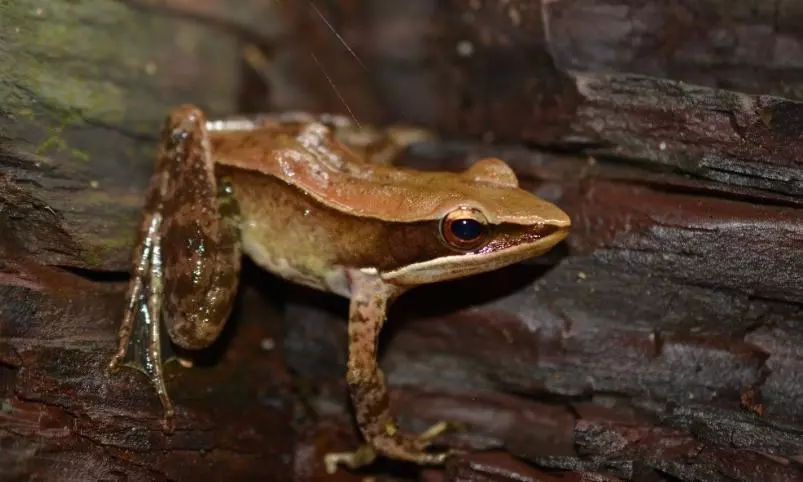
A frog species long believed to be restricted to the central Western Ghats has been confirmed in Telangana’s Nallamala Hills, extending its known geographical range to the Eastern Ghats and drawing attention to the region’s relatively unexplored amphibian diversity.
Researchers from the Zoological Survey of India (ZSI) recorded the Indian golden-backed frog (Hylarana indica) at Saleswaram waterfall in the Amrabad tiger reserve, Nagarkurnool district. The finding, published in the ‘Records of the Zoological Survey of India’, is based on three specimens collected during a survey in July 2020.
The species was earlier considered a narrow endemic of the central Western Ghats in Karnataka and Kerala. Researchers used morphological measurements, photographic documentation and molecular analysis to establish the identity of the specimens. Analysis of the 16S ribosomal RNA gene showed only 0.2 to 0.5 per cent genetic divergence from known Western Ghats populations, confirming their close genetic relationship.
The study was authored by Bharath Bhupathi, K.P. Dinesh, Deepa Jaiswal, M. Karuthapandi and Pratyush P. Mohapatra. The researchers said the finding was the first authentic record of Hylarana indica from the Eastern Ghats in Telangana and called for further surveys to establish the species’ distribution.
Researchers say the discovery is significant amidst the limited documentation of amphibians in the Eastern Ghats. The region has only 28 recorded amphibian species, compared with 253 in the Western Ghats and 455 across India. Amphibians are considered important ecological indicators, as their presence can provide insights into the health and integrity of ecosystems.
“The Eastern Ghats still have vast unexplored areas, and further faunal explorations could provide valuable insights into the region’s actual biodiversity,” said Dr Jaiswal of ZSI, Hyderabad. She called for comprehensive taxonomic studies and molecular research to reassess amphibian diversity and assess the species’ conservation requirements.
ZSI director Dr Dhriti Banerjee said the discovery should draw greater attention to biodiversity conservation in unexplored landscapes and protected areas, particularly permanent water bodies in inhabited landscapes.
Dr Pratyush P. Mohapatra of ZSI, Kolkata, described the Eastern Ghats as a rich field for scientific exploration, saying systematic documentation could reveal previously unrecorded diversity, potentially new species and evolutionary relationships.
Dr Dinesh, an amphibian systematist at ZSI’s Western Regional Centre in Pune, said recent surveys in the Eastern Ghats had already yielded a new species of cricket frog and two frogs earlier believed to occur only in Sri Lanka. “These hills are clearly far richer than their present species list suggests,” he said, calling for systematic surveys, taxonomic research and long-term biodiversity monitoring.
The study says the golden-backed frog has not yet been evaluated by the IUCN. An earlier assessment, however, had considered it vulnerable in Karnataka’s Chikkamagaluru district. Researchers said further field studies were needed to understand its population and conservation needs in the Eastern Ghats.