Rumble Strips on PJR Flyove Make for Back-breaking Ride

27 Jun 2025 12:09 AM IST27 Jun 2025 12:09 AM IST
Experts and commuters question GHMC’s decision to install harsh rumble strips on Kondapur–Gachibowli flyover’s sharp curves, citing serious road safety risks
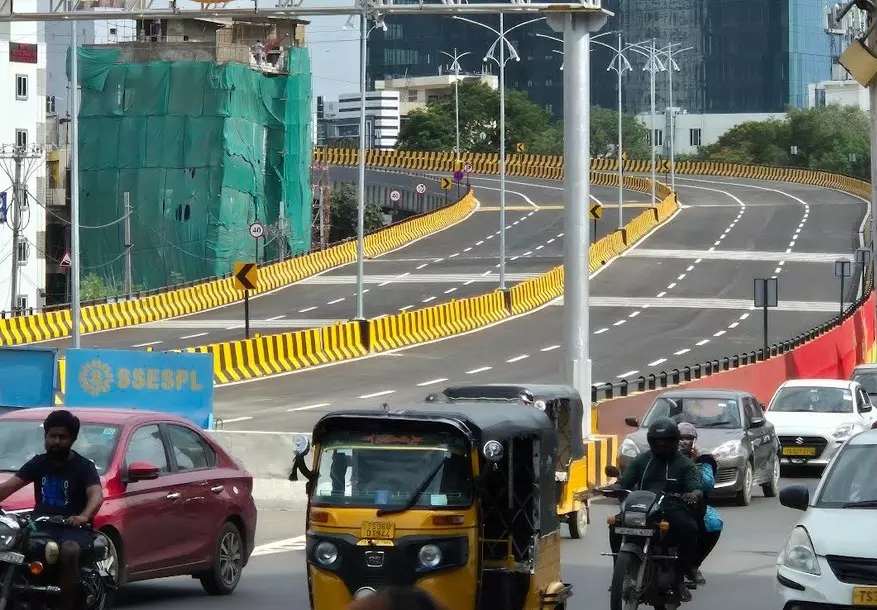
Thick rumble strips laid along sharp curves of the PJR Flyover raise concerns among road safety experts and residents even before its opening. (Image:DC)
Hyderabad: Even before its inauguration, the newly-constructed Kondapur–Gachibowli flyover, to be named the PJR Flyover, has triggered serious road safety concerns, particularly due to rumble strips installed along its curves. These strips appear to contradict earlier GHMC assurances about removing “unscientific” speed control mechanisms across the city.
While locals believe the flyover could ease traffic congestion, many fear the rumble strips may make commuting riskier. “The curves on the flyover are scary. We haven’t started using it yet, but the way people speed and the number of curves is already worrying,” said Mohd Ghouse, who runs a pan shop near the ramp. Though the flyover remains barricaded, a visit by Deccan Chronicle revealed that the rumble strips were thick, harsh and placed at sharp turns.
Commuters and experts worry these could do more harm than good. In 2022, after several accidents and complaints about discomfort caused by such strips, GHMC officials had promised that only scientifically engineered strips, conforming to IRC (Indian Roads Congress) norms, would be retained.
Speaking to Deccan Chronicle, Dr S.P. Anchuri, infrastructure consultant and chairman of FOCUS (Forum for Construction Utility Services), Hyderabad chapter, said that harsh rumble strips and excessive curvature could have been avoided if authorities considered vehicle dynamics and commuter behaviour. “Rumble strips near curves should be a last resort, yet they are commonly used on unscientifically designed city flyovers. Even after the Biodiversity Flyover accident, the design of this flyover doesn’t reflect any serious concern for commuter safety.” He added that rumble strips can trap rainwater between layers, increasing the risk of skidding. “
Two-wheeler tyres are especially vulnerable. In the rain, even small puddles can prove fatal,” Dr Anchuri explained. Besides safety risks, the strips also create shallow ruts over time, making the road surface uneven even after their removal. “They make it difficult for two-wheelers to change lanes smoothly,” said B. Srikanth, a commuter. As per IRC guidelines, rumble strips must meet specific engineering standards — a width between 150 to 300 mm, height not exceeding 15 mm, and spacing of 250 to 500 mm between strips. Usually, they are laid in 5 to 10 rows across at least 2.5 metres of lane width. Experts warn that deviations from these parameters, particularly on curved flyovers, can affect vehicle stability and endanger riders. The PJR Flyover, they fear, may have ignored these standards.
( Source : Deccan Chronicle )

Next Story