Firm to Produce Cold-Water Fish Rainbow Trout in Hyd

India is among the world’s largest fish producers, but inland cold-water aquaculture for food remains limited.
Hyderabad:Food-grade rainbow trout, traditionally limited to cold hill regions, is now being produced inland near Hyderabad using controlled recirculating aquaculture systems, marking a shift in how high-value fish for consumption is farmed in India.
The integrated aquaculture facility, set up by SmartGreen Aquaculture at Kandukur Mandal in Ranga Reddy district, uses a closed-loop recirculating aquaculture system (RAS) to grow trout in a biosecure indoor environment. The project involves an investment of about $6 million and has a planned annual production capacity of 1,200 metric tonnes once fully scaled.
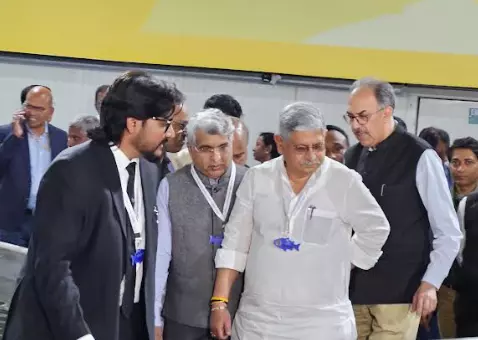
The facility was inaugurated on Monday, by Rajiv Ranjan Singh, Union fisheries minister. At the inauguration, Singh said the project demonstrated how technology could enable cold-water aquaculture beyond traditional geographies.
“This is not sport fishing or stocking for recreation. This is entirely food production,” said the company founder and managing director Aditya Rithvik Narra. “Our focus is on producing edible rainbow trout consistently, safely and close to the consumer.”
Unlike traditional open-water trout farming, which depends on natural cold streams, the RAS model allows precise control of temperature, oxygen levels and water quality. “Trout is a sensitive species. Even small variations can affect survival and quality,” Narra said. “RAS allows us to maintain stable conditions despite being in a warm region like the Deccan Plateau.”
The facility includes hatchery units, indoor grow-out tanks, processing and cold-chain infrastructure. Fish harvested from the farm are processed on-site into edible products such as fillets, steaks and degutted portions. “By integrating farming and processing, we reduce delays, intermediaries and quality loss,” Narra told Deccan Chronicle.
The first phase of operations, with an estimated output of around 360 metric tonnes annually, is nearing market readiness. “We are scaling in phases to ensure biosecurity and consistency before expanding to full capacity,” he said.
The project also includes plans for a microalgae biorefinery and a skill centre focused on RAS operations. “Microalgae will support feed, sustainability and future applications beyond aquaculture,” Narra said.
According to officials associated with the facility, the project provides direct and indirect employment to around 200 people and includes training and buy-back arrangements for small farmers using compact aquaculture units.
India is among the world’s largest fish producers, but inland cold-water aquaculture for food remains limited. “Our aim is to show that geography does not have to decide access to high-quality fish,” Narra said.
