Experts Blame Cheaper Inflammable Interiors for Setting Bus Ablaze

Forensic officials say the speed of the blaze highlights what the interiors of many private sleeper buses are made of.
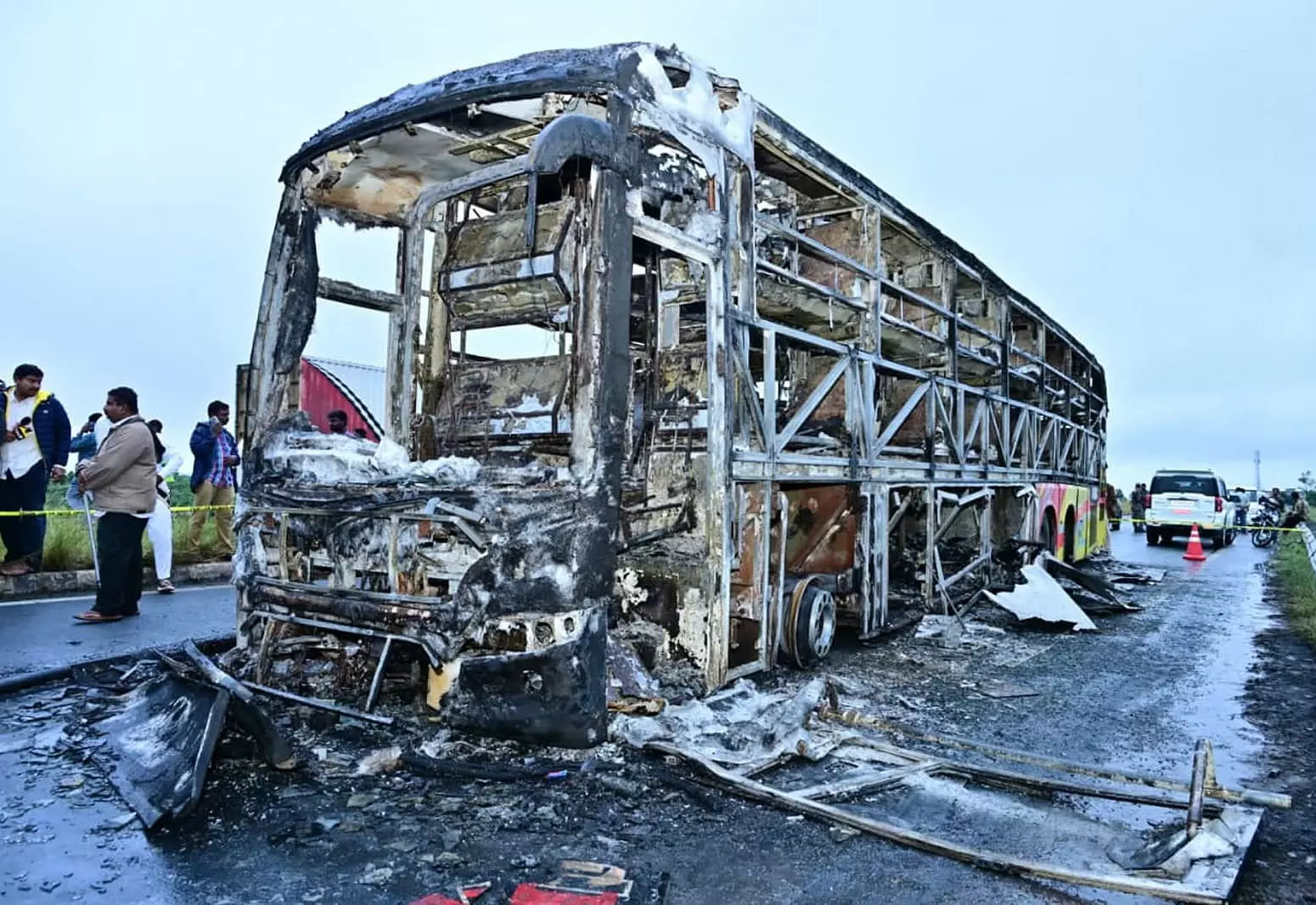
Hyderabad: The deadly Kurnool bus fire that killed over 20 people on the Hyderabad–Bengaluru route is now being attributed to a mix of “external ignition and internal vulnerability” — petrol leaking from a motorcycle that hit the bus, and a cabin lined with materials that burn fast and trap heat.
Deputy Inspector General Koya Praveen, who is leading the probe, told the media that “the bus’s diesel tank remained intact. The motorcycle appears to have been dragged under the coach, and petrol leaking from it ignited.” He added that flames reached the passenger section within moments.
Forensic officials say the speed of the blaze highlights what the interiors of many private sleeper buses are made of. “When you have polyurethane foam in seats, PVC ceiling panels, vinyl flooring, and synthetic curtains, the fire doesn’t stay local — it races through the bus,” said Dr R.S. Nair, a Hyderabad-based fire-safety researcher.
“These materials are cheap and common, but they catch fire at normal air-oxygen levels and release poisonous gases such as carbon monoxide and hydrogen cyanide.”
Nair explained that the kind of foam used in most bus seats has a Limiting Oxygen Index (LOI) of about 18 to 21, meaning it burns easily in the 21 per cent oxygen found in normal air. “Fire-resistant materials, which have an index above 26, need more oxygen to keep burning,” he said. “That difference can give passengers several more minutes to escape.”
Passengers who survived said they barely had time. “We woke up to people screaming,” said Jayant Kushwaha, who managed to jump out. “The front door would not open. Someone broke a window, and we got out one by one. In two minutes, the whole bus was burning,” he told reporters.
Another survivor, Ashwin, said he saw “the entire ceiling and bunks catch fire at once.”
Mechanics at city service centres said most private operators skip interior safety checks. “We only service the engines and brakes,” said Ravi Kumar, who works at a bus-repair unit in Balanagar. “Nobody ever asks us to replace the seat foam or curtains with fire-proof ones. The owners prefer cheaper material because they think fire is a rare risk.”
Another technician, Sandeep Reddy, who services luxury coaches in Kukatpally, added, “These buses are refurbished repeatedly with used foam and panels from scrap markets. They look good outside, but inside they’re full of flammable stuff.”
Investigators say this kind of rapid spread — known as flashover — happens when every surface inside a closed space heats up and ignites almost simultaneously. “It’s like a room turning into an oven,” said Meera Balasubramaniam, a transport-safety researcher. “If the door fails or there is no smoke alarm, there’s no time left.”
Officials are also checking whether the luggage compartment contained flammable items. “Petrol from the bike was the trigger, but we cannot ignore what passengers carry,” Balasubramaniam said. “Paint cans, oil, aerosol sprays — they all add to the fire load.”
Under India’s vehicle-safety code, all passenger buses are required to use flame-tested materials under the IS 15061 standard, but enforcement remains weak. As DIG Praveen put it, “It took less than three minutes for the whole bus to catch fire. The materials and the jammed door left no chance.”
For the victims’ families, that short span between a spark and an inferno has now become a long road to accountability.
