Experts Back NCC-Type Training For Youth To Handle Emergencies

Experts favour wider NCC-style training in first aid, disaster management and crisis response for Indian youth instead of compulsory military service.
The Flydubai FZ1073 cockpit emergency, where passengers and crew restrained a co-pilot after he allegedly stabbed the captain and the aircraft went into a steep descent, has put an interesting question before India: How much emergency, military-style or national-service training should young people receive in case they find themselves in a crisis? Wounded Indian captain, Smit Machchhar, managed to open the cockpit door before passengers intervened and other pilots travelling on the aircraft later took control.
Conversations with a former Northern Army commander, an emergency doctor and a civic representative point toward the desirability of wider National Cadet Corps (NCC), first-aid and crisis-response training, but distinguish such preparation from short-term compulsory induction into the Armed Forces.
“Military training should become a part of every young student,” said Lt Gen. Hari Prasad (retd), a decorated soldier, and a former General Officer Commanding-in-Chief of the Army’s Northern Command. His support for wider training, however, stops well short of putting young people into the regular Army for brief tenures. “If they really want to become good soldiers, you have to be part of the organisation for a much longer period and bond with the organisation that you are part of,” he said.
During this incident, Israeli plumber Yaniv Hayoun, one of those who helped overpower the co-pilot, said he understood what to do partly from watching Air Crash Investigation. The episode, therefore, does not establish that military experience caused passengers to respond as they did.
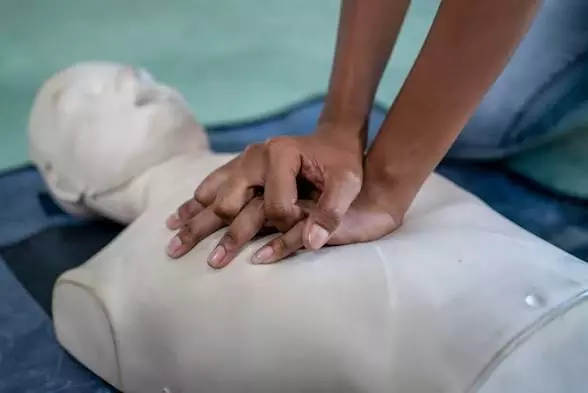
Dr Rahul Singh Sardar, founder director of ICATT Air Ambulance Service, said the first medical skill is recognising that a previously well person has suddenly become critically ill or injured and knowing what to do immediately. “It is a very simple skill which can be taught in a two-hour session,” he said of Basic Life Support.
Dr Singh, who joined the NCC Air Wing during his school days at Hyderabad Public School, said camps and group tasks taught cadets how to work together. However, he does not favour copying Israel’s draft system for India.
“We don’t have to go down that extreme route. Obviously, our population is too big for drafting,” he said. His preference is compulsory NCC-style training through schools, coupled with Basic Life Support and emergency care. “Our organisation has trained 28,000 people in BLS on a single day as a world record, and has trained 65,000 people so far.”
In a similar proposition where young people could be trained to respond to emergencies without being turned into short-tenure soldiers, B.T. Srinivasan, secretary-general of the Confederation of Resident Welfare Associations (CoRWA), favoured compulsory training in disaster management, first aid, fire safety, evacuation, crisis handling and leadership through schools and colleges.
“Rather than compulsory military training for every youth, India could consider compulsory, structured NCC-based disaster and emergency-response training for students,” he said.
That distinction becomes harder to ignore once scale enters the picture. United Nations population projections put India’s 18-to-23 population at about 153.3 million in 2026, while the ministry of defence said this year that NCC had nearly 20 lakh cadets. Srinivasan cited the money and manpower that universal military training would require; Hari Prasad came to the same practical limit from his experience of training soldiers.
“Any type of training requires big, huge establishments,” he said, warning that too many trainees could affect training quality and living conditions. Wider exposure to emergency and military-style instruction, in their accounts, is therefore a different undertaking from preparing an entire age group for the Armed Forces.
The Central government has so far stayed on the voluntary side of that line as well. Hari Prasad still sees value in training young people outside the regular Army. He said a year or a year and a half of military-style preparation could teach discipline and responsibility if India had the resources. An expanded NCC-type programme, he said, could prepare young people for emergencies and supporting roles even though frontline military work requires specialist training built over much longer periods.