El Nino Impact Closing In on Hyderabad: Drinking Water Supply to Take a Hit

The Singur project, which supplies 110 million gallons a day (MGD) of the total 576 MGD the city consumes every day, according to official estimates, has reserves that might last just another 80 days.
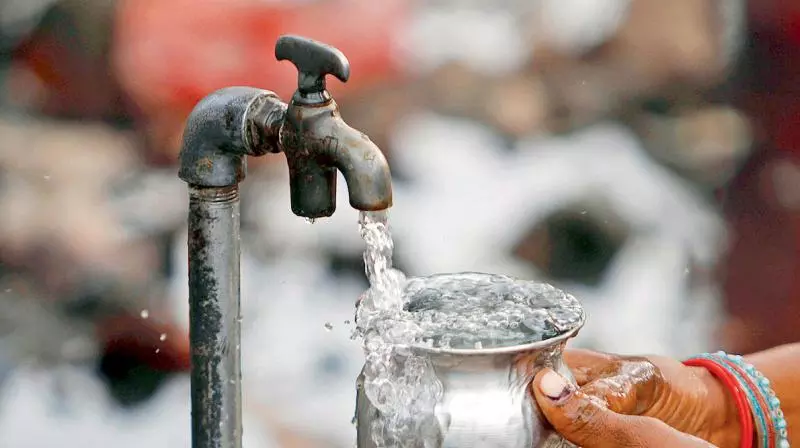
Hyderabad:The ‘super’ El Nino may be continuously brewing and getting stronger in the Pacific Ocean and Hyderabad may have so far escaped its impact but that appears set to change with at least one major source of drinking water for the city, the Singur dam, slowly hitting rock bottom levels.
The Singur project, which supplies 110 million gallons a day (MGD) of the total 576 MGD the city consumes every day, according to official estimates, has reserves that might last just another 80 days. Water from Singur, or from its downstream Manjira barrage is supplied to several areas in the Greater Hyderabad area, particularly the western sections, as well as in the heart of the city such as Khairatabad.
Some 3 lakh drinking water connections are expected to be affected with restricted supplies once the reserves run out, though urgent steps are being taken to have at least 40 to 50 MGD from the Godavari Phase II to supply water to areas served by water from Singur or Manjira. That the situation is entering dire conditions territory can be gauged by the fact that this ‘augmentation’ is being viewed as something akin to ‘emergency oxygen supply’ to a patient suffering from serious breathing problems.
Sources in the government said that in this all-or-nothing situation, every citizen needed to step up and begin reducing water use. “Just by not letting a tap flow freely while washing your face, or brushing your teeth, can cut individual use by a few litres a day. And these add up and can help in pushing the reserves past the 80 day availability. People do not realise how much water is wasted every day just while performing daily chores,” a senior government official said.
The situation in areas served by the Singur project may result in rescheduling alternate day supplies to once in three days, and that too in restricted quantities, with just less than half of the water expected to make its way to these areas. “All we need is some good rainfall in the Singur catchment areas such as Narayankhed, Jarasangha, and Kangti, and of course, in the Manjira river further upstream,” an official explained. “If this happens, with the cyclone brewing in the Bay of Bengal bringing rain to these regions, we will be over the hump.”
Meanwhile, even to get the alternative 40 to 50 MGD supply from Godavari Phase II, which gets water to Shamirpet from Mallannasagar reservoir, a three-day trial run will be required to check how well the Godavari Ring Main II pipeline will function. Some work on this pipeline still needs to be completed, which will be done in 60 days. After this, water can be taken from Shamirpet to the Lingampalli reservoir and then to Kukatpally from where it can be supplied to parts of areas now served by Singur. A part of the plan to overcome the coming challenge is also to use some water from Osmansagar and Himayatsagar — a new filter bed is now being built for this purpose, according to officials.
Where Greater Hyderabad gets its water from
Source – Volume
Osmansagar: 24
Himayatsagar: 11
Manjira: 40
Singur: 70
Krishna: 270
Godavari: 161
in million gallons a day
Current supplies from Singur/Manjira
Manjira Ph I: 13*
Manjira Ph II: 27.50
Singur Ph III: 34.75
Singur Ph IV: 34.75
Total: 110
in million gallons a day
Of the 110 MGD, 8 MGD used for bulk supplies for industries. If Singur/Majira supplies stop, the bulk supplies are expected to take a hit
Reservoir Monthly drawal Available supply
Nagarjunasagar (Krishna) - 1.37 tmc ft - 12 months
Godavari - 0.83 tmc ft - 12 months
Singur -0.333 tmc ft - 2.6 months
Manjira –0.246 tmc ft - 2.6 months
Himayatsagar: - 0.087 tmc ft - 21.3 months
Osmansagar 0.144 tmc ft - 13.5 months
