El Nino Hit Monsoon Starts Impacting Agri Operations

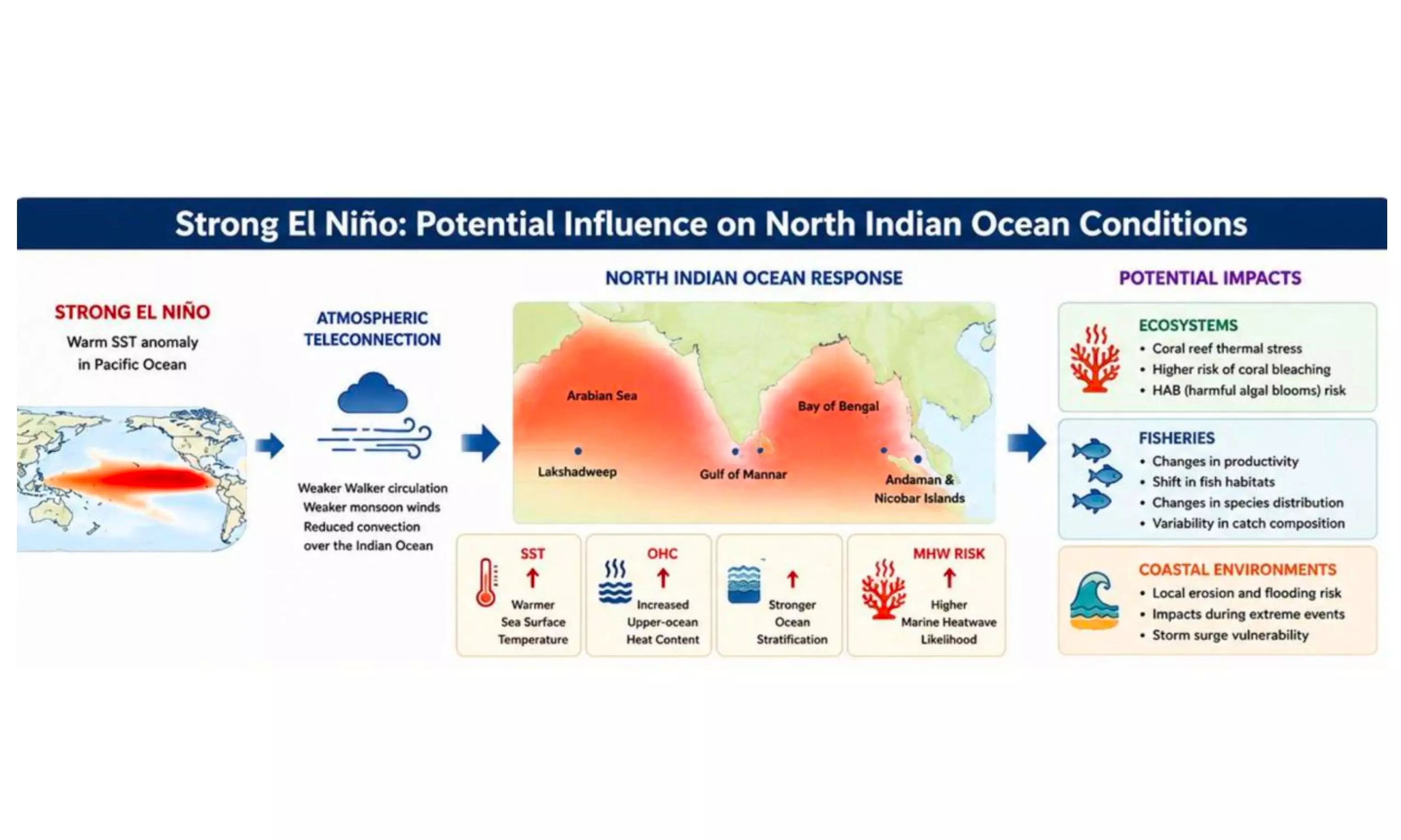
The persistence of El Nino is expected to influence ocean conditions across the North Indian Ocean, with higher sea surface temperatures resulting in increased upper-ocean heat content, stronger stratification, and a higher likelihood of marine heatwaves.
Hyderabad: The ongoing El Nino event in the central Pacific Ocean that has already resulted in a seriously deficient start to the southwest monsoon season for India, is not going away anytime soon, and is expected to stay put well into February 2027.
This longer ‘shelf-life’ of El Nino is not only expected to impact fisheries and the state of Bay of Bengal and the Arabian sea but could also mean news that none might want to hear at present – a serious possibility of negative impact on the 2027 Indian monsoon season.
The Indian National Centre for Ocean Information Services (Incois), in its first-ever El Nino bulletin on Monday, has said that El Nino was expected to remain dominant “from June 2026 through February 2027.” The probability of this happening, Incois said, was between 70–90 per cent, while the El Nino Southern Oscillation (ENSO) conditions returning to a neutral phase was 10-30 per cent.
“El Nino extending into the summer is never good news for the monsoon to follow,” a meteorology expert told Deccan Chronicle. “Things don’t change quickly in the ocean and the weather systems. While nothing can be said with any degree of certainty, the likelihood of the 2027 monsoon season also being hit cannot be ruled out. This will be a very likely outcome of what is happening now,” the weather scientist said.
In its first of what Incois said will be a series of El Nino bulletins, the research institution said deep learning weather models devised by it provides skilful prediction of Nino 3.4 index up to a lead-time of 15 months From June 2026 onwards through the forecast period to February 2027, El Nino is expected to be the dominant ENSO phase.
The persistence of El Nino is expected to influence ocean conditions across the North Indian Ocean, with higher sea surface temperatures resulting in increased upper-ocean heat content, stronger stratification, and a higher likelihood of marine heatwaves. These conditions, Incois said, could affect marine ecosystems, fisheries, and coastal environments in the Bay of Bengal and the Arabian Sea.
Among the impacts is the likelihood of a fall in the catch of two species of fish from the Bay of Bengal which could also see high wind-sea conditions in the upcoming fishing season. There might be some extreme weather events because of warmer ocean conditions, while coastal regions may also experience localized erosion, flooding, and storm surge impacts during severe weather episodes.
However, on the other hand, Arabian Sea on the western Indian coast is expected to have relatively calm ocean conditions and extended fair-weather windows, Incois has said.
