DDS Women And The Question of Who Preserves Community Media

In an era where we have started referring to cassettes as ‘vintage’, their years of labour and priceless knowledge now stand to become obsolete
About 120 kilometres from the bustling metropolis of Hyderabad lies Pastapur in Zaheerabad, a village that has quietly become a model for community-led transformation. At the heart of this change is the Deccan Development Society (DDS), an agricultural collective run entirely by Dalit women.
Four decades ago, Pastapur was arid, crop failures were routine, and many dalit families survived by begging for food or daily wages. When PV Satish Kumar, then working for Doordarshan, arrived here in the early 1980s for a project, what he found was one of the worst drought-hit regions in Telangana. The turning point came when the community, guided by Satish and supported by initial UNESCO funding, decided to form a cooperative that placed decision-making power directly in the hands of the women farmers.
Today, they have transformed the landscape and the lives of those associated with DDS. They revived traditional millet varieties, set up community grain banks, and developed sustainable farming practices long before organic became a buzzword. This women-led cooperative has established seed banks, community film units, and Sangham Radio - India's first community radio. What began as survival has now become a globally recognised model of sustainable, community-owned development.
You feel the depth of that connection the moment you sit with the elders. As we officially sit down together for a talk, they take the dappu and start singing together. “This is how they start every meeting,” program coordinator Madan explains. After the song, each one starts speaking about what work DDS has done and continues to do, without failing to mention what impact it has had in their individual lives as well. DDS doesn’t exist separately from them, one feels. There is no separation between the organisation and the people who built it; DDS is them, and they are DDS.
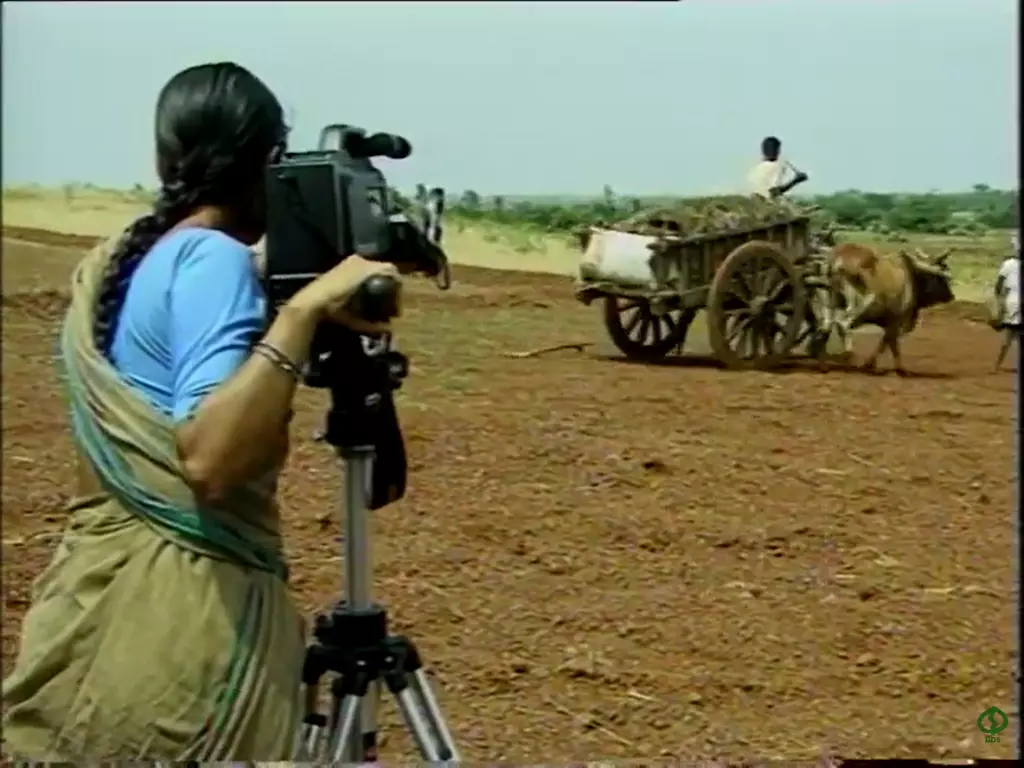
Once it's 70-year-old Chinna Narsamma’s turn, she blushes. “I have spoken in the videos. Why don't we just play that?” she suggests. The makeshift screen, using a whiteboard and projector, lights up. The videos are very old. The shy old woman who sits in front of me is on the screen. The young saree-clad woman stands next to a sizable video camera and explains about different camera shots: “Here the camera is on top, looking down on the subject, just like a patel looks at the slave. So this (camera angle) is called a Patel shot.” This is how they learned and trained on these equipments. “When the camera is low, and at the spot of the gaythod (slave), looking up, it's called a gaythod shot. In the Sangham, we are all equals. So we call the eye-level shot as Sangham shot.”
“It's our own women who are shooting, so we feel free to speak without feeling shy,” she explains, with the same shy smile.
To them, the camera is an extension of their fellow women. It is their mediator, it's their memory, and it's their witness too. “We have degraded lands. If we go and tell them this, they might not believe us. But these videos can make them see the miseries we face,” says Manjula, a Sangam member from Eedulapally.
An archive caught between eras
Once a trailblazing camerawoman of the community, Chinna Narsamma now sits amid towering shelves full of cassettes. There are three types of cassettes, and then CDs, neatly labelled - BT Cotton, Millet Crop, etc.
These women, coming predominantly from marginalised communities, didn't have access to fertile lands. Their hard labour went into arid lands at the borders of villages, which didn't even have proper irrigation.
Historically denied access to formal education and then systematically kept outside of public resources, these women and their Sanghams found ways to make this infertile land give them a livelihood. The food security that was a result of this collective revolution is now the cornerstone of their empowerment. They themselves took up the camera and recorded these farming techniques, what we can now call indigenous wisdom, to use as a resource for the other farmers in the Sangham. They have travelled to approximately 25 countries by now, sharing and learning farming techniques with farmers in these countries. They have even been the trainers for many women farmers to use video recordings to store their farming knowledge.
But in an era where we have started referring to cassettes as ‘vintage’, their years of labour and priceless knowledge now stand to become obsolete. “I can’t show you what is in it anymore. We have three types of cassettes, of which VHS cassettes are now accessible. The cameras and equipment to watch the old model cassettes are unavailable now… and those cameras with us have also gone bad…,” Narsamma sighs.
Friends and well-wishers in some media houses have come forward to help digitise these tapes. Narsamma’s brother Yesu, one of the first members of the community to learn how to handle the equipment, took 100 tapes, carefully chosen from the thousands of tapes they had with them, to the Hyderabad office. Sadly, the age-old machine gave up by the time they digitised three cassettes.
“Now the only hope is to send them to Vijayendra Patel garu, in Pune. He has a machine,” says Yesu. But Patel, one of the lifetime trustees of DDS and one of the trainers who taught the co-op members to operate cameras, says that even he won't be able to help much. “I only have one machine, which is very old, and I don’t think it will be able to digitise 97 tapes. The better option would be to approach those who do this commercially. But that would cost a lot, which is not something DDS can afford right now.”
These women filmmakers, who questioned why only the privileged are allowed to run media, or even have the right to radio waves, took it upon themselves to tell their story, addressing topics such as food and seed sovereignty, genetically engineered agriculture, water democracy, community-owned media and environmental sustainability. “Through critical evaluations of state policies and solidarity with local communities,” they say, these films are an attempt to address the challenges faced by rural communities.
Centre for Sustainable Agriculture, DDS’ sister organisation, is going to start a Grameen Academy for training farming techniques, agroecology, policies, bioinputs and more. The DDS tapes, containing decades of stories of their own struggles and solutions, would be invaluable assets to teach the next generation of farmers and researchers.
Shooting their farming techniques and archiving them via the Community Media Trust was a way of overcoming illiteracy for these women from the Dalit community. But with changing times have come hostile government policies, evolving media technologies, rapid digital divide, climate crisis and whatnot. The more the challenges, the more it feels necessary to preserve the indigenous knowledge they have amassed over four decades of labour.
“With time, all community-run media initiatives have faced challenges like digital divide, dwindling audience, financial crunch and resource limitations. Amidst these pressing issues, the bigger and most important task is to make sure the process stays community-centred even when we try to catch up with evolving technologies," says Dr Vinod Pavarala, professor of Communication at the University of Hyderabad, who is also one of the board members at the society. Reflecting on the plight of community media, he adds, "Participatory practices should continue when we collect and tell stories. The community should be involved in the production, and they should be able to tell their stories without worry or influence from outsiders. That's the key part. Whether radio or video, or any new technology, what's utmost important is that this process stays true to the community."