Concerns Rise Over Rain-Induced Seepage Into SLBC Tunnel
Seepage continues at slbc tunnel as rains approach, rescue ops ongoing
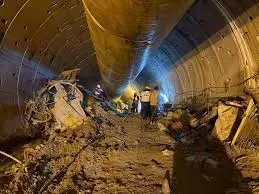
Hyderabad: More than three months after the February 22 collapse of a section of the SLBC tunnel in Nagarkurnool district, there appears to be no break for the pumping of water seeping into the tunnel from the rocks above, and this seepage is expected to increase in the days to come as the rains set in over the state.
According to the government, one of the primary reasons for the tunnel collapse — the accident in which eight workers died and the bodies of six of them are still to be retrieved — was accumulation of water along the tunnel alignment where the tunnel boring machine was moving through. When the tunnel collapsed the seepage reached a high of around 5,000 litres of water a minute which over several weeks stabilised around 3,000 litres per minute.
Irrigation officials had earlier said that during the rainy season, the seepage can reach up to 7,000 litres per minute. Ever since the rescue operations began in the fourth week of February, engineers have been pumping out the water accumulating in the tunnel in round-the-clock operations using a series of pumps located at different distances in the 13.9-km long tunnel.
The existing pumping system in place inside the tunnel should be able to cope with additional flows if they increase. There is some 480 metres of rock above the tunnel and we do not expect any surge in seepage even when rains set in over the Nallamala hills and the forests above the tunnel, a senior irrigation department engineer said on Wednesday.
“We hope the rains in the region will not be heavy and long,” the official added. Incidentally, the location where the tunnel collapsed is not very far from the Mallelatheertham waterfall on the surface as well as two perennial streams that flow across the tunnel alignment.
The irrigation department has set itself a deadline of June 30 to complete all investigations to find a way to take the tunneling forward, and these include geophysical and geotechnical and tectonic studies. If the monsoon rains stay steady and strong over the Nallamala forests, then this might impede the pace of the studies, an official said.
The department has concluded that the only way forward to complete the tunneling from the inlet side in Nagarkurnool district is to dig a bypass tunnel parallel to the existing tunnel alignment using the traditional drill and blast method. The tunnel boring machine that was destroyed in the accident has been written off and given the fears over unstable regions along the alignment, only a bypass tunnel is the way out, officials said.
