CJI to Students: Go Abroad for Master's with Purpose

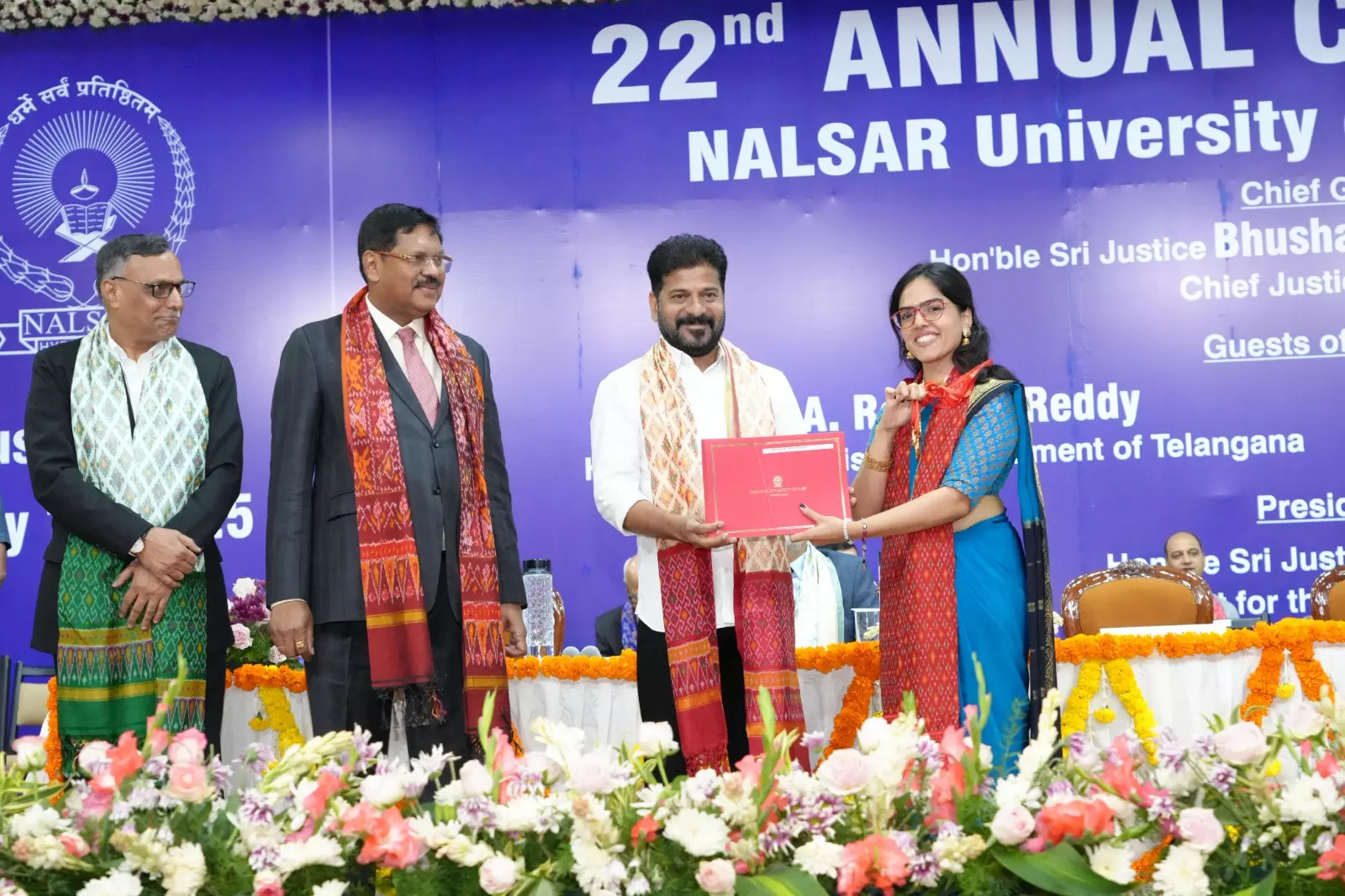
The ceremony was attended by Chief Minister A. Revanth Reddy, Supreme Court judge Justice P.S. Narasimha, acting Chief Justice of Telangana High Court Justice Sujoy Paul and other High Court Judges.
Hyderabad: Chief Justice of India B.R. Gavai cautioned students against pursuing foreign master's degrees merely for prestige or societal pressure, urging them to study abroad only with a clear purpose and on scholarships, not at the cost of family finances.
“A foreign degree alone is not a stamp of your worth. Go abroad to learn, not to impress.” He noted that while international education may broaden perspectives, it often leads to debt, anxiety and compromised career choices when pursued under pressure, Justice Gavai told the 22nd annual convocation of NALSAR University of Law in Hyderabad on Saturday.
The ceremony was attended by Chief Minister A. Revanth Reddy, Supreme Court judge Justice P.S. Narasimha, acting Chief Justice of Telangana High Court Justice Sujoy Paul and other High Court Judges.
Referring to Master of Law (LLM) programmes abroad, Justice Gavai said Indian students often spend between Rs 50 lakh and Rs 70 lakh, which burdens families and places undue stress on the learners. He called for mindful academic decisions and urged students to focus on their work instead.
He also noted that the popularity of foreign LLMs reflects a lack of confidence in India’s postgraduate legal education. To address this, he called for greater investment in domestic LL.M. and post-doctoral programmes, stressing the need to retain and nurture top legal minds within the country.
Justice Gavai highlighted the challenges faced by students returning from abroad, saying many come back with new ideas only to find Indian institutions unwelcoming and resistant to change. “To retain our best minds, we must build nurturing academic environments, offer transparent, merit-based opportunities and restore dignity and purpose to legal research in India,” he said.
He stressed that reform in legal education must go beyond infrastructure and focus on imagination, mentorship, policy innovation and ethical workplaces. Citing the backlog of trials and the plight of under-trial prisoners, he said the legal system is “badly in need of fixing,” but expressed confidence that Indian citizens will rise to the challenge.
In his closing remarks, Justice Gavai offered five guiding pillars for life: friends, family, books, hobbies and health. “These will be your sentinels in all seasons,” he said, adding that Dr B.R. Ambedkar’s lifelong pursuit of knowledge should serve as an inspiration. He emphasised the importance of mastering legal fundamentals. “The strongest minds are not those who chase every trend, but those who explain core concepts with clarity and insight,” he said.
Justice Gavai also underscored the value of mentorship. “Mentorship is not a favour; it is a responsibility,” he said, sharing how a mentor's belief changed his own life. He encouraged both seniors and new graduates to foster a culture of guidance and support. “That is how we build not just careers, but a community of care within the profession.”
Among the awardees, Ishika Garg received eight gold medals, K.S. Shailendra won seven and Architha secured six. Bhavya received four medals, while Tejaswi, Shruti and Akil Surya won three each. Shruti and Sanvi secured two medals each, and Srivalli, Anushka, Arivalagan, Jahnavi, Pradyumna, Shamik and Vishnu won one medal each.
