Hyderabad Rains: Civic Apathy Makes Traffic Cops’ Work Tough

Police stand in water, manage jams as leaks, poles and delays worsen chaos
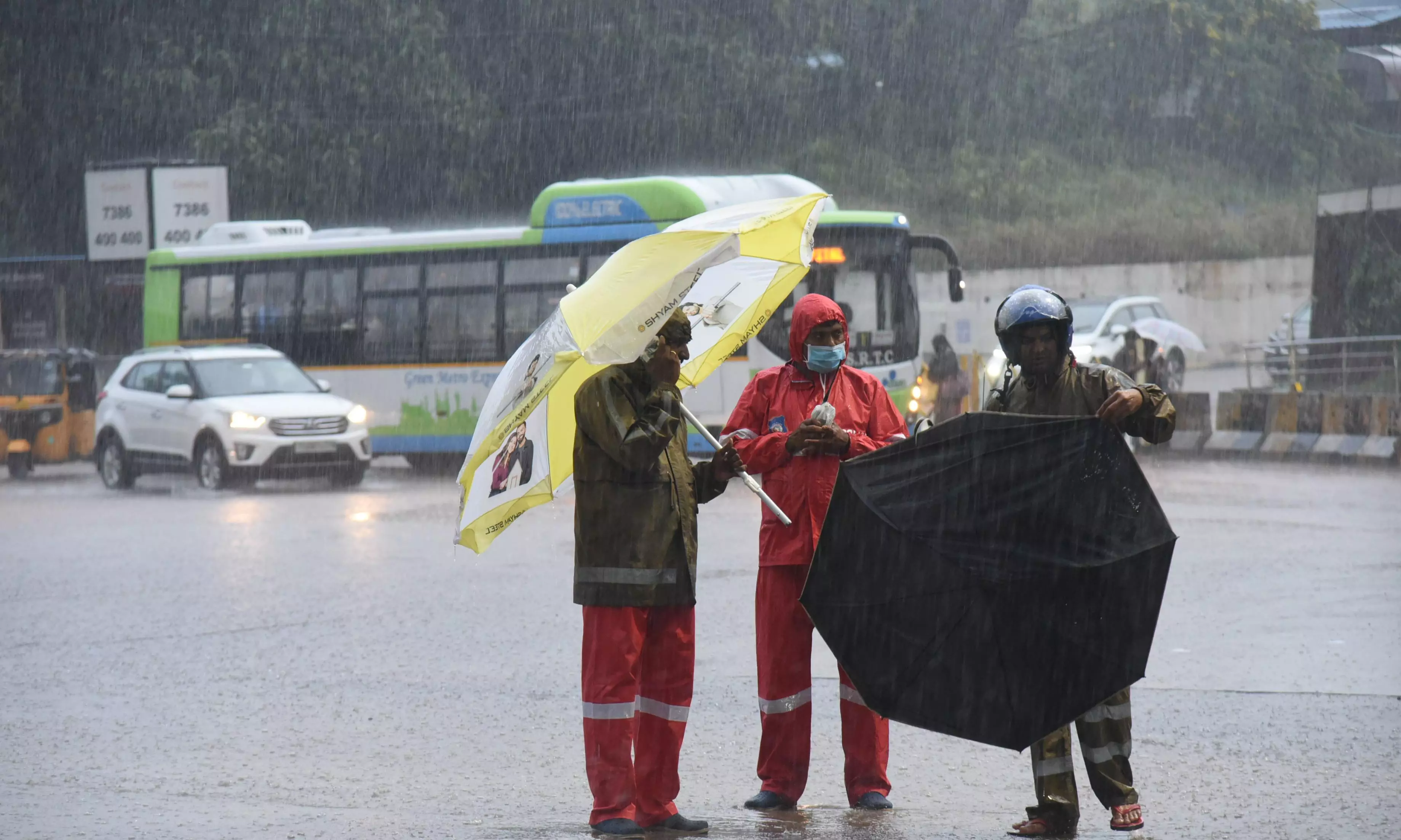
Hyderabad: As heavy rains lashed the city, Hyderabad’s traffic police, often standing in knee-deep water with only raincoats for protection, found themselves battling not just traffic snarls but also civic lapses.
At Madhapur, where thousands of IT employees leave work between 4 pm and 8.30 pm, the traffic situation worsens with every downpour, said inspector B. Satyanarayana. “The entire Madhapur stretch is clogged during peak logout hours. With waterlogging near the flyover, traffic slows down significantly,” he explained. In earlier spells, police coordinated with GHMC and HMDA to install pumps and drain water. “Special teams act once the rain stops. About 20–30 per cent of the water is cleared within hours, but until then, the flow remains choked,” he explained.
Breakdowns and congested U-turns are the biggest hurdles. We have installed CCTV cameras at all flyovers. When a vehicle breaks down, the nearest cop responds quickly to fix the situation and restore flow, Satyanarayana said.
Two-wheeler riders stopping at U-turns, especially under Metro stations during the rains, add to the congestion. “Packed U-turns can cause jams stretching for kilometres. We ensure that at least one constable monitors each U-turn to prevent complete standstills. It doesn’t eliminate congestion but makes it manageable,” he said.
Beyond traffic flow, poor inter-departmental coordination remains a chronic problem. A traffic inspector, requesting anonymity, cited delays by civic agencies. “If a road is sanctioned, water leakages or drainage issues should be fixed first. Instead, they ignore it. Once the road gets damaged again, traffic suffers,” he said.
He pointed to Pragati Nagar in KPHB, where road expansion projects have been narrowed because electricity poles were not shifted. “A CC road should last 10 years. With proper coordination, we could have had a seven-metre road. Because of delays, only a six-metre road is being laid. This will choke in two years,” he explained.
According to him, agency lethargy even extends to safety hazards. “Even after media reports on bent poles or dangerous leaks, it takes months to respond. That delay risks commuters and leaves us firefighting every rain,” he said.
Despite the challenges and long hours, traffic personnel remain deployed at U-turns, junctions and waterlogged stretches, manually guiding vehicles to keep movement continuous.
A traffic home guard near Banjara Hills said he barely gets time to eat. “When I have to eat, a substitute takes my place. Someone must always be on the ground because vehicles often skid during rain and sometimes the injured need immediate medical help,” he said.
