Citizens’ Group Geo-Tag 672 Trees at KBR Park

Volunteers create a geo-tagged public database after SC halts tree felling near KBR.
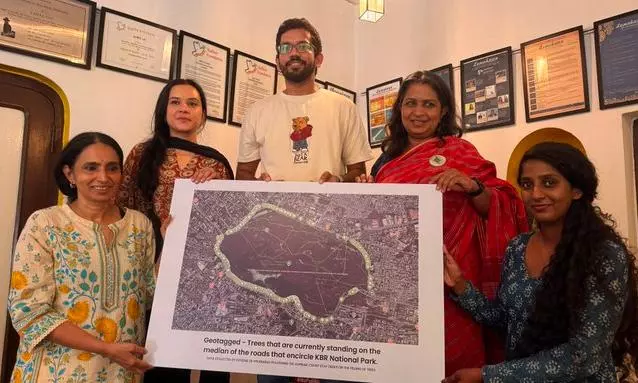
Hyderabad: A citizen-led effort to document trees around KBR National Park has resulted in the creation of a geo-tagged public database of 672 trees, weeks after the Supreme Court halted further tree felling in the park’s eco-sensitive zone.
The mapping exercise was undertaken following the Supreme Court’s May 18, 2026, stay order on tree cutting in the eco-sensitive zone around KBR National Park. The order came after a petition alleged that tree felling was continuing despite an earlier stay.
Over three days, a team of 15 citizen volunteers fanned out around KBR National Park and documented every standing tree on the road medians surrounding the park. Each tree was assigned a unique identification number, geo-tagged using GPS coordinates, identified by species and plotted on a detailed map that has now been placed in the public domain.
The initiative was led by development consultant Natasha Ramarathnam and supported by citizen volunteers associated with the Save KBR movement. The geo-tagged map was unveiled at an event on Thursday. According to the survey, the documented trees include several mature specimens and a wide variety of native species. Natasha said the exercise was aimed at creating accountability and making it easier to monitor and protect the remaining trees around the park.
“This is about creating accountability. While we cannot bring back the trees that have already been felled, it is critical to scientifically document the trees that still remain. Once these trees are mapped and enumerated, monitoring and protecting them becomes far more effective,” she said.
Naturalist Asiya Khan, who assisted with species identification, said the survey challenged claims that the median plantations were recent and consisted largely of a single species. The documentation instead found a diverse mix of species, including several older trees and native species.
Organisers said the publicly accessible map would improve transparency and help citizens, researchers and authorities track changes in tree cover around one of Hyderabad’s most prominent urban green spaces. The exercise is also expected to support ongoing conservation efforts linked to concerns over proposed infrastructure projects in the vicinity of the park.
