Centre’s Caste Census Announcement Is Victory For Telangana People And Govt: Bhatti

Telangana government scientifically conducted a caste census, making the State a role model for the country
Hyderabad: The Central government’s announcement to conduct a caste census was the result of pressure exerted by the Telangana people’s government and the all India Congress, said Telangana Deputy Chief Minister Bhatti Vikramarka here on Saturday.
The Telangana people’s government has scientifically conducted a caste census, making the State a role model for the entire country. After India gained independence, it was only in Telangana that such a comprehensive caste census was carried out successfully without any objections.
The State government has committed to incorporating the findings of this caste survey into its policy-making decisions. The outcomes of the caste census should be taken to the public, and the Backward Classes (BCs) should stand in support of the government.
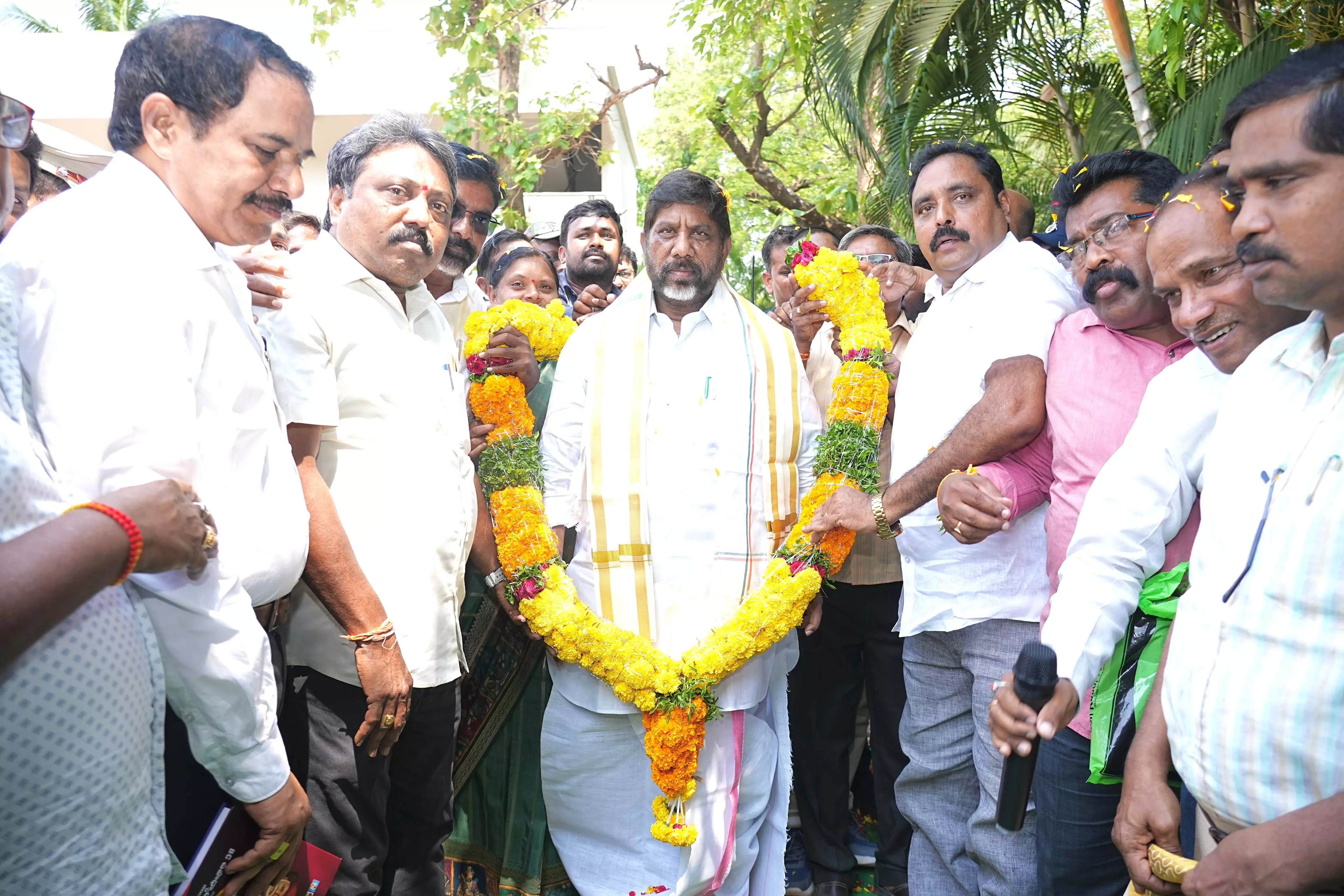
In Khammam, the BC Employees’ Association and leaders of various BC caste organizations honored Bhatti with grand shawls and extended their congratulations.
During the felicitation event held on Saturday at the Praja Bhavan Camp Office in Khammam, Bhatti stated that the Central government’s declaration to conduct a caste census across the country was a victory for Telangana’s people and the Congress government.
He expressed gratitude to the Telangana government for leading the way in pushing the Centre to take this decision. Acting under the directives of AICC President Mallikarjun Kharge, Opposition leader in Lok Sabha, Rahul Gandhi, and Congress leader Sonia Gandhi, the Telangana government carried out the caste census meticulously, without any errors.
A resolution was passed in the State Assembly granting 42 per cent reservations to BCs and was submitted to the Centre with significant pressure. He also mentioned that a resolution was passed during the Congress Working Committee (CWC) meeting in Gujarat, demanding a nationwide caste census, similar to the one conducted in Telangana.
This was followed by raising the issue in Parliament, which ultimately compelled the Centre to agree to a national caste census, Bhatti said.
He highlighted that no caste census had been conducted in India since 1930, and Telangana’s initiative was the first successful effort post-independence. He acknowledged that conducting such a survey was a complex task, but Chief Minister A Revanth Reddy, himself as a Deputy Chief Minister, and the entire cabinet undertook this challenge and completed the process within 50 to 55 days.
He clarified that the caste census did not merely collect information about castes but also gathered data on people’s economic, political, and employment conditions, the distribution of natural resources among communities, and their standard of living. This data will inform the government’s future welfare and development policies.
The Planning department, under his ministerial leadership, conducted the caste census with precision and without errors. The survey was executed by forming a block of 150 houses, appointing enumerators, assigning one supervisor for every ten blocks, and deploying coordinators at mandal and district levels.
The process was closely monitored by district collectors and the state-level leadership, ensuring a smooth and objection-free survey. The final results were presented in the Assembly, where a bill was passed. He revealed that BCs constitute 56 per cent of the population in the State, leading to the passing of a Bill to provide 42 per cent reservations in local bodies and government jobs.
