BJP's Renewed Push For Local Body Polls In Telangana
As Telangana gears up for its crucial and much-delayed local body elections, the BJP is intensifying its efforts to convert the significant electoral momentum it has recently built into lasting grassroots power.
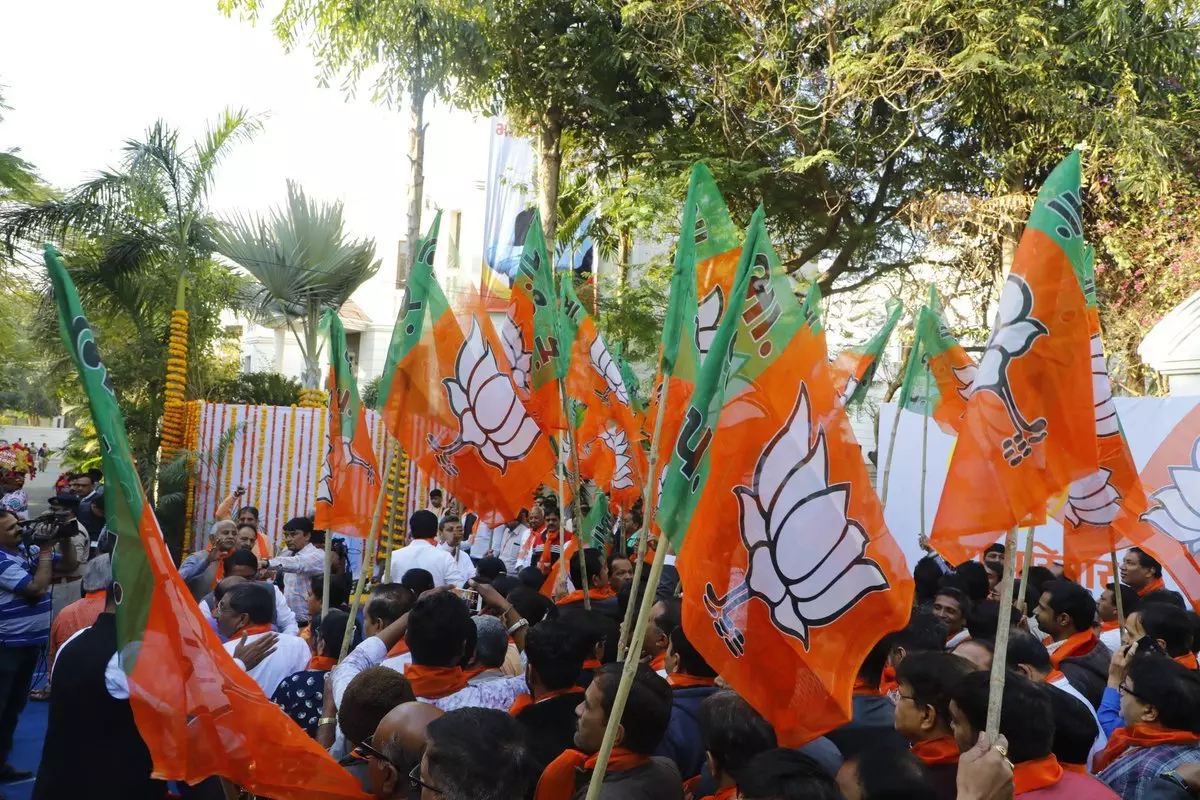
Hyderabad:As Telangana gears up for its crucial and much-delayed local body elections, the BJP is intensifying its efforts to convert the significant electoral momentum it has recently built into lasting grassroots power.
Central to the party’s strategy is the ‘Ghar Ghar BJP’ campaign, a key component of the Maha Sampark Abhiyan, which commenced on August 3. This is not a typical election campaign focused only on rallies and speeches; instead, it represents a granular approach rooted in booth-level electioneering that goes directly to citizens’ doorsteps.
Every booth committee president has been assigned the task of visiting at least 100 homes. During these visits, they deliver personalised messages from Prime Minister Narendra Modi, emphasising the transformative welfare initiatives of the Centre.
The teams also distribute detailed literature spotlighting a wide array of central government schemes — free ration rice for the poor, construction of pucca houses under housing schemes, availability of toilets promoting sanitation, concessional loans targeting women entrepreneurs, rural electrification drives, and the flagship Ayushman Bharat health insurance programme, which ensures `5 lakh of free medical treatment to millions.
Speaking to Deccan Chronicle, state BJP president N. Ramchander Rao underscored the strategy behind this approach. “This campaign marries a high-decibel central leadership message with personalised household attention,” he said.
“It critically highlights the failure and corruption of the incumbent Congress government and previous BRS government. Issues like unpaid sanitation workers, distress faced by tenant farmers, and rural governance bottlenecks demonstrate why Telangana needs competent leadership,” he explained.
The state BJP chief said his party was capable of delivering governance that truly benefits the people and contrasted it with the alleged inefficiencies and neglect attributed to the current government.
Augmenting this narrative, state BJP general secretary Dr Kasam Venkateshwarlu elaborated on the indispensability of grassroots mobilisation. He stressed that dismantling the deeply entrenched rural political networks built over decades by the BRS and the Congress requires not just rhetoric but a professional, data-driven, and highly-localised campaign.
“It’s about connecting the big-picture development projects with the daily realities of voters,” said Venkateshwarlu. “Only by integrating central welfare messaging with concrete local outreach can we overcome long-standing caste loyalties, kinship-based affiliations, and patronage systems that have historically dominated rural Telangana.”
Since assuming office as the new BJP state president, Ramchander Rao has toured 15 districts, engaging with grassroots party workers, intellectuals, and professionals — including doctors and lawyers — as part of a comprehensive mass outreach strategy.
These electoral ambitions must be understood against the backdrop of the BJP’s historically modest presence in Telangana’s decentralised governance. In the 2019 rural local body elections, the BJP secured only 163 out of 12,751 gram panchayats.
The party failed to win a single zilla parishad chairmanship, as the BRS swept most districts and the Congress established itself as the distant runner-up.
The 2020 urban polls saw the BJP gaining 223 municipality seats out of 2,727 scattered— a marginal performance overshadowed by the BRS juggernaut, which won over 1,500 seats and more than 100 municipalities.
However, the GHMC elections of December 2020 marked a pivotal moment for the BJP. The party’s tally surged from a mere four wards to 48 wards. This leap signified the BJP’s emergence as Hyderabad’s principal opposition force and provided a blueprint for urban expansion. Yet, the struggle to penetrate rural pockets remained, highlighting a tale of two electorates — a rising urban presence constrained by limited rural outreach.
The BJP’s fortunes improved significantly during subsequent election cycles. In the 2018 Assembly elections, the BJP won one seat (Goshamahal) and garnered barely seven per cent of the vote, confined largely to Hyderabad’s urban pockets.
By 2023, the scenario had changed markedly: the BJP clinched eight Assembly seats spread across North Telangana — including Nirmal, Armur, Sirpur, Adilabad, Mudhole, and Nizamabad Urban — alongside strongholds in Kamareddy and Hyderabad’s Goshamahal. The party’s overall vote share nearly doubled to 13.88 per cent, showing gains in 97 of the 110 seats it contested, particularly in the north and Hyderabad.
The 2024 Lok Sabha elections further underscored this upward trajectory, with the BJP increasing its tally from four to eight seats and its vote share rising sharply to 35.08 per cent. The party retained its traditional northern bastions — Adilabad, Nizamabad, Karimnagar, and Secunderabad — and expanded into western and southern parts of Telangana, including Medak, Malkajgiri, Chevella, and Mahabubnagar.
Underlying this rise was a mix of sustained grassroots mobilisation, a resonant communication strategy emphasising the “double-engine sarkar” (simultaneous BJP rule at the Centre and state levels), and growing anti-incumbency sentiment directed at both the BRS government and the newly instated Congress administration.
Voters increasingly credit the Modi-led central government for delivering critical welfare schemes amidst perceived state-level neglect, explained NV Subhash, the chief official spokesperson of the BJP.
BJP vice-president Dr. G. Manohar Reddy said the party’s 2025 campaign stood out for its sophistication and scale. Leveraging micro-data analytics, the party tailors its outreach to specific communities and localities, merging central welfare narratives with the political realities and aspirations of individual voters.
He expressed confidence that this kind of professionalisation of electioneering — combined with the deployment of extensive ground forces — could well redefine Telangana’s political contours.
A notable innovation in the campaign was the introduction of a missed-call facility (dial 92400 15366) to encourage citizen participation and feedback, exemplifying the party’s drive for direct engagement beyond traditional rallies.
Leaders at every level, from Ramchander Rao to district and booth-level workers, are personally involved in door-to-door visits, strengthening the party’s grassroots presence.
The success of these elections will not only indicate the BJP’s ability to break the stranglehold of the BRS and the Congress on local governance but also reflect whether it can evolve into a genuinely durable, competitive force across Telangana’s urban and rural landscape.
STATISTICAL DATA for Graphics
Municipal elections in January 2020
Polls held for 2,727 seats
BJP: 223
Congress: 495
TRS: 1,500+
Municipality Control
Total 120
BJP: 1
Congress: 3
AIMIM: 1
BRS: 100+
GHMC
Total 150
BJP: 48 (previously 4)
BJP: 35.56% vote share
BRS: 35.81% vote share
Rural elections in January 2019
12,751 gram panchayats
BJP: 163
Congress: 2,709
TRS: 7,774
MPTCs (Mandal Parishad Territorial Constituencies)
Total 5,817
BJP: 211
Congress: 1,377
BRS: 3,556
ZPTCs (Zilla Parishad Territorial Constituencies)
Total 538 ZPTCs
BJP: 8
Congress: 75
BRS: 446
Zilla Parishad Chairpersons
Total 32
BJP: 0
Congress: 0
BRS: 32
Assembly Elections
2018
BJP: 1 seat (Goshamahal)
BJP: 7% vote share
2023 Telangana Assembly
BJP: 8 seats
BJP: 13.88% vote share
Notable Gains
Increased vote share in 97 out of 110 repeated contests
Biggest surges: Nirmal (+44%), Armur (+31%), Sirpur (+30%)
Growth in North Telangana & Hyderabad urban
Lok Sabha Elections - 2019 General Election
BJP: 4 seats (Adilabad, Karimnagar, Nizamabad, Secunderabad)
BJP: 19.65% vote share
Lok Sabha Election - 2024 General Election
BJP: 8 seats (retained 4, new Medak, Malkajgiri, Chevella, Mahabubnagar)
BJP: 35.08% vote share (NDA)
BRS (TRS) Vote Share
2019: 41.71%
2024: 16.68% (sharp fall)
Other Key Statistical Points
Gram Panchayats won by BJP: About 160 in 2019 (widely reported, non-party basis)
Ward member-wise data: Not officially/widely reported for parties
Sarpanch term ended in Feb 2024; ZPTC & MPTC terms ended in June 2024; Municipal term ended in Sept 2024
BJP strategy
Central Finance Commission funds stopped for Telangana: `2,300 crore (due to election delays)
Upcoming campaign (Maha Sampark Abhiyan): From August 3, 2025 – door-to-door campaign, every booth president to visit at least 100 houses
Mandal-level election workshops completed: 566 mandals
District-level workshops conducted: 31 districts
