BJP, Experts Question Musi Revival Cost, Approach

BJP backs cleanup, flags DPR flaws, funding gaps, fears over demolitions
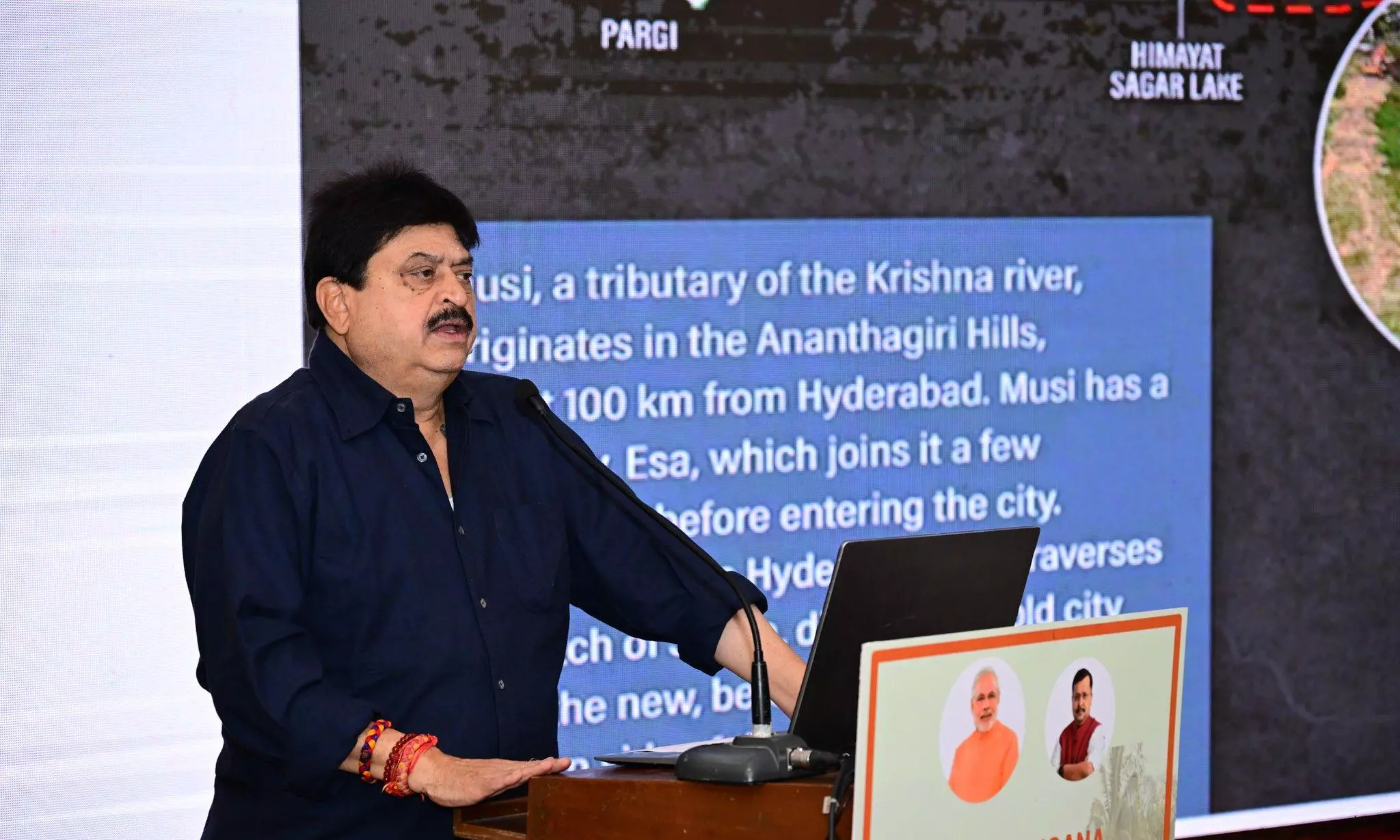
Hyderabad: BJP state president N. Ramchander Rao questioned how the state government, which is struggling to clear pending pensioners’ dues, plans to fund the Musi rejuvenation project at a cost of Rs 1.5 lakh crore. He raised doubts over the Gandhi Sarovar Project — a component of the Musi initiative — whose cost escalated from Rs 5,000 crore to Rs 7,000 crore within days.
Speaking at the BJP’s blueprint presentation for Musi river rejuvenation in Hyderabad, Rao emphasised that the project extends beyond the twin cities and impacts all of South Telangana. He urged a holistic approach, covering the river’s upper catchment areas through to its confluence with the Krishna River. “Musi cleaning is an investment in our future — it’s not just a project but one tied to our lives, farmers, and Telangana’s overall development,” he said.
While clarifying that the BJP supports cleaning the Musi, Rao opposed the demolition of poor people’s homes and described the government’s DPR and approach as “impractical.” He criticised the arbitrary buffer zone policy, questioning why tall structures in Narsingi — close to the river — escape inclusion, while homes of the poor and middle class at Madhu Ridge Apartments fall under it. He charged that the government is sowing fear among residents along a five‑km stretch adjoining the river.
Vedire Sriram, adviser on Water Policy and Management to the Maharashtra government, described the state’s works as superficial beautification rather than true revival. He stressed that rivers are living systems requiring a holistic approach from catchment to confluence. Citing global examples, he noted that rejuvenation takes at least 20 years and must begin in upper catchments, followed by the 55‑km urban stretch and the 120‑km final section from Nagole to Wadapally in Nalgonda district, where the Musi merges with the Krishna.
Sriram pointed out that the Central Water Commission (CWC) has not been consulted, questioning how the state expects international funding without CWC approval. He urged focus on catchment areas through percolation structures and massive afforestation involving multiple departments.
Charging that the Rs 160‑crore DPR is riddled with loopholes, Sriram offered to provide a revised DPR free of cost. He said it would address key issues such as sourcing water from Singur and Manjeera for Rs 100 crore, instead of Rs 1,000 crore from Mallanna Sagar, the tail‑end of the Kaleshwaram project, which demands Rs 10,000 crore annually in power and maintenance costs.
Sriram further stressed that stakeholder participation is vital for the success of any major project. He suggested holding meetings with people in villages and towns along the river’s course. He said improving wetlands is crucial to enhance water quality, but this aspect is missing from the government’s DPR. He added that water quality must be brought down to below 3 PPM, achievable through grassland development in catchment areas and sewage treatment. He also noted that the government lacks clear data on polluted water entering the river, as many houses in the city are illegal and unaccounted for.
