Birla Science Centre Gets Singareni Pavillion With Stegodon Tusks, Toba Ash

Stegodon fossils exist only in four locations worldwide, including the Narmada valley.
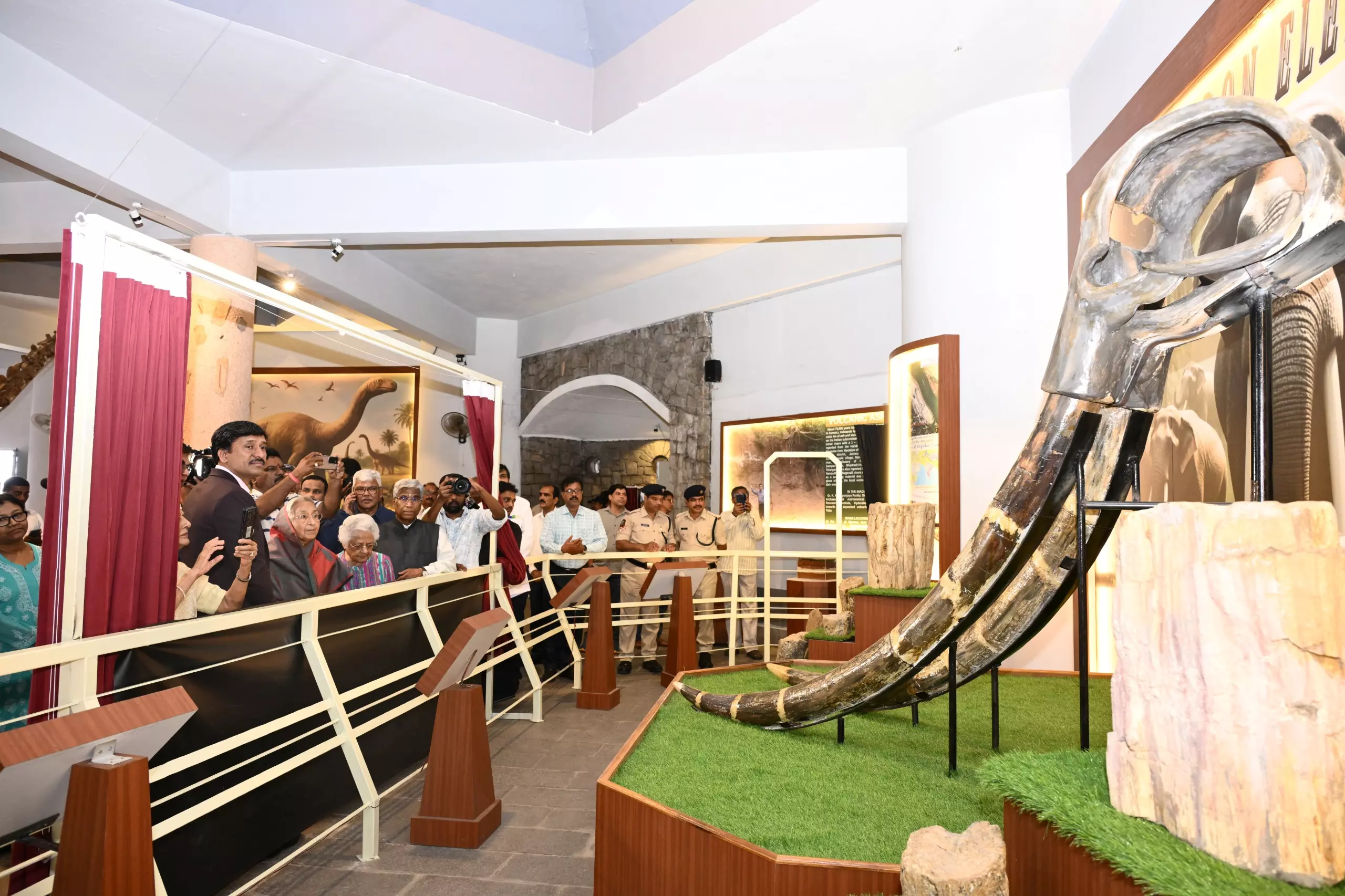
Hyderabad:Miners at the Singareni Collieries Company Limited (SCCL) while digging for coal came up with a strange find: What appeared to be pieces of bone. On a detailed examination, it was found to be pieces of tusks of a stegodon, elephant-like mammals that could reach 12 feet in height and walked in the area up to 6,000 years ago.
The tusks, found at the Medapalli open cast mine in Ramagundam, were painstakingly restored and have now been put on display at the Birla Science Centre at the Singareni Pavilion. It also features ash from the Toba volcano eruption about 75,000 years ago in Indonesia, that was found in Singareni. The gallery also features petrified wood and is located next to the Dinosaur Pavilion, which features fossils found earlier in Adilabad district.
Stegodon fossils exist only in four locations worldwide, including the Narmada valley. One pair of tusks was recently donated to the Birla Museum, while another set was given earlier to the Nehru Zoological Park by Singareni. Each displayed tusk measures about seven feet long.
Stegodons belong to a genus believed to have existed from 11 million years ago to as recently as 6,000 years ago. The elephant-like mammals had long, curved tusks that could reach 10 to 12 feet. In some species, the tusks grew so close together that their trunks had to be held sideways.
Nirmala Birla, chairperson of the G.P. Birla Archaeological, Astronomical and Scientific Research Institute, was present when N. Balram, chairman and managing director of SCCL, inaugurated the gallery. Balram praised the centre’s efforts to promote scientific thinking and knowledge dissemination and thanked partner organisations like Isro, Geological Survey of India, and Atomic Energy Commission.
Nirmala Birla noted the educational value of the new exhibits and their ability to connect visitors to the ancient past.
With regard to the Toba ash, Dr K. Mruthyunjaya Reddy, director of the institute, said, that he along with a team of experts had visited the site and collected the samples. “About 75,000 years ago, Mount Toba erupted in Sumatra, Indonesia, spewing nearly 2,800 cubic km of ash and lava into the atmosphere. The material spread across the Indian subcontinent and formed deposits 1–3 metres thick,” he said. The deposits are found in several minor riverbeds, including from the Haridra river, a tributary of the Manjeera, at Hastalpur in Narsapur mandal, Medak district; the Jurreru river near Jwalapuram and Banaganapalle village in Nandyal district; and the Murreru river, a tributary of the Godavari, at Sampathnagar in Bhadradri-Kothagudem district. Similar deposits have also been found in the Gundlakamma, Vamsadhara, and Nagavalli rivers.
Due to its glass shard content, the ash is often used as a scouring material, and local women use it as a natural dishwashing agent,” he said.
