Bihar’s SIR Foundations Shaky: Ashok Lavasa

He warned that when citizens are asked to prove their citizenship anew, when categories and documents are introduced without clarity, the very institution meant to safeguard universal franchise risks appearing partial.
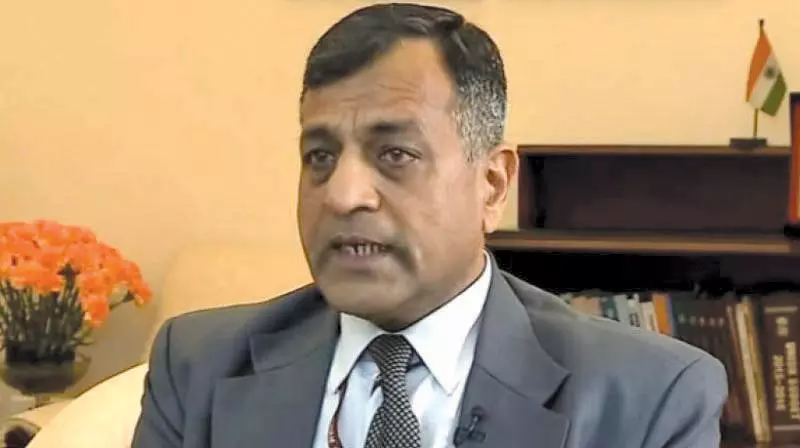
Hyderabad:Democracies rarely collapse with a single blow. They fray slowly, often through decisions that appear procedural, said former Election Commissioner Ashok Lavasa. Delivering the Ajay Gandhi Memorial Lecture organised by Manthan here on Saturday, he argued that the present controversy around the Election Commission of India (EC) is less about one state’s electoral rolls and more about the principles that anchor public trust.
His talk carried particular relevance at a time when the commission faces scrutiny in the courts and questions over its neutrality. He warned that when citizens are asked to prove their citizenship anew, when categories and documents are introduced without clarity, the very institution meant to safeguard universal franchise risks appearing partial.
He invoked the Irish poet and writer W.B. Yeats and said, “The best lack all conviction, while the worst are full of passionate intensity.” The line, written a century ago in Ireland, felt uncomfortably current.
Democracies across the world, Lavasa noted, face exhaustion. Authoritarian regimes now adopt liberal postures while elected governments display illiberal tendencies. India’s Election Commission, created in 1949 as a constitutional body separate from the executive, was meant to resist precisely this drift. Its work, unlike Parliament or the courts, touches citizens directly. Rolls must be prepared, elections conducted and a level field maintained. These functions, he said, are the foundation of equal citizenship.
The controversy in Bihar, where a “special intensive revision” divided electors into groups and required proof of citizenship from those enrolled after 2003, revealed how fragile that foundation can be. He noted how terms never before used entered official orders. Voters were separated by birth years and asked to produce different kinds of documents, some tied to their parents and even both parents.
In a state with floods, high migration and limited access to papers, millions faced the risk of being left out. Lavasa argued that such a move was a departure from the Election Commission’s long-standing principle of inclusion first, objections later.
He recalled how India’s first Chief Election Commissioner, Sukumar Sen, had postponed elections to ensure the rolls were prepared with care. Women could not be listed as “wife of” or “daughter of”; they were required to be identified by name, an insistence that dignity and agency were inseparable from the right to vote. Universal franchise, extended when literacy stood at barely 16 per cent, was defended by Dr B.R. Ambedkar with confidence that people would learn to cast their votes intelligently once matters were explained to them. Such faith, Lavasa said, should continue to guide the Commission.
The Bihar exercise, he argued, ignored those founding principles. “If your name existed in 1951, in 2003 and in 2025, but if for some reason you do not sign that form and give it back, you will be excluded. So how fair is that?” he asked.
Lavasa added that claims of cleansing the rolls were shaky. “How does this procedure guarantee purification? Because what you are doing is you are downloading the existing data and you are giving it to the elector to sign and resubmit. So whatever discrepancies are there in your data, you will inherit.”
His closing note drew once again on Dr Ambedkar. “If the people who are elected are capable and men of character and integrity, they would be able to make the best even of a defective Constitution….A Constitution, like a machine, is a lifeless thing. It acquires life because of the men who control it and operate it. And India needs today nothing more than a set of honest men who will have the interest of the country before them,” he concluded.
