AyuSewa Train Ambulance Service Becomes a Lifeline for Long-Distance Critical Care Patients

For air travel, the service arranges transfers via domestic and international flights, providing special airport assistance to ensure quick boarding and minimum discomfort.
Hyderabad: When critical illness strikes, timely access to the right hospital can decide the course of survival. For families struggling to move patients across states, ambulance services that make this possible have become a lifeline.
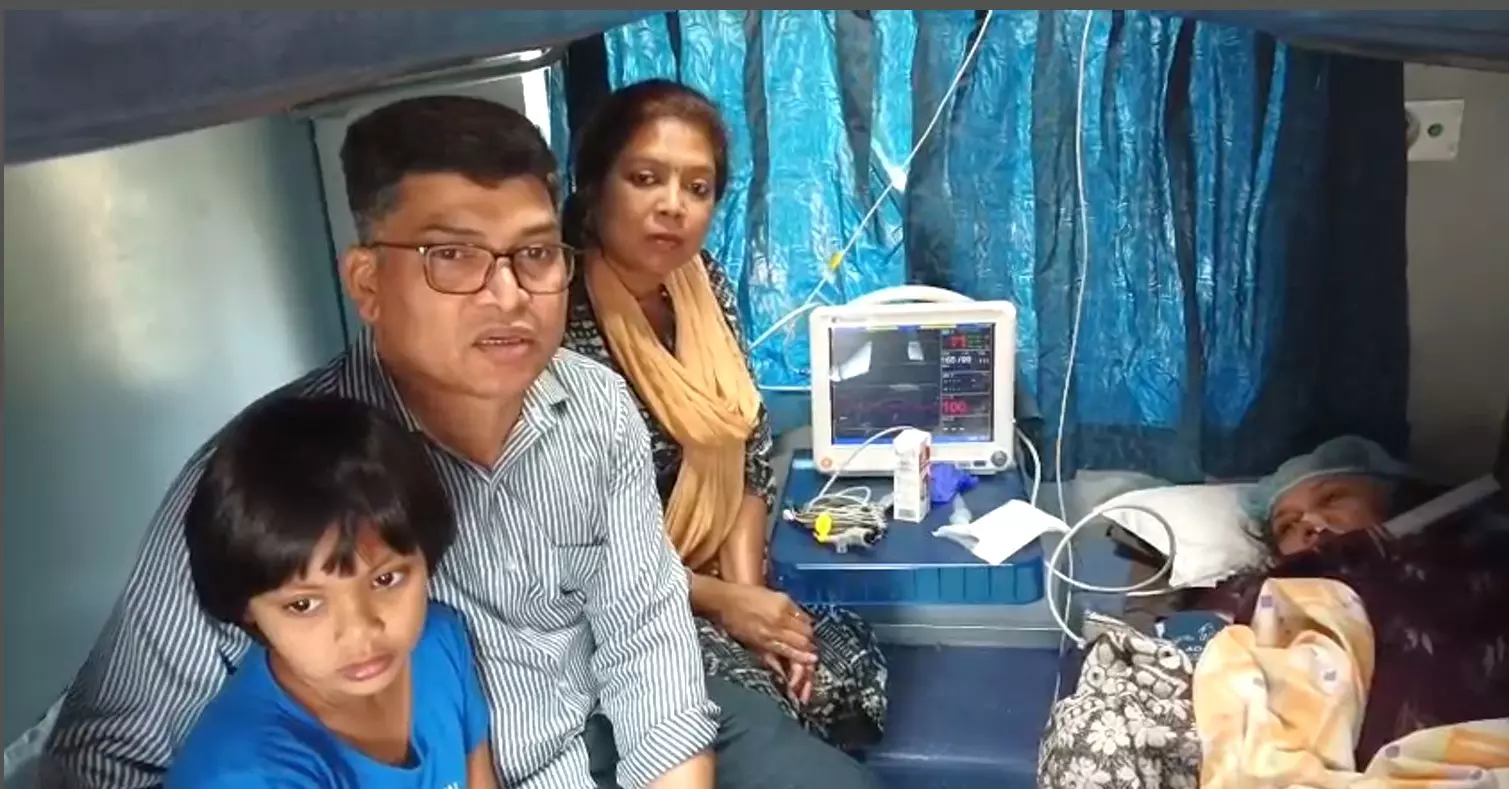
Rajeev Banerjee from Pune recalled the ordeal when his mother-in-law, Purnima Mukherjee, suffered a brain stroke followed by haemorrhage. She slipped into a coma and had to be shifted urgently from West Bengal to Pune. “Through some source, we came to know about a train ambulance service. We opted for the bed-to-bed service. She was transported from a hospital in Chander Nagar to Pune—a 35-hour journey. The medical care and overall service were excellent. We did not face any problems,” he said, crediting AyuSewa, a train ambulance service specialising in long-distance critical care transfers.
Founded in 2022 by Patna-based Vikash Sinha, AyuSewa operates air, train and road ambulance services. Its fleet is fitted with full ICU facilities and staffed by doctors and paramedics trained to handle emergencies in transit. In three years, the organisation claims to have transported over 5,000 patients across 100 cities. Cases have ranged from multi-organ failure, severe burns and neurotrauma to newborn complications, spinal injuries and cardiac conditions.
“Our uniqueness lies in providing all types of medical equipment that may be required during transport. Ambulance service plays a critical role in saving lives by moving patients safely from one city to another. We are proud to offer international-standard care 24/7, 365 days a year,” said Sinha.
Amit Verma, who used AyuSewa to shift his father—a fourth stroke survivor — from Lucknow to Mumbai, said, “The services were smooth from day one, right from booking till hospital admission. My father was shifted without any difficulty.”
Another family transported a relative in critical condition from Patna to Hyderabad, a journey of over 2,000 km completed in 36 hours. A patient was also moved from Siliguri to Vellore over 2,500 km without incident. “I did not face any problems while transporting my sister such a long distance. I’m grateful,” said a relative.
AyuSewa’s model adapts to different modes of transport. For road journeys, patients with chronic liver or kidney disease, heart problems, spinal injuries or multiple fractures are shifted in ambulances equipped with semi or full ICU setups. For train transfers, the organisation books AC two-tier or first-class cabins, installing equipment required for critical care. “Our experts know which trains have a reliable power supply for ventilators and monitors, and we carry backup power for up to eight hours,” a team member explained.
For air travel, the service arranges transfers via domestic and international flights, providing special airport assistance to ensure quick boarding and minimum discomfort.
From metropolitan hospitals to smaller towns, AyuSewa has emerged as an emergency bridge for patients who cannot access advanced treatment locally. For many families, it has meant not just timely medical intervention, but also a journey made less overwhelming by the assurance of care on the move.