Awareness Rally Marks World Vitiligo Day At OGH

“Treatment outcomes vary, but with early diagnosis and a tailored approach, many patients experience visible improvement and better quality of life. In the future, AI tools will enhance clinical diagnosis and treatment planning, which is why this year’s theme is ‘Innovation for Every Skin, powered by AI”: Dr Rakesh Sahay, medical superintendent of OGH
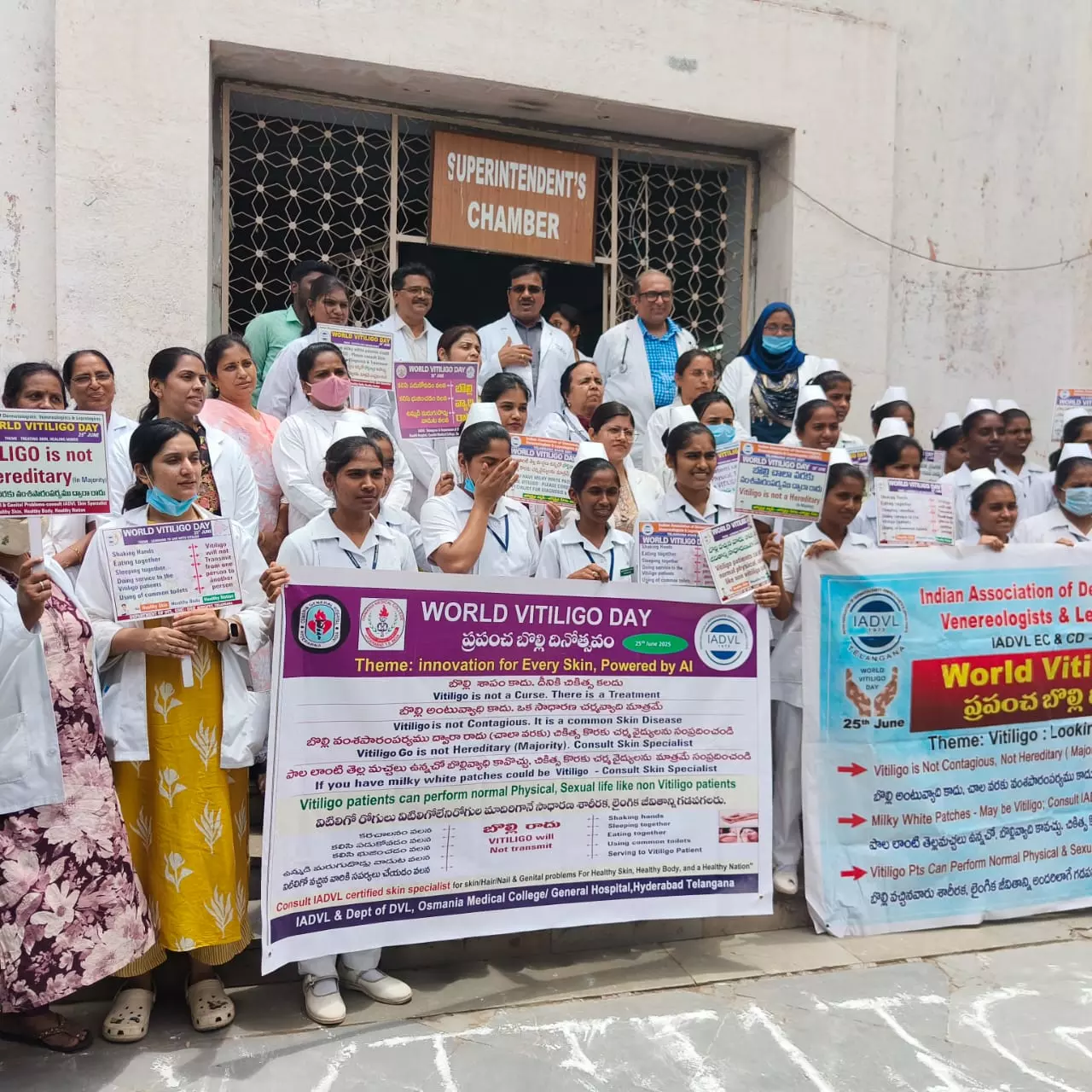
HYDERABAD: When global pop icon Michael Jackson revealed he had vitiligo, it brought global attention to a condition long hidden in the shadows. His death anniversary on June 25 is now observed as World Vitiligo Day to raise awareness about the autoimmune skin disorder and the social stigma faced by those affected.
To mark the occasion, the department of dermatology, venereology and leprosy (DVL) at Osmania Medical College and General Hospital organised a rally and seminar on Wednesday. “Vitiligo affects nearly 1 per cent of the world’s population. It is caused by the destruction of melanocytes, the pigment-producing cells, leading to white patches on the skin. The condition is not contagious, not life-threatening and certainly not something to be stigmatised,” said Dr Bhumesh Kumar Katakam, head of the DVL department.
He added that while vitiligo can appear at any age, it most commonly develops before the age of 40. Though its exact cause remains unknown, factors such as genetic predisposition, oxidative stress, emotional trauma and associated autoimmune conditions are known triggers. A confirmed diagnosis requires a skin biopsy, though non-invasive tools like the Wood’s lamp test and dermatoscopy are also useful in clinical assessment, Dr Kumar added.
Though there is no permanent cure, various treatments can help restore skin pigmentation. “In early stages, topical treatments like corticosteroids or calcineurin inhibitors such as tacrolimus and pimecrolimus are prescribed to reduce inflammation and promote repigmentation. In some cases, medications like Prostaglandin E2 or Tofacitinib—a Janus kinase inhibitor—may be used,” said a dermatologist from the department.
Among the most effective interventions is Narrowband UVB phototherapy, which exposes affected skin to specific ultraviolet light to activate melanocytes and suppress the immune response. For localised patches, laser therapy is recommended. For patients with stable vitiligo unresponsive to medical treatment, surgical options are available. These include punch grafting, suction blister grafting, and cellular suspension techniques, where healthy skin or pigment cells from unaffected areas are transplanted to depigmented zones.
“Treatment outcomes vary, but with early diagnosis and a tailored approach, many patients experience visible improvement and better quality of life. In the future, AI tools will enhance clinical diagnosis and treatment planning, which is why this year’s theme is ‘Innovation for Every Skin, Powered by AI,’” said Dr Rakesh Sahay, medical superintendent of OGH.
Students from the nursing department also participated in the programme and staged a skit to dispel myths about vitiligo and highlight the social stigma still surrounding the condition.
