The discovery attracted people who rushed to the spot to see what was found since the area has several historical structures.
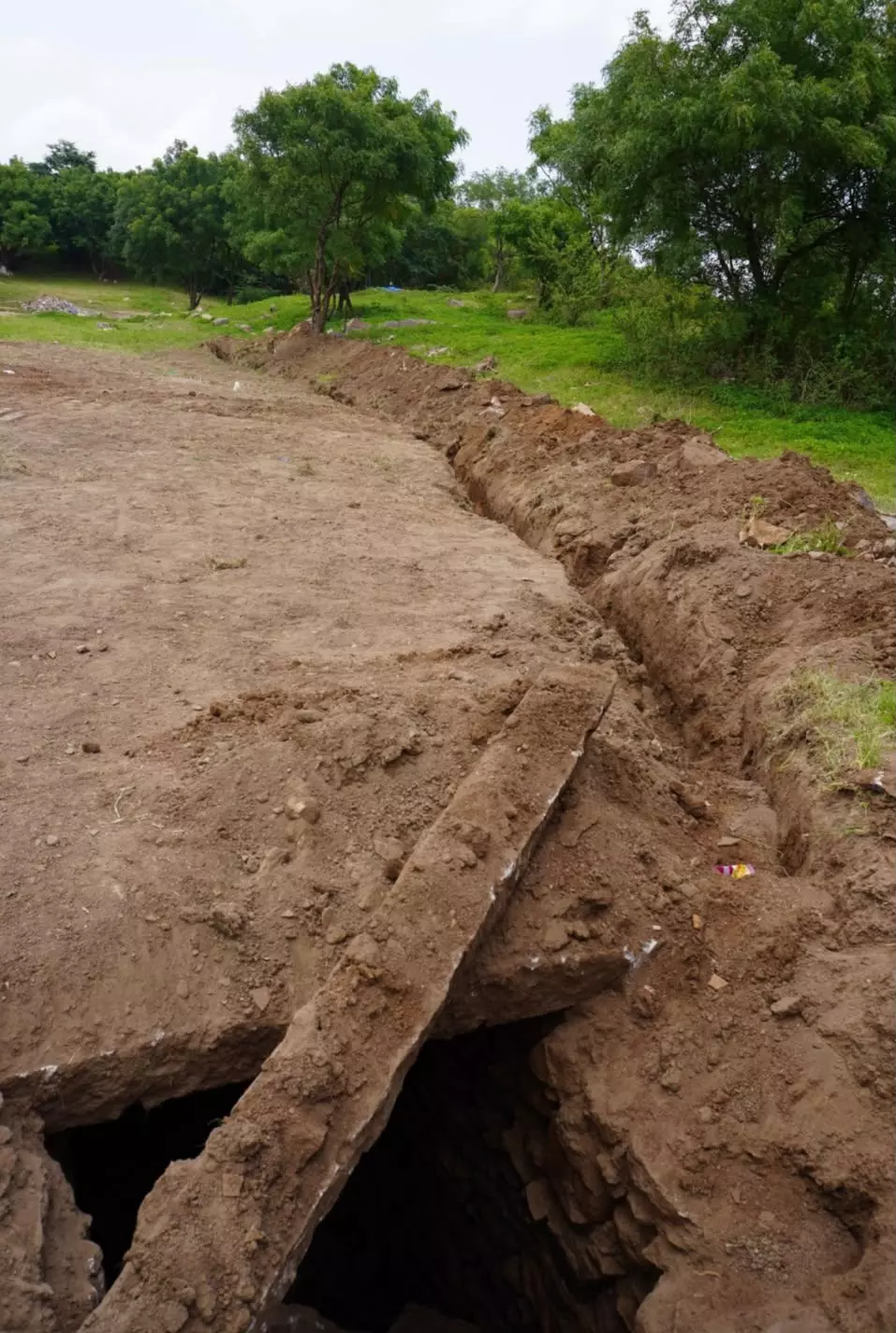
Hyderabad: A preliminary inspection by the Archaeological Survey of India (ASI) on Friday at ‘Athara Seedi’ near the Patancheru darwaza of Golconda fort revealed that the structure at the site was an ancient rectangular underground chamber. This came against claims that there was a tunnel at the site.
The structure was found on Thursday evening during development work by clearing the vegetation and levelling the ground, which is being used by children for playing cricket. The discovery attracted people who rushed to the spot to see what was found since the area has several historical structures.
As the news circulated on social media, the ASI Hyderabad Circle deputed its archaeologist, engineer, surveyor and the site in-charge of Golconda fort to verify the facts at the area, which is within the prohibited area of the fort that extends beyond 100 metres from the fortification wall. As per the preliminary inspection, ASI said the structure is not a tunnel but a rectangular-shaped chamber measuring approximately 1.2 m × 1.8 m in length and width and 2.2 m in depth.
"It is constructed of granite stone, with rough stone masonry forming an internal wall-like structure. The team also noticed a few red-coloured potsherds, which appear to belong to the medieval period," it said. A senior ASI official said its purpose or usage could not be identified without detailed investigation. "It could have been used as a storage chamber or for utility purposes," the official said.
The ASI Hyderabad Circle will report the matter to the Director-General, ASI, and, upon approval, a detailed investigation will be undertaken to ascertain the purpose and usage of the chamber and to determine whether similar chambers exist in the surrounding area.
ASI-Hyderabad has told the Artillery Centre, Golconda, to not proceed with levelling of the land until further investigation at the site. According to the official, the Army had cleared the vegetation and was levelling the land for Agniveer training. The area had also been used by anti-social elements, prompting the Army to take up the work.
The structure is located near a large graveyard and a dargah. Heritage activist Md. Habeebuddin said whenever excavation takes place in the Golconda Fort area, there is usually public curiosity about whether or not any treasure was found.
Unlike Thursday, people who gathered at the site were stopped from seeing the newly found chamber as Army personnel asked the police to take action against those who trespassed.
A board at the entrance declared the area an “Indian Army Protected Area” and stated that entry was allowed only for authorised personnel. It also warned that legal action would be taken against trespassers.
Historian Mohammed Safiullah said the area was highly elevated and that the inner fortifications and the passage were gradually closed off over time. He said it was not a tunnel but an area that was also used by guards. “Finding a tunnel here is difficult. What has happened now is essentially the rediscovery of something that had been lost over time.” He said such structures needed to be protected and preserved as they were part of the historical heritage of the fort.
INTACH Hyderabad convener P. Anuradha Reddy said since the structure is near the Patancheru darwaza area, it could be connected to that part of the fort. "The area should be studied by comparing it with old maps,” she said.
The Golconda fort, a nationally protected monument under ASI-Hyderabad, is one of the largest and most prominent forts in the Deccan Plateau.
Built on a hill rising to approximately 120 metres, the fort encompasses a medieval Islamic settlement within its massive stone fortifications. The complex comprises defensive structures, gateways, bastions, mosques, gardens, residential quarters and royal structures. With three lines of fortification walls and 87 bastions, Golconda represents a remarkable example of medieval military architecture and urban settlement.
The Bala Hissar portion is situated on a hillock, and the fortification wall encloses several other minor structures that were constructed for the utility of the public when the fort functioned as a residential settlement.