Delivering the keynote address, Prof. Puranam argued that AI's impact on organisations was a question of workplace design rather than simply predicting technological developments.
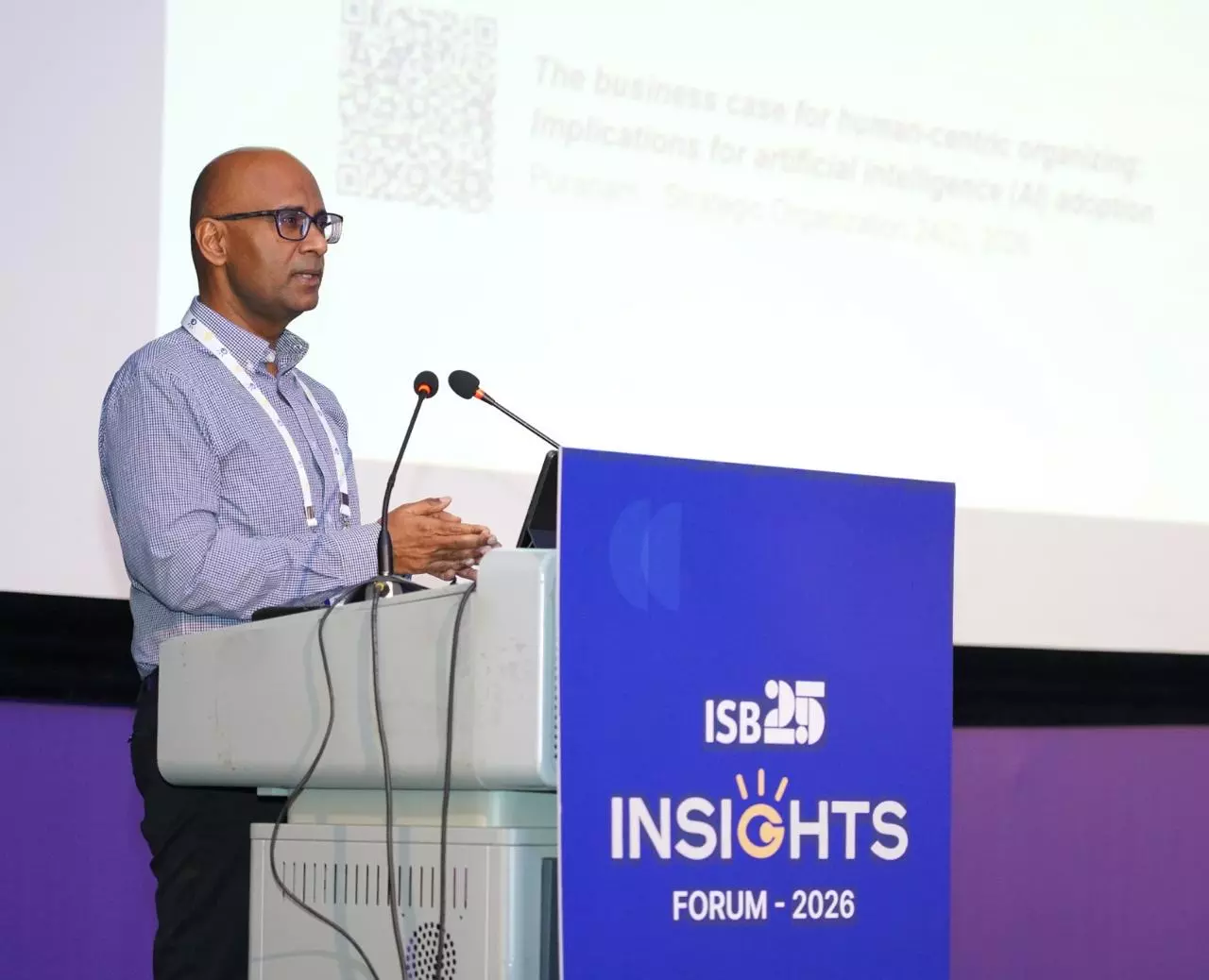
Hyderabad: Artificial intelligence may change how organisations function, but people will remain important because they can take responsibility and identify mistakes that machines miss, said Prof, Phanish Puranam of INSEAD, a France-based business school, at the fourth ISB Insights Forum here on Friday.
Delivering the keynote address, Prof. Puranam argued that AI's impact on organisations was a question of workplace design rather than simply predicting technological developments. Drawing on research from INSEAD’s Organizations and Algorithms Programme, he examined four common concerns about AI and explained how careful organisational design could produce different outcomes.
“People will remain valuable because they can be held accountable and catch errors that machines miss,” he said. Organisations that test, learn and adapt could use AI to help employees build skills, work together and take greater ownership of their work, he added.
The forum, hosted by the Indian School of Business (ISB) here during the institution’s 25th anniversary year, featured researchers, business leaders, policymakers and philanthropists who discussed how academic research could address economic and social challenges.
Six panel discussions examined the geopolitics of AI, financial innovation, livelihood creation, policymaking during economic crises, women’s career progression and community healthcare.
A session on women’s advancement at work used survey data from women professionals in India to examine their career experiences and compare them with findings largely drawn from Western workplaces. Another discussion looked at ways to improve the reach and effectiveness of community health workers.
Panels on financial innovation examined how cross-border technology rules, market competition and governance influence businesses and financial inclusion. A separate session explored how commercial models could generate stable incomes at the grassroots.
ISB dean Prof. Madan Pillutla said the institution was founded to study problems relevant to India with global academic rigour. “The forum gives us an opportunity to share the problems we are studying and hear from decision-makers about what our researchers should explore next,” he said.
Prof. Karthik Balakrishnan, deputy dean, faculty and research, ISB, said the strength of a research ecosystem depended on the quality of research rather than the volume produced. “Research is relevant only if it is rigorous enough to be acted upon. Its relevance should be judged over time, not over the next quarter,” he said.
The forum also conferred the ISB Research Catalyst Award on Ashish Dhawan, founder-chairperson of The Convergence Foundation, for his contribution to strengthening the research and knowledge ecosystem.