KTCB members Kondaveeti Gopivaraprasad Rao, Mohammad Naseeruddin and Ahobilam Karunakar identified a dense concentration of Paleolithic tools at coordinates 18.5498° North and 80.2680° East in Kannaigudem mandal: Reports
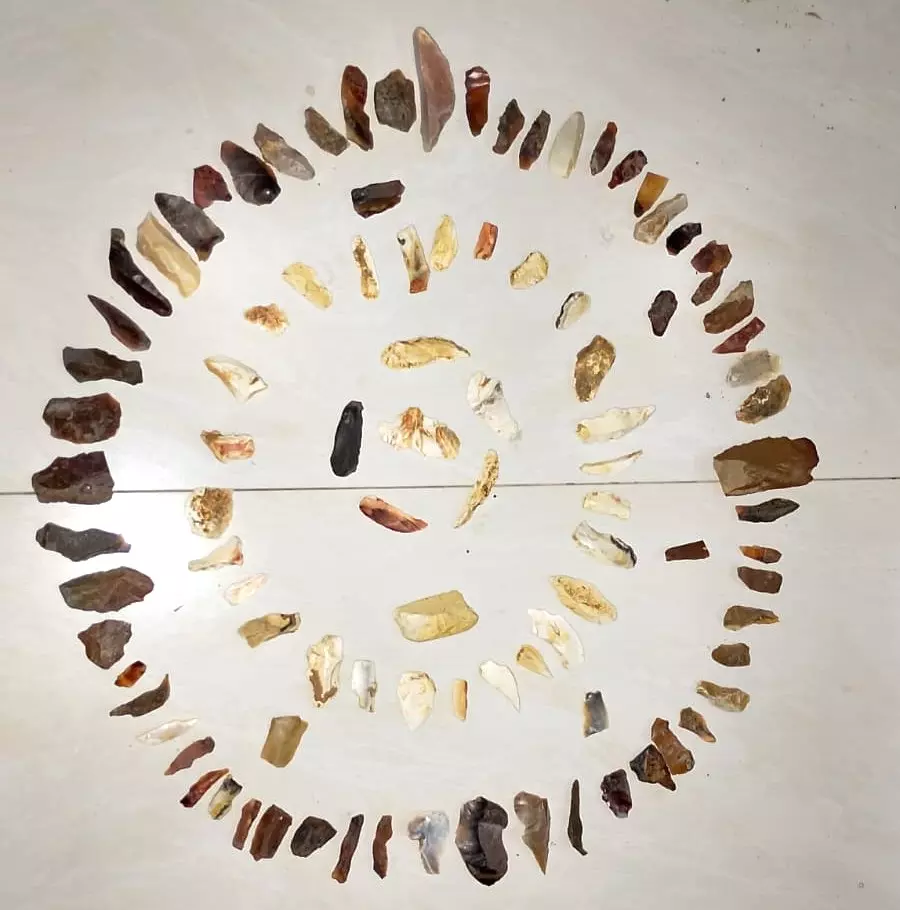
WARANGAL: Members of the Kotha Telangana Charitra Brundham (KTCB) have discovered a Paleolithic tool factory at Bhupathipur village in Mulugu district, offering rare insights into the lives of early humans who lived in the Godavari river basin tens of thousands of years ago.
KTCB members Kondaveeti Gopivaraprasad Rao, Mohammad Naseeruddin and Ahobilam Karunakar identified a dense concentration of Paleolithic tools at coordinates 18.5498° North and 80.2680° East in Kannaigudem mandal. The site is being recognised as a prehistoric tool-manufacturing centre.
The team documented 12 distinct Paleolithic stone tools along with hundreds of smaller Mesolithic microliths, indicating that the region served as a hub of human activity and craftsmanship over several millennia. The artefacts reflect a sophisticated range of early stone technology. Measuring between three and six inches, the tools include biconvex and bifacial types used for heavy-duty cutting, butchering, hide processing and woodworking.
A detailed study of chipping patterns and manufacturing techniques suggests that the tools belong to the Middle to Upper Paleolithic periods, dating back roughly 1,00,000 to 40,000 years. The presence of bifacial cleavers and biconvex hand-axes points to advanced stone-working skills among prehistoric inhabitants of the Deccan Plateau.
The artefacts were recovered from a stream bed in the upper Godavari basin near the Devadula pipeline in the western agency forest area. Researchers believe the location provided access to raw material and water resources, making it suitable for permanent or seasonal settlement. The high density of artefacts suggests the site functioned not merely as a habitation zone but as a specialised workshop where tools were produced on a large scale.
KTCB researchers said the discovery significantly reshapes understanding of early human settlement in the region. The co-existence of Paleolithic tools and Mesolithic microliths at a single site indicates repeated occupation by human groups from different periods. They have urged the government and archaeological authorities to protect the forest-agency site from encroachment or damage, noting that it holds crucial evidence of the cultural evolution and survival strategies of early humans.

