Work Begins On Creating Artificial Coral Reefs In Rameswaram

There are 117 types of coral reefs naturally found in the Gulf of Mannar, Bay of Bengal and Palk Strait in Ramanathapuram district.
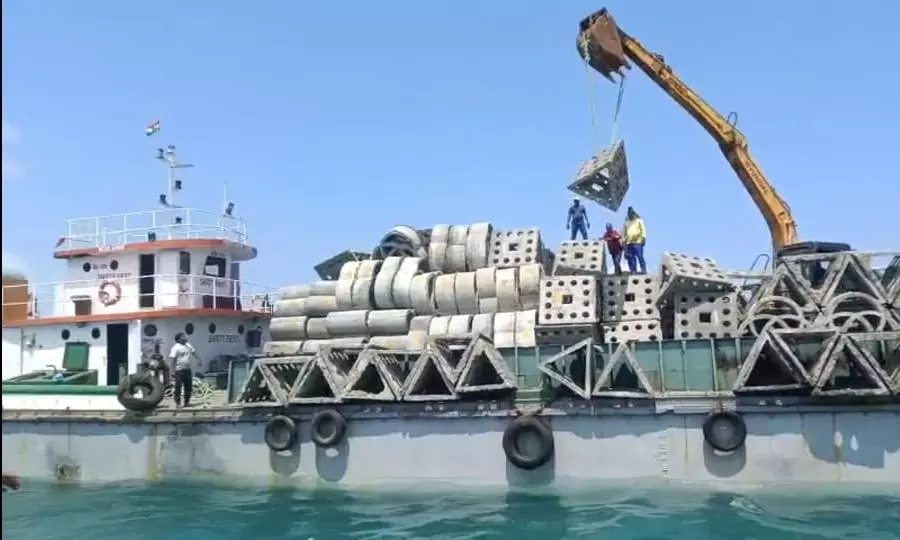
RAMESWARAM: Work on constructing artificial coral reefs in the sea is about to begin in the Rameswaram island region to protect rare marine life.
There are 117 types of coral reefs naturally found in the Gulf of Mannar, Bay of Bengal and Palk Strait in Ramanathapuram district.
More than 500 marine species, including seahorses, dolphins and sea turtles, depend on these coral reefs for their survival.
But the coral reefs, a habitat and food source for fish, have been disappearing in recent times due to illegal harvesting for sale, plastic waste and the use of banned fishing nets.
If this trend continues, coral reefs will completely disappear by 2050, researchers have warned. As a result, the central and state governments are implementing various schemes to protect these endangered coral reefs.
In this context, the Tamil Nadu fisheries department has started the work of setting up 26,000 artificial coral reefs to protect the rare marine life in the Gulf of Mannar, Bay of Bengal and the Palk Strait and to grow the endangered coral reefs.
It has been said in the next two months, about 26,000 artificial coral reefs, worth Rs. 43 crore, will be set up at 145 locations in 29 coastal villages, including Rameswaram, Thangachimadam, Pamban and Mandapam.
The artificial coral reefs produced so far are being transported to the Pamban Kundugal deep sea fishing port. From there, they are loaded onto boats using cranes and dropped into the sea near coastal villages.
The primary objective of the project is to improve fish reproduction by creating spawning and breeding habitats for fish.
The artificial coral reefs thus brought to the Thangachimadam fishing port were transported by ship and placed in the Thanneer Ootru area next to Thangachimadam in the Bay of Bengal sea area.
