Unauthorised Buildings Major Enforcement Challenge in Chennai

A significant part of planning enforcement involves buildings where owners have obtained approval but are alleged to have subsequently carried out additional construction or changed the use of the premises in violation of the sanctioned plan
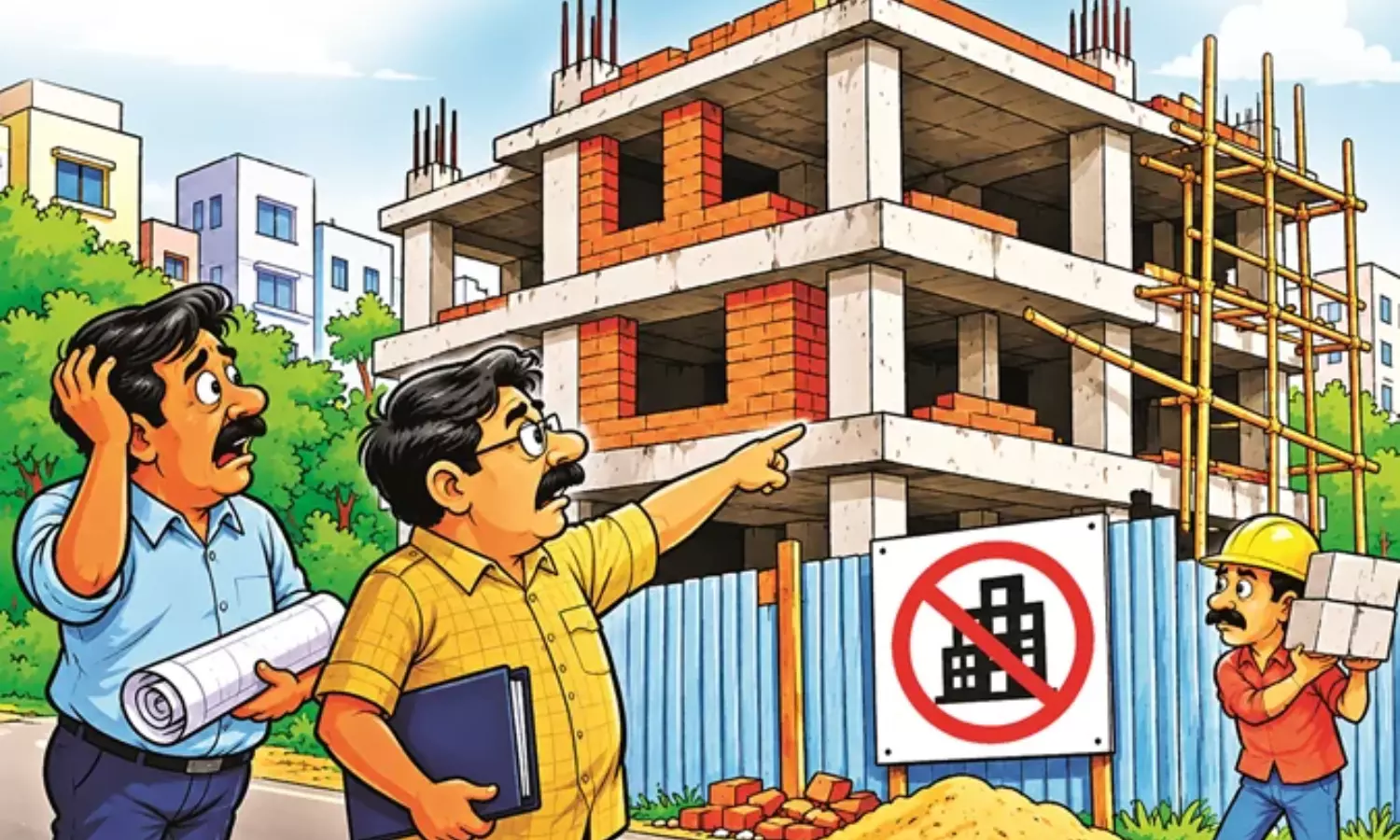
CHENNAI: A large number of buildings coming up without mandatory planning permission, or with substantial deviations from sanctioned plans, continue to pose a major enforcement challenge in Chennai, leaving civic authorities struggling to detect violations and take timely action.
Greater Chennai Corporation (GCC) conducted surveys and identified buildings that had been constructed “wholly unauthorised without obtaining building plan permission”. Such structures were treated as unauthorised and liable for action under the Tamil Nadu Town and Country Planning Act.
The problem, however, is not confined to buildings that have no approval at all. A significant part of planning enforcement involves buildings where owners have obtained approval but are alleged to have subsequently carried out additional construction or changed the use of the premises in violation of the sanctioned plan.
These disputes can involve additional floors or floor area, changes in land or building use, inadequate setbacks and other departures from the approved plan.
Unauthorised construction can have consequences beyond the individual property, particularly in a densely built city such as Chennai.
At a review meeting chaired by Corporation Commissioner, Dr. G.S. Sameeran, at the Ripon Buildings in July, senior officials were directed to submit field inspection reports detailing the action taken against buildings constructed in violation of approved plans and premises being used for purposes other than those sanctioned.
The monitoring committees had been constituted at the regional and zonal levels to oversee enforcement. Officials have been issuing notices to owners of buildings found to have violated sanctioned plans or to have put to unauthorised use, seeking explanations before initiating further legal action.
However, residents have raised the difficulty of enforcing the rules and court orders regarding unauthorised buildings across the city.
In Alapakkam, local resident F. Jobinston Sherwin approached the Tamil Nadu Local Body Ombudsman in August 2023, alleging that officials had failed to stop the construction of a ground-plus-two-storey building at Metro Nagar in ward 150, Valasaravakkam zone.
The matter eventually reached the Madras high court, which directed GCC to demolish the building within five weeks. Sherwin said the case demonstrated the importance of acting while construction is still under way rather than waiting until a building was completed.
“The building was constructed without obtaining permission from GCC. I had raised the issue when the construction was taking place. The authorities should have stopped it at that stage,” he said.
Residents have also questioned whether enforcement is being applied consistently across the city.
V. Gopalakrishnan, a resident of MGR Nagar, pointed to buildings in his locality and questioned the delay in taking action against structures that residents claim have violated planning regulations.
“GCC recently demolished a multi-storeyed, unauthorised building on Pugazhendhi Street in MGR Nagar. The authorities delayed action for two years despite a Supreme Court order. GCC finally demolished it after constant media pressure. They are also delaying implementation of court orders on Ratna Buildings on Anna Main Road. When will GCC lock, seal and demolish Multi Mahal on P.T. Rajan Salai, in K.K. Nagar, next to Ratna Buildings,” he asked.
Such complaints point to a larger concern: identifying a violation is only the first step. The effectiveness of planning enforcement ultimately depends on whether notices are followed by inspection, adjudication and, where warranted, implementation of final orders.
For Chennai, the challenge is, therefore, two-fold — preventing unauthorised construction before it becomes a completed building and ensuring that violations detected after construction are dealt with through a legally sustainable process.
Civic officials have long faced the practical difficulty that enforcement becomes more complicated once a multi-storeyed building is completed and occupied. At that stage, demolition or sealing can have significant financial and social consequences, while prolonged litigation can further delay implementation.
N. Viswanathan, an advocate, said cases before the high court show that the real test lies earlier in the construction cycle. “Timely inspections, accurate records and immediate intervention can prevent a planning violation from becoming a completed structure, a prolonged legal dispute and eventually a difficult demolition or de-occupation exercise. With Chennai undergoing rapid redevelopment and increasing construction activity, effective monitoring of building permissions and timely enforcement will be critical to ensuring that the city’s growth remains within its planning framework,” he said.
