TN Budget Eyes Cross-Border Metro Rail Link with Karnataka's Bommasandra

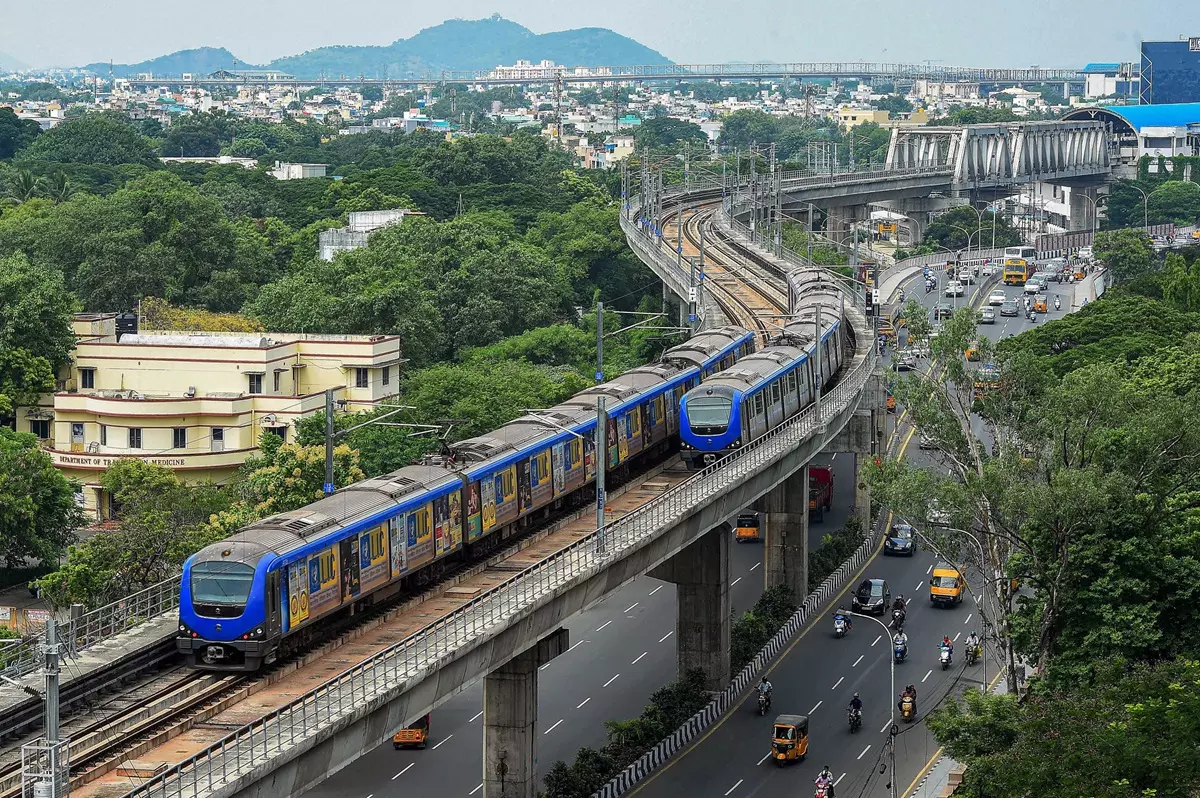
In his Budget address, the minister stated that the construction of Phase II of the Chennai Metro Rail Project, spanning 118.9 km across three corridors at an estimated completion cost of Rs 63,246 crore, is progressing at full speed
Chennai: With a commitment to propel Tamil Nadu into a US $ 1.5 trillion dollar economy by 2036, the State government, in the budget for 2026-27, gave priority to empowering women, improving governance, housing for all, safe drinking water, sustainable livelihoods, protecting social justice and promoting green cover.
Presented by State Minister for Finance, Planning and Development, N Marie Wilson, in the State Assembly on Wednesday, the Budget proposed to generate an additional revenue of Rs 16,000 crore through GST, the registration department, computerization of mining operations and an additional privilege fee on liquor manufacturing.
Among the announcements were the establishment of a Specialized Government Law College in Madurai in 2027-28, training of mechanics servicing fossil-fuel vehicles in EV and battery maintenance, benefiting 22,500 persons over 5 years, at a cost of Rs.3 crore and skilling 5 lakh youth by 2031 in partnership with institution like IIT, under the AI Industry Development Programme.
Earmarking Rs 1,051 crore for youth welfare and sports development, the minister announced the setting up of 10 Olympic centres of excellence, at a cost of Rs 50 crore and an integrated youth development programme, "Take Up Sports, Give Up Drugs," to channel the NCC and NSS together with the health, police and social welfare departments.
He allotted Rs 42 crore for conducting Tamil Nadu Rural Sports Competitions and Rs 2 crore for upgrading the Tamil Nadu Physical Education and Sports University and announced that daily one hour sports period would be introduced in all Government and Government aided schools.
While the privilege fee on liquor was expected to bring in Rs 1,000 crore, the ‘Faceless Assessment’ under GST, ‘Faceless Registration’ in the Registration Department and end-to-end computerisation in mining were together expected to generate about Rs 15,000 crore in additional revenue, Wilson said in his two and a half hour budget speech.
Stating that Tamil Nadu’s debt had doubled over the past five years, reaching about Rs 10 lakh crore, he said the State trailed peer States on fiscal indicators like Own Tax Revenue as a proportion of GSDP, Revenue Deficit and Fiscal Deficit, leaving limited fiscal space for new schemes.
Guided by the principle ‘All are equal by birth’, numerous welfare schemes had been implemented in the last three months by the Government, founded on the ideals of inclusive growth, social justice, equality, women’s safety, eradication of poverty, total eradication of drugs and a corruption-free, honest and transparent administration, he said.
Citing the increase of free electricity to 200 units for consumers with bi-monthly consumption of up to 500 units, waiving of farmers’ loan through co-operative societies, a special package for Kuruvai cultivation, setting up the ‘Singapenn Special Task Force’ for women’s safety, creation of Anti-Narcotics Task Force Units at the district level and closing of 717 liquor outlets as the government’s achievements in the three months after the TVK came to power, he said the ‘Thaaimaaman Thanga Mothiram’ scheme for children born in Government Hospitals would be implemented from 15 September.
Among the fiscal reforms brought in were abolition of the submission of unnecessary certificates by contractors in public tenders, and allowing contractors registered with any Government department to bid for tenders of any other department, relaxing eligibility criteria for low-value procurements to encourage young entrepreneurs and small businesses to bid for the first time, he said.
Granting of planning permission for multi-storied and high-rise buildings entrusted with the Chennai Metropolitan Development Authority eliminating corruption, he said and announced some schemes in the education sector, with an allocation of Rs 44,527 crore for School Education Department.
'Super Clean Super Campus' Scheme will ensure daily cleaning, drinking water and toilet maintenance and 24-hour security in 10,000 schools in the first phase, at a cost of Rs.139 crore, 'Palli Niraivu Thittam' would modernise 3,734 schools - 2,514 primary, 365 middle and 855 high and higher secondary schools - at an estimated cost of Rs 2,132 crore and Perunthalaivar Kamarajar Schools of Excellence, residential schools for Classes IX to XII, would offer free education, food, boarding, textbooks and uniforms.
Allocating Rs 8,393 crore for the higher education department, he urged the Union Government to cancel the NEET examination and revert to the system of admission to medical colleges based on Class XII marks and said the 'Vetri Laptop Scheme' for college students would be implemented at a cost of Rs2,000 crore.
For the Social Justice Department, he allocated Rs 3,937 crore to take up schemes and said Rs 13.41 crore would be provided to pay incentives to girl students for not dropping out of school. Earmarking Rs 1,700 crore for Backward Classes, Most Backward Classes and Minorities Department, he said the Hajj subsidy would be increased from Rs 25,000 to Rs 35,000 and Rs 1.01 crore would be allocated for the formation of additional Christian and Muslim Women Aid Societies.
A subsidy of up to 50% of cost, subject to a maximum of Rs.30,000, would be provided for advanced AI based assistive devices, including sports prosthetics, myoelectric limbs and cochlear implant batteries for the disabled, for whose welfare Rs 1,485 crore as allocated.
Under the 'Annan Seer' scheme, an 8 gram gold coin and a silk sari will be presented to brides at a cost of Rs 812 crore and integrated senior citizen homes would be established in 12 districts.
Under the Rs 560 crore 'Thai Maaman Thanga Mothiram Thittam,' every newborn delivered in a Government hospital will receive a 1 gram gold ring and 1,000 mobile geriatric treatment centres will be introduced in a phased manner with the allocation of Rs33 crore allocated.
BUDGET AT A GLANCE
Theme: Vetri Tamizhagam
Total Receipts: Rs 3,50,766 crore
Total Disbursements: Rs 4,72,585 crore
Revenue Sources:
Own tax revenue: Rs 2,26,740 crore
Own non-tax revenue: Rs 27,835 crore
Grants in aid from Union Government: Rs 32,921 crore
Share in Central Taxes: Rs 62,531 crore
Own tax revenue:
Commercial tax 68.9 %
Stamps and Registration 15.5
Motor Vehicle Taxes 6.6
State excise 6.2
Others 2.8
Total expenditure: Rs 4,72,585 crore (an increase of 8.52 % from 2025-26)
Revenue expenditure 4,05,802 crore
Capital expenditure: 56,985 crore
Revenue deficit Rs 69,219 crore
Fiscal deficit as a percentage of GSDP 3.48%
Major sectoral allocations:
Education Rs 52,920 crore
Rural Development Rs 39,609 crore
Urban Development Rs 38,715 crore
Health Rs 23,357 crore
Food and Cooperation: Rs 22,859 crore
Highways Rs 21,524 crore
Energy Rs 15,828 crore
Police 14,552 crore
Transport Rs 13,561 crore
Social Welfare: Rs 9,819 crore
Water Resources Rs 9,264 crore
Industries and MSMEs Rs 6,556 crore
Social Justice Rs 3,938 crore
