JUST SPAMMING | How Inseparable Is TN Politics from Cinema
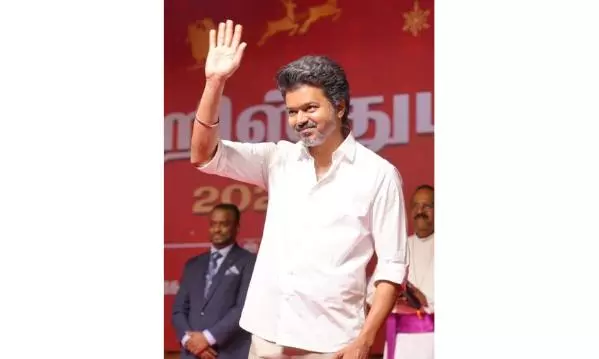
The only difference between 2013 and now is that Vijay was not a practicing politician then. He only had political aspirations and was preparing the ground for his entry into politics.
That cinema is intertwined with politics in Tamil Nadu is old hat. But what now comes to light in the run up to the release of the two Tamil films, Jananayagan and Parasakti, in 2026, is that movies, particularly the emotions that they evoke both on and out of the silvers screen, could be harnessed deftly to play real political games. It was the Congress party that excelled in that art when an entire line up of leaders, including Members of Parliament, went up in arms when the Central Board of Film Certification refused to clear the Vijay starrer ‘Jananayagan’ for public screening. What all those leaders saw as undemocratic or unbecoming of the Union Government in a film getting caught in pre-release controversies, be it with censors or otherwise, is not known.
In the case of Vijay, too many of his movies had run into trouble before opening in theatres. Significant among the plethora of episodes relating to films like Master, Mersel, Puli, Sarkar, Kaththi, Thalaiva, Kaavalan and so on, while Thalaiva took Vijay and his father S A Chandrasekar to Kodanad estate where the then Chief Minister J Jayalalithaa was on a sojourn in 2013. They were peeved because the film could not be screened in the State then and rushed to meet the Chief Minister. The impasse was cleared only after the tagline of the film, ‘Time to Lead,’ was removed from the posters and publicity material. But no one remembers any leader from the Congress rising in anger against the blockade put up by the then government on some pretext or the other.
The only difference between 2013 and now is that Vijay was not a practicing politician then. He only had political aspirations and was preparing the ground for his entry into politics. Now that he is in the thick of it as the chief of a political party, the Congress honchos wanted to support him and also make use of the opportunity to hit out at Prime Minister Narendra Modi. Perhaps they expressed their solidarity with Vijay to keep the doors open for an alliance with his party, in case. When even a party like the Congress with no significant connection to tinsel town sees a political cause to fight in a Censor Board routine action leading to the stopping of a film release, one can understand how much cinema has intertwined itself with politics.
More than that, other major development in Tamil tinsel town, the release of the film ‘Parasakthi’ for Pongal, is also not devoid of political trappings since the Censor board that delayed the clearance and then issued a U/A certification – it means children cannot watch it without parental permission – besides reportedly ordering drastic cuts in the film that is basically a retelling of a historic event. Only because the film was seen through a political prism by the Censors themselves the removal of some scenes and dialogues relating to anti-Hindi agitation in Tamil Nadu were ordered. If they had seen the film as a work of fiction, they might have cleared it without the cuts.
Originally, Parasakthi is the title of a 1952 celluloid blockbuster that launched the late legendary thespian ‘Sivaji’ Ganesan as an actor, who made an impression among Tamil movie-goers by his eloquent delivery of the dialogues written by ‘Kalignar’ M Karunanidhi, former Chief Minister. In fact, it was a landmark movie that set the trend for the politicization of Tamil cinema. Apart from the scriptwriter who then became a highly accomplished politician at the national level, even the hero, Sivajai Ganesan, dabbled in politics as a Congress party leader and then launched his own party. The film, the original Parasakthi of 1952, also helped the growth of the DMK as a political force and in the process making politics and cinema inseparable in Tamil Nadu.
But it was only ironic that at the present moment when another ‘Parasakthi’ hits the screens 75 years later, politics, which continues to dominate the celluloid world, should inform the censor board of the possible consequences in allowing the modern raconteur to have his own narration. Or the refusal for certification of Jananayagan should spawn a slew of conspiracy theories, both political and otherwise. Non-political conspiracies said the censor delay in certification is to wait for Parasakthi to release first and run out of steam so that Janaayagam can have its day after the Pongal frenzy dies down. Some are coming out with a theory that the Vijay films have never flopped in the box office or failed to thrill his fans even if launch dates have been postponed.
Political conspiracy theories include the ruling BJP at the Centre –CBFC comes under the Union Government – targeting Vijay to force him into an electoral alliance, now that it has begun coalition talks with various parties in the State. Another theory is that the BJP and the DMK have come together clandestinely to work against the political rise of Vijay. Though conspiracy theories are common, particularly when it comes to matters relating to film stars and their activities, the manner in which a development in tinsel town gets a political contour is part of the modern narrative in which many people, particularly youth, are unable to distinguish the real from the reel. What is tragic is that even key players, both in politics and films, are not prepared to segregate their two personas.
