How Best Can Chennai Withstand Extreme Weather Events?

Coordinated effort alone will ensure right response
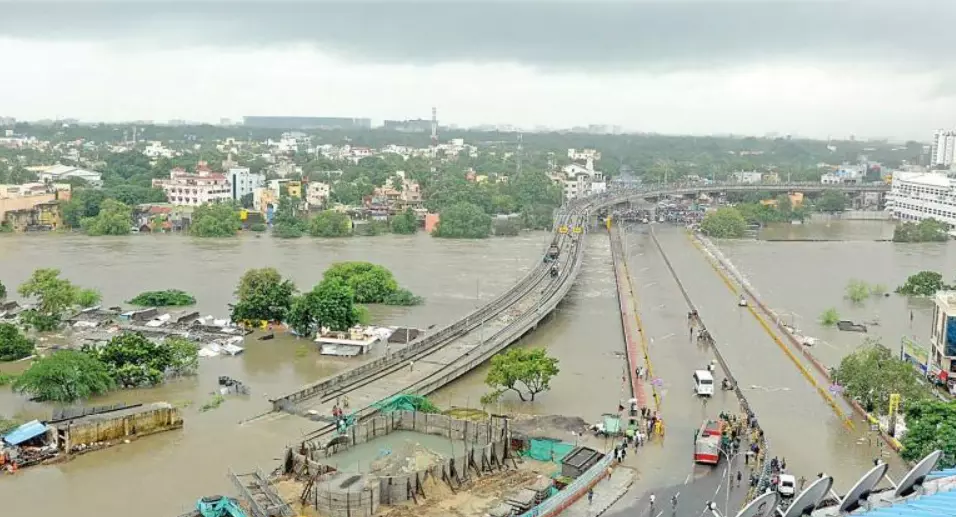
Chennai: The devastating flash flood in Nepal has once again brought the destructive potential of extreme weather into sharp focus, serving as a grim reminder that disasters can overwhelm communities and infrastructure with frightening speed.
For Chennai, preparing for the northeast monsoon and has its own painful history of catastrophic flooding, the events unfolding in the Himalayan region raise an uncomfortable but necessary question: Is the city truly prepared for an extreme weather event?
The question assumes greater significance at a time when Greater Chennai Corporation (GCC) is racing to complete monsoon-preparedness works across the sprawling metropolis.
Stormwater drains are being cleaned and constructed, canals and waterways are being inspected, vulnerable areas are being identified and emergency arrangements are being put in place ahead of the annual monsoon season.
But preparedness is about far more than the number of kilometres of drains constructed, the number of projects sanctioned or the amount of money allocated for civic works.
The real test is whether the entire system can withstand intense and prolonged rainfall.
“Disaster preparedness should not be measured merely by the number of projects completed on paper,” said an urban planning expert. “The real question is whether all components of the city’s drainage and emergency response systems work together when an extreme rainfall event occurs.”
The city has witnessed devastating floods in the past, when intense rainfall overwhelmed drainage networks, submerged residential neighbourhoods, disrupted transport and left thousands of people struggling for basic necessities.
Every major flood has exposed weaknesses in Chennai’s relationship with water — a relationship complicated by rapid urbanisation, shrinking open spaces, the loss of natural drainage channels and increasing pressure on lakes, wetlands and waterways.
As the northeast monsoon approaches, those concerns are once again returning to the forefront.
The Corporation has undertaken extensive stormwater drainage works in recent years, particularly after repeated flooding exposed gaps in the city’s infrastructure. New drains have been constructed, existing networks upgraded and efforts made to identify missing links between smaller neighbourhood drains and larger waterways.
Yet, the effectiveness of the system depends on something deceptively simple: whether water has a clear path to flow.
Rainwater must move from streets into stormwater drains, from smaller drains into larger channels and eventually into rivers, canals, lakes or the sea.
A blockage, an incomplete connection or a poorly maintained waterway at any point in this chain can cause water to accumulate upstream, potentially flooding residential neighbourhoods within hours.
“Drainage cannot be viewed as an isolated engineering project,” said a disaster-management specialist. “A drain is only as effective as the system it is connected to. If the final outfall is blocked or the receiving waterbody is already full, the entire chain can fail.”
This is particularly significant for Chennai’s low-lying and historically flood-prone areas. Localities in and around Velachery, Madipakkam and Pallikaranai in south Chennai have repeatedly experienced waterlogging during intense rainfall while vulnerable pockets across north and central Chennai have faced similar challenges.
For residents, however, the debate over infrastructure often comes down to one practical question: How quickly will the water recede when it rains?
“We have heard about drainage works and flood-preparedness measures every year,” said a resident of a flood-prone locality in south Chennai. “But when there is very heavy rain, people want to know whether water will enter their homes and how long they will remain stranded.”
Across several parts of the city, infrastructure works are still under way. Stormwater drains are being constructed or upgraded, roads are being repaired and civic agencies are working to complete pending projects before the monsoon gains strength.
Unfinished drainage works can become vulnerable points during heavy rain. Dug-up roads can turn hazardous for motorists and pedestrians, construction debris can obstruct water flow.
A GCC official involved in monsoon preparedness said the focus was on strengthening both infrastructure and emergency response.
“Our objective is to identify vulnerable locations in advance and ensure that the required machinery, personnel and emergency arrangements are available,” the official said.
“Continuous monitoring and coordination between different departments will be critical during periods of intense rainfall,” he added.
The condition of Chennai’s canals and other watercourses will be equally important. The Nepal tragedy has also highlighted a broader lesson about modern disasters: they can escalate rapidly and trigger a chain of failures.
A single extreme weather event can damage roads, disrupt electricity, isolate communities and hamper rescue operations. When multiple systems fail simultaneously, a difficult situation can quickly turn into a humanitarian crisis. Chennai’s geographical conditions are vastly different from those of Nepal, but the fundamental lesson remains relevant.
A city’s preparedness cannot be judged only by the infrastructure it builds. It must also be measured by the strength of its emergency response. Pumping arrangements will be particularly important in low-lying areas.
However, pumps alone cannot solve the problem if the waterways receiving the discharged water are already overflowing.
Chennai’s flood-preparedness system must, therefore, function as an integrated network rather than as a collection of individual projects. The coordination between the Corporation, police, fire and rescue services, electricity authorities and other agencies will determine how effectively the city responds when vulnerable neighbourhoods begin to flood.
