From Screen to Secretariat: Grading Joseph Vijay's First Two Months as CM

Two months in, what does the record actually say?
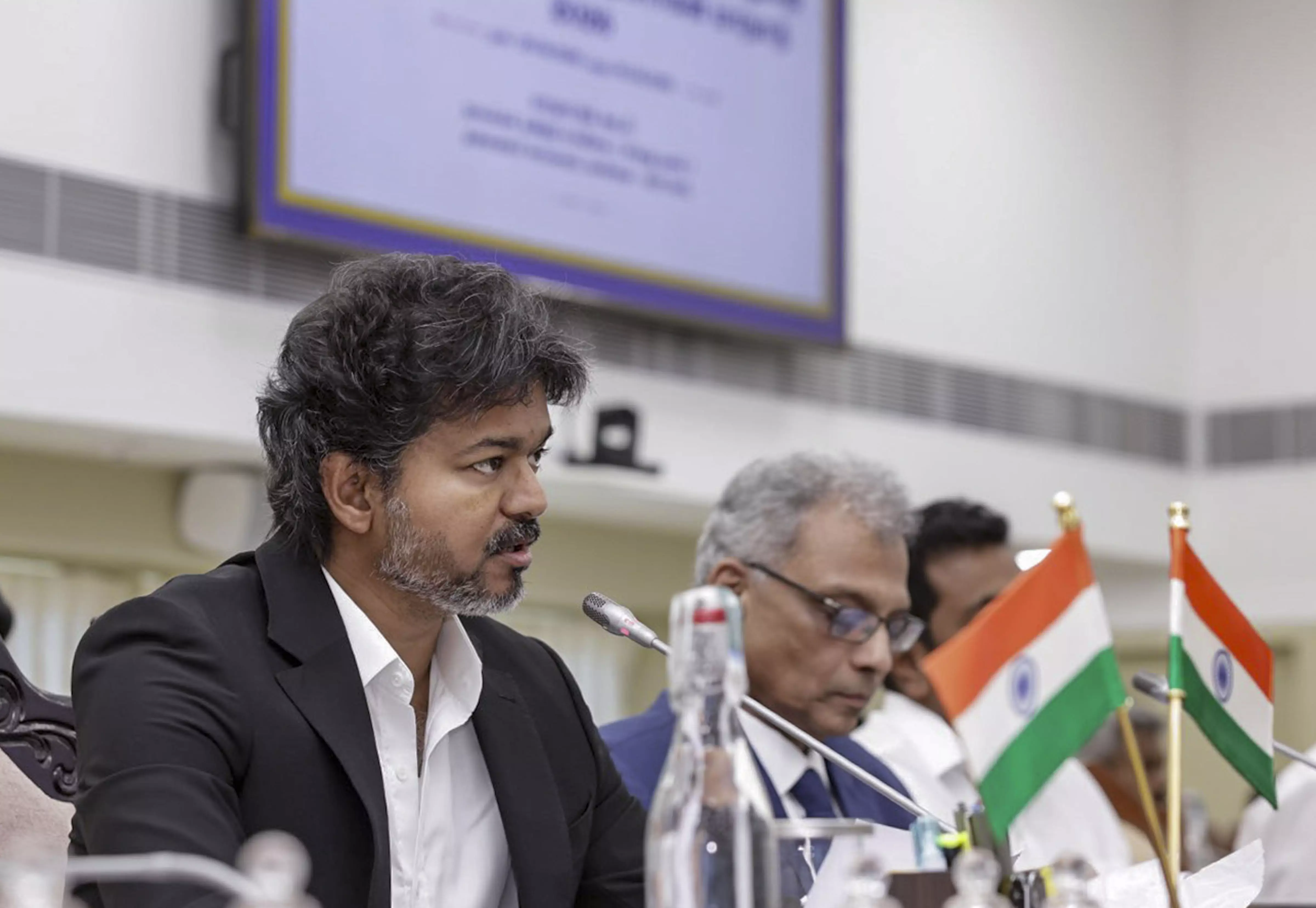
Tamil Nadu has had actor-politicians before. MG Ramachandran built a welfare state out of screen charisma. Jayalalithaa governed for two decades with an iron grip. But Ilaya Thalapathy Vijay - now Muthalamaichar Thiru C. Joseph Vijay - is a different kind of experiment. Unlike established political parties that build politicians into leaders, Vijay is a star who built a party around him.
The style inside the Secretariat has attracted its own attention. Vijay arrives on time every morning in a black suit and white shirt, a deliberate departure from the white veshti that has defined Tamil Nadu's political class for generations. He reportedly spends nearly seven hours at his desk Monday to Friday, has made punctuality a non-negotiable expectation for senior bureaucrats, and brings his lunch from home rather than hosting the lengthy political meals that are a staple of the CM's calendar. None of this transforms governance by itself.
In a bureaucratic system led by a party built around one man, does what the person at the top signals matter?
Two months in, what does the record actually say?
The win that made it possible
Before anything else, the mandate itself was spectacular. TVK contested alone in 233 constituencies and emerged as the single largest party with 108 seats, in Tamil Nadu's first-ever hung assembly. The state recorded its highest-ever voter turnout of 85.1%. The ruling party’s incumbent Chief Minister lost in his own seat in Kolathur, a constituency he had held three times.
Before the results were out, political observers gave him generous odds of being a kingmaker. Not the king.
Analysts noted that TVK pulled votes across caste lines, winning 24 of 46 reserved constituencies, pulling young voters, women, and first-time voters away from both Dravidian parties.
Analysts have called it anti-incumbency against DMK, Vijay's organised fanbase, a well-funded digital campaign, the right promises at the right time. All of that is probably true.
The path to government was messier. The Governor initially refused to invite TVK citing the party's shortfall of the majority mark, and there were a few tense days of political horse-trading before Congress, the Left parties, VCK and IUML fell into place. BJP and AIADMK offered alliance, but Vijay stood by his earlier declaration that TVK considers BJP an "ideological opponent".
He was sworn in on May 10, alongside nine ministers, at Chennai's Nehru Indoor Stadium.The first CM in 59 not to have risen up from Dravidian ideology.
Day one decisions
On his first working day, Vijay signed three government orders. Two hundred units of free electricity for every household. A dedicated women's protection force called Singappen for rapid response to crimes against women. Sixty-five Anti-Narcotics Task Force units deployed statewide.
These were campaign promises translated into gazette notifications within hours of taking office. That kind of speed is deliberately theatrical, of course, but it also sets a tone. He said in his oath-taking speech: "We will not touch a single paisa of the people's money and we will not allow anyone to loot the State." Whether that holds is the real test, but the opening moves were clean and on-message.
Within 48 hours, he also ordered the closure of 717 TASMAC liquor outlets operating within 500 metres of places of worship, educational institutions and bus stands. Of these, 276 were near religious sites, 186 near schools and colleges, 255 near bus terminals. Campaign promise, gazette notification.
Centre-state relations
Vijay went to Delhi twice in his first month as Chief Minister.
The first visit saw him call on Prime Minister Narendra Modi and Finance Minister Nirmala Sitharaman, submitting a memorandum on key state issues including opposition to Karnataka's Mekedatu dam project on the Cauvery, the safety of Tamil Nadu fishermen near Sri Lanka and requests for enhanced central allocations.
Before the second visit for the NITI Aayog Governing Council meeting on June 11, Tamil Nadu signed an MoU with the Union Government for Jal Jeevan Mission 2.0, securing ₹2,177 crore in initial central allocation for drinking water infrastructure across the state's 25 municipal corporations. Vijay also directed officials toward a 24x7 water supply target for these corporations.
Coalition management
Running a coalition with Congress, CPI, CPI(M), VCK and IUML while maintaining principled distance from both DMK and BJP is a balancing act. So far, the cabinet has been expanded twice. First to 23 ministers in late May, then with IUML and VCK representatives, without any visible fracture. Six AIADMK MLAs resigned their seats to join TVK by June, suggesting floor dynamics are tilting his way. Seven seats are now vacant and by-elections are pending.
In the last two days, another controversy broke out. TVK MLA N Elaiyaraja filed a complaint on June 29, alleging that a man reached out on behalf of members of a major political party and asked to vote in a particular manner during a proposed resolution against the Speaker of the Tamil Nadu Legislative Assembly and was offered up to ₹35 crore as an inducement.
As of now, the complaint has led to eight arrests.
The public works story
One of Vijay's earliest administrative directions was to GCC and departments to adopt open competitive bidding for civic works.
The results showed up in under a month. According to reports, contractors bidding for Greater Chennai Corporation road restoration tenders quoted 25 to 30 percent below official estimates.
In Ambattur zone, a road project estimated at ₹25 lakh drew nine bidders. The winning bid came in 25.9% below estimate, bringing the cost to around ₹17 lakh and saving the corporation nearly ₹9 lakh on a single contract. In Tondiarpet, a ₹30 lakh project saw bids come in 25% lower. In Sholinganallur, contractors bid as low as 36% below estimate.
Greater Chennai Contractors Association president Rama Rao offered the sharpest point of comparison. The same tenders, under the previous system, went at 10% above estimate. "If it were a Rs 25 lakh tender, contractors executed it for Rs 27.5 lakh. Now the same work is being taken up for Rs 16 lakh," he said. "It needs to be questioned how officials allowed budgets to be inflated by 35-40% in the past."
Welfare, infrastructure and the vision document
Beyond public works, the government's first month included a comprehensive overhaul of Tamil Nadu's 620 Amma Unavagam canteens, directing kitchen modernisation and hygiene improvements. A first phase of cooperative bank loan waivers for economically vulnerable borrowers was announced. Several stalled Jal Jeevan Mission drinking water projects were revived. A ₹134.83 crore package was unveiled for paddy cultivation support. Forty new vehicles were deployed for rural healthcare and emergency services.
The government also released the Vetri Tamizhagam Vision Document — a 436-point governance blueprint covering 35 departments, built around ten pillars drawn from the Tirukkural. Vijay released a White Paper on Tamil Nadu's finances, acknowledging a debt burden of over ₹10 lakh crore inherited from the previous administration.
The mistakes
On May 12, two days into office, the government appointed Rickey Radhan Pandit Vettrivel, a TVK spokesperson who is also a personal astrologer to Vijay, as Officer on Special Duty (Political) to the Chief Minister. The appointment drew immediate fire from across the political spectrum. A petition was filed in the Madras High Court challenging the appointment as unconstitutional and made without any transparent process.
The government revoked the order within 24 hours.
Then there was the driver's son. Vijay gave a TVK candidacy to Sabarinathan, son of his long-time personal driver-turned-PA Rajendran. Sabarinathan won and is now an MLA. The optics of a first-generation party handing a legislative seat to the son of the chief minister's driver went viral in March.
The Senthil Balaji case remains unresolved. Vijay had made the former DMK minister, facing an ED cash-for-jobs case, a campaign target. The Enforcement Directorate wrote to the Tamil Nadu government for prosecution sanction within 48 hours of TVK taking office. The sanction has not come. The government has not addressed this publicly.
What two months can and cannot tell you
It cannot tell you whether 200 units of free electricity will be delivered without the kind of fiscal stress that eventually forces cuts. It cannot tell you whether Singappen becomes a real force or a press release. It cannot tell you whether the anti-narcotics units will do anything the existing machinery was not already meant to do.
What it can tell you is that Vijay has moved faster and with more coherence than most first-time CMs. The early orders were decisive. The Delhi outreach has been pragmatic rather than ideological. He has kept a messy coalition intact through its first stretch. He has signed things that, if implemented, would meaningfully affect people's lives.
Tamil Nadu will judge the rest over five years. Two months is a photo taken early in the morning. The light is yet to dawn.
