Vijay’s Assembly Playbook: Ministers Attack Oppn, CM Holds Midfield

The strategy has become increasingly apparent during the ongoing Budget session, with TVK ministers repeatedly stepping up to counter Leader of the Opposition Udhayanidhi Stalin, AIADMK general secretary Edappadi K Palaniswami and other opposition leaders
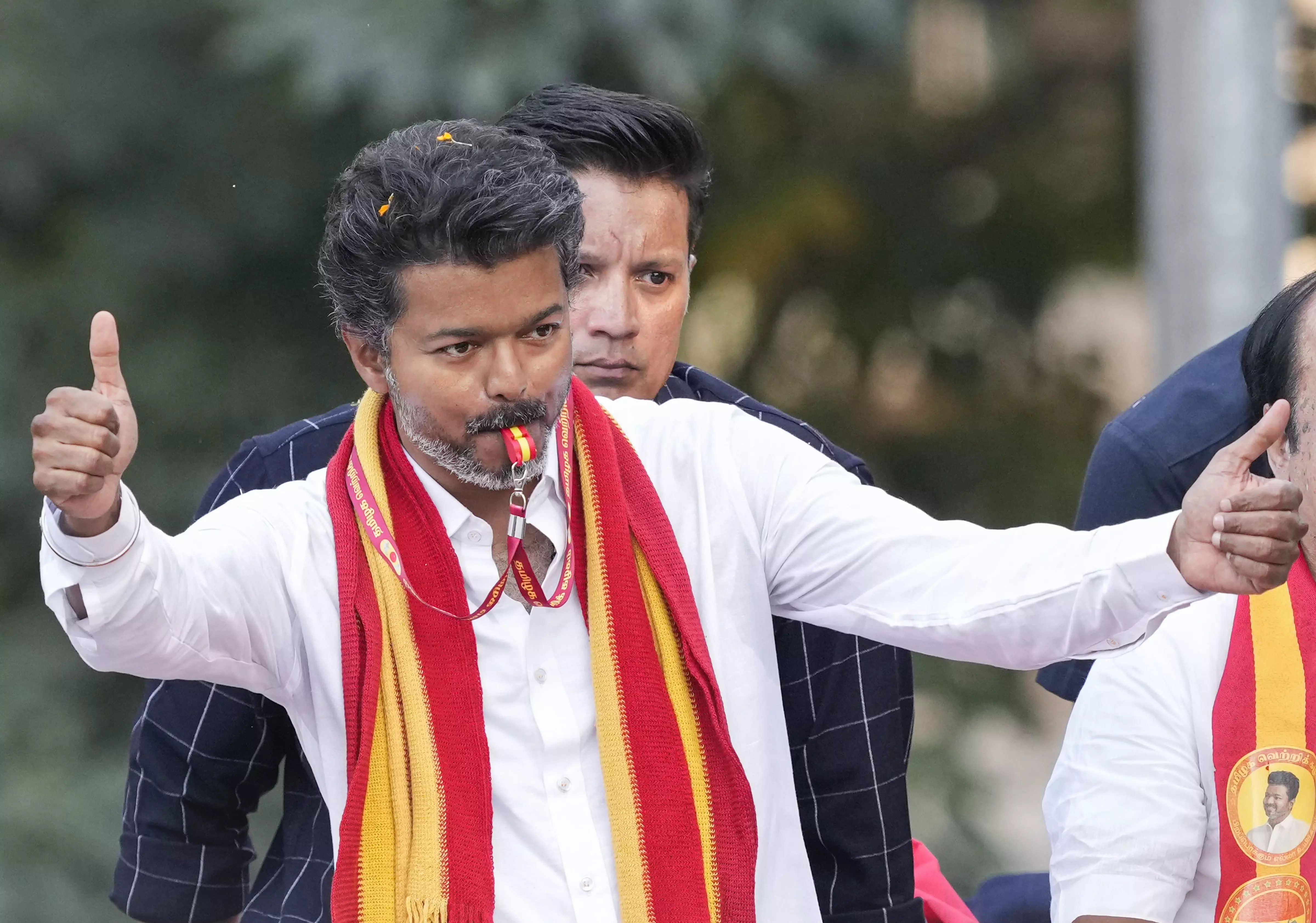
Chennai: For Chief Minister and TVK president C. Joseph Vijay, the Tamil Nadu Legislative Assembly appears to have acquired a familiar shape — a football field, where he has chosen to keep himself largely in the midfield while deploying a set of trusted ministers to lead the attack, absorb Opposition pressure and return the fire.
The strategy has become increasingly apparent during the ongoing Budget session, with TVK ministers repeatedly stepping up to counter Leader of the Opposition Udhayanidhi Stalin, AIADMK general secretary Edappadi K Palaniswami and other opposition leaders. The attacks have ranged from governance and budgetary decisions to electoral promises, dropped Parandur Greenfield Airport row, law and order, NEET, power tariff and supply, the Cauvery-Mekedatu dispute and delimitation.
The ruling party had clearly identified its principal responders. Ministers Aadhav Arjuna, N Anand, CTR Nirmalkumar, S Ramesh and Rajmohan have emerged as the government’s principal voices in the House, with each taking turns to defend the new administration as “forwards” and challenge the opposition”.
Among them, Aadhav Arjuna has assumed the most combative role. His exchanges with Udhayanidhi have covered a wide political canvas — from lottery-related controversies and party funding to allegations concerning the previous DMK regime, liquor policy, delimitation, law and order and the Cauvery dispute. His interventions have often transformed routine legislative exchanges into political contests.
Nirmalkumar, handling Law and Energy Resources, has also frequently entered the fray, while School Education Minister Rajmohan and HR&CE Minister Ramesh has adopted a more measured approach in defending the government and questioning the Opposition.
Yet the strategy has exposed its own vulnerabilities. Some remarks by Aadhav Arjuna and Nirmalkumar in the House have subsequently faced intense criticism from the Opposition and social media users, who questioned their factual basis by citing historical records and available data.
At times, the reactions were not confined to the Opposition benches. There were murmurs within the treasury benches too when exchanges threatened to drift from the subject, prolong debates and consume valuable Assembly time.
Speaker J C D Prabhakar has consequently found himself intervening more frequently as a 'referee' in the football match. On occasions when Aadhav Arjuna or Nirmalkumar strayed from the subject or their remarks created discomfort in the House, the Speaker urged them to return to the issue under discussion. Some contentious remarks were also expunged from the proceedings.
The contrast with ministers such as K G Arunraj, Rajmohan and N Anand has been noticeable. Their criticism of the Opposition has generally remained within the contours of the debate. Even Leader of the House K A Sengottaiyan has, on occasions, faced the Speaker’s intervention over remarks that attracted objections.
That distinction matters because Vijay’s strategy is not merely about having ministers speak; it is about deciding who speaks, when they speak and how far they go.
The Chief Minister, who often relies on prepared text while responding to Opposition charges, has largely allowed his trusted colleagues to handle the immediate political counter-attack rather than personally answering every allegation.
The approach was particularly evident during debates on law and order. Although the portfolio rests with Vijay, Aadhav Arjuna, Nirmalkumar and Rajmohan have stepped forward to respond to Opposition criticism on the subject.
On one occasion, Aadhav even asked colleague Anand to remain silent, indicating that he would respond to the issue in the House. Such moments have offered a glimpse into the emerging division of roles within the ruling benches.
Vijay, however, has not surrendered the attacking role altogether. He has intervened when an issue carries a larger political dividend.
His reference to three alleged “incriminating files” relating to the previous DMK regime triggered one of the sharpest exchanges of the session. Udhayanidhi immediately turned the statement into a challenge, demanding that Vijay produce the files and initiate action. The issue subsequently travelled outside the House, with DMK leaders pressing the Chief Minister to disclose their contents.
On delimitation, too, Vijay has personally taken the lead, presenting the issue as one concerning Tamil Nadu’s political representation in Parliament. The subject has occasionally produced an unusual convergence, with parties otherwise divided along political lines supporting the State’s position.
That is where the football analogy begins to acquire political relevance. In 'Bigil' movie, Vijay’s character does not attempt to win a match single-handedly. He builds a team, assigns roles and trusts his players to perform. In the Assembly, the Chief Minister appears to be following a similar template — keeping the principal political authority with himself while allowing his ministers to engage the Opposition on the floor.
Speaker Prabhakar, meanwhile, has increasingly resembled the referee in this contest. His task is more complicated than simply maintaining order. With proceedings being telecast live and individual exchanges instantly circulating through social media, every interruption, retort and controversial statement can acquire a life of its own within minutes.
His interventions to keep members on the approved subject, prevent unverified allegations and restrain departures from prepared speeches have therefore assumed greater significance. The challenge is to maintain discipline without allowing the Assembly to become politically sterile.
For Vijay, this is a different field from the football pitch of 'Bigil', but the principle is familiar: a team succeeds when every player understands his position.
The TVK chief appears to have found his forwards. Aadhav Arjuna and Nirmalkumar have taken the more aggressive positions; Rajmohan, Arunraj and Anand have largely provided a steadier voice; and Vijay has retained the option of entering the contest himself when the issue demands the weight of the Chief Minister.
The Opposition, however, is unlikely to allow the ruling benches to dictate the tempo. Udhayanidhi and the DMK legislators continue to test the government on policy and performance, while Palaniswami has mounted his own attacks. For a government still establishing its political identity, every Assembly debate is consequently more than a legislative exercise. It is a test of authority, preparation and political endurance.
The real test for Vijay’s Bigil-style strategy will come not from the sharpness of the exchanges but from what follows them.
For now, Vijay has chosen his formation. His forwards are taking the attack, his midfielders are controlling the tempo and the Speaker is blowing the whistle when the contest threatens to spill beyond the rules.
The Budget session will show whether that formation can merely win political exchanges — or whether it can deliver the government the more difficult victory of turning electoral promises into results.
