Deficit Southwest Monsoon May Affect Vulture Population of Nilgiris

Dr. B. Ramakrishnan, head of the Department of Wildlife Biology at the Government Arts College here, said several species of vulture are now categorised as critically-endangered species across the world due to rapid population decline caused by various eco-toxicological reasons
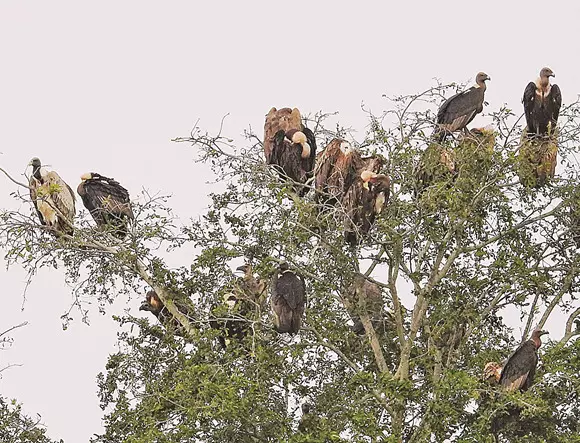
OOTY: While the world observed International Vulture Awareness Day on Saturday, an expert here cautioned that the El Nino impact and the resultant deficit rainfall in the Nilgiris this southwest monsoon may play havoc with the nesting, feeding, breeding and behaviour biology of the vultures in the Segur plateau in the Mudumalai Tiger Reserve (MTR) buffer zone limits in the Nilgiris, considered as the hub of the vulture population in the state as four species of vultures viz., white-rumped vulture, long-billed vulture, red-headed vulture and Egyptian vulture that are seen in various parts of south India thrive in Segur plateau, though in limited numbers.
Dr. B. Ramakrishnan, head of the Department of Wildlife Biology at the Government Arts College here, said several species of vulture are now categorised as critically-endangered species across the world due to rapid population decline caused by various eco-toxicological reasons.
Vultures, nature’s own disposal crew, which ruled the Indian sky in the past, faced the wrath of the eco-toxicological factors as the vulture population is now being confined to a few areas in the country.
Segur plateau and its adjacent mountain junglescape in MTR buffer zone limits in the Nilgiris is considered the paradise of the vulture population in the state as the presence of a couple of hundreds of good breeding population of vultures in Seguar plateau made this landscape a highly suitable habitat for the vultures to thrive.
Vultures play a very crucial and irreplaceable role in maintaining the delicate balance in the ecosystem, especially the jungle ecosystem, by feeding on the carcass of dead animals, thus playing a cleansing role to keep the jungles in the pink of health. Their presence can help limit the transmission of diseases by controlling the population of other facultative scavengers such as feral dogs.
Vultures need a crucial and high requirement for water during their reproductive cycles due to a combination of embryo survival, thermoregulation, and behavioural needs.
Vultures need an abundance of water for reproduction for several primary reasons that include maintaining nest and egg humidity.
Vultures drink water after feeding on the carcass of dead animals to aid in protein digestion and manage metabolic waste. Digesting high-protein meat produces toxic nitrogenous waste. Birds convert this waste into concentrated uric acid. Processing and flushing out the uric acid require functional hydration, prompting them to seek water.
Moreover, vultures have the most acidic digestive systems in the animal kingdom. Water helps dilute heavily concentrated gastric juices and facilitates the smooth break down of dense flesh and bone. While raptors get a large percentage of their moisture directly from the flesh and blood of their prey, eating dried carcasses or sun-baked carrion lacks adequate moisture, necessitating supplemental drinking.
After feeding, vultures immediately seek out water bodies to drink vast volumes of water and to bathe. Bathing cleans their feathers and skin of rotting blood, bacteria and parasites. If parents do not thoroughly wash in clean water sources before returning to the nest, they risk introducing lethal pathogens to their highly-vulnerable eggs and chicks.
If adequate water, especially shallow water bodies, is not available for the vultures near their breeding sites, then this drought-like condition would force parent vultures to fly much further distances to find food and water. When parents are away from the nest for too long, the single egg they lay each year, as it is known that vultures are slow-breeders, becomes vulnerable to predators or lethal temperature exposure, leading to nest failure and reproduction abnormalities and related aberration in breeding behaviour, Ramakrishnan explained.
