Citizen Groups Seek Action To Save Chennai’s Pallikaranai Watershed

The consultation also led to the formation of the Pallikaranai Collective, bringing together groups working on the watershed’s lakes, ponds, canals and wetlands
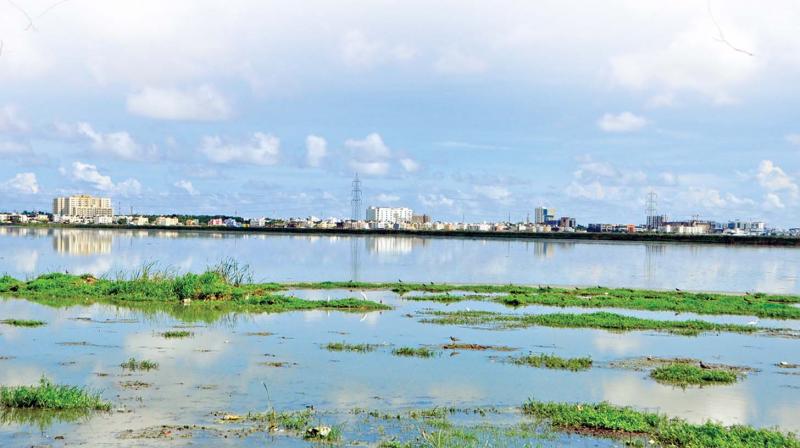
Chennai: With the city having lost a significant portion of its wetlands amid unregulated urban expansion, citizen groups have called for a fundamental shift in the way the Pallikaranai watershed is planned and managed - from isolated projects to an integrated, basin-level approach.
The demand is part of the Citizen’s Charter for the Pallikaranai Watershed, prepared by the Chennai Wetlands Action Collective (CWAC) and Oorvani Foundation, after a consultation involving resident welfare associations, conservation groups, activists and experts at Indian Institute of Technology Madras Research Park.
The consultation also led to the formation of the Pallikaranai Collective, bringing together groups working on the watershed’s lakes, ponds, canals and wetlands.
“The charter is a collective reference to the key challenges facing the watershed, while providing a common platform to advocate for its protection and sustainable management,” said Bhuvana Raj, community anchor, Oorvani Foundation. She said it could also serve government agencies as a consolidated set of community-informed concerns and priority actions.
The Pallikaranai watershed, part of the Kovalam water basin, contains a cascade of 65 major lakes and hundreds of ponds draining towards the Pallikaranai marshland, a protected Ramsar wetland. The citizen groups said the interconnected system could not be managed through isolated, lake-by-lake projects.
“Inter-departmental coordination is critical. Agencies cannot continue to work independently when the entire watershed functions as one connected system,” said Dr. S. Janakarajan, former Professor at the Madras Institute of Development Studies, and hydrologist.
The collective has sought an independent, specialised and inter-departmental committee, comprising experts and people’s representatives, to examine policy gaps, prepare a coordinated implementation plan and fix responsibilities and timelines for departments.
It has also sought demarcation and protection of wetlands and floodplains under the Wetland (Conservation and Management) Rules, 2017, implementation of the 2020 guidelines and a Flood Plain Zoning Act in Tamil Nadu.
The groups have raised concerns over encroached infrastructure, illegal construction and proposed projects within the Pallikaranai Ramsar site and its buffer zone.
“The Pallikaranai Ramsar site is being occupied by government agencies like CMRL and real estate giants, which would worsen flooding in OMR and Semmenchery,” said Raju of CWAC, stressing the need to consolidate the concerns of affected residents through the charter.
The collective has also demanded an end to further dumping at the Perungudi dumpyard and demarcation of the marsh using 1911 revenue records, in line with the NGT order cited in the charter.
On lake restoration, the groups have sought a scientific template covering upstream and downstream canals, storm-water connections and catchment management. They have opposed concretisation and sought audits of restoration works at Navalur, Raman Thangal and Sholinganallur lakes, besides scrapping proposed lake-front development at Madambakkam and Sembakkam.
At Nanmangalam lake, Sathya Anand of the Saving Nanmangalam lake group said sewage continued to enter the water body and its outlet channel disappeared after about a kilometre due to encroachments.
“We need clear demarcation of the lake, protection of its boundaries and restoration of its natural outlet,” he said.
Canal blockages are another major concern. In Velachery, M. Balakrishnan of Tansi Nagar Welfare Association said the six-vent watercourse, the only outlet for water from a large surrounding area, remained obstructed by debris and encroachments despite court orders and residents’ demands.
In the southern catchment, Atish Baisantry of the OMR Gandhinagar (T&S) Plot Owners Welfare Association said restoration of Navalur lake had not resolved downstream drainage problems.
“Navalur lake has been restored, but its downstream outlet does not have the capacity it needs. The canal is clogged with vegetation, sewage and waste, while walls and construction have further obstructed the natural waterway. Gandhinagar floods every monsoon because there is no proper storm drainage,” he said.
The charter has called for desilting the entire 13-km Buckingham canal, removal of construction debris near Sholinganallur-Akkarai Road and the Muttukadu estuary, and a dedicated flood-mitigation plan for Semmenchery and Perumbakkam resettlement areas.
It has also sought decentralised, catchment-based sewage treatment plants, underground drainage systems, strict action against untreated sewage discharge and source-level waste segregation. Illegal waste transfer stations and dumpyards affecting water bodies such as Nanmangalam lake and Pallavaram Periya Eri should be removed, the groups said.
The collective has argued that watershed- and basin-based planning, stronger wetland protection and coordinated implementation across departments are essential to improve Chennai’s resilience to both floods and water stress.
