Case for Looking After Women Guest Workers Beyond Factory Floor

Tamil Nadu’s workforce has strong contingent of women. Their needs extend outside of just pay
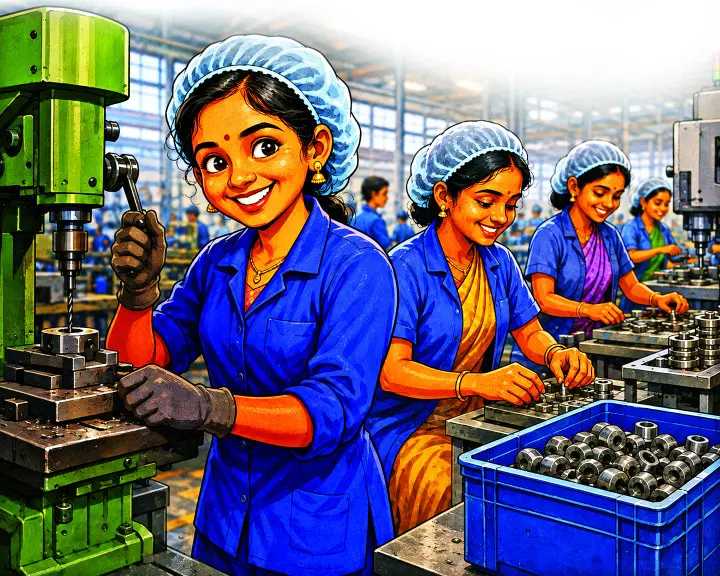
CHENNAI: As Tamil Nadu strengthens its position as one of India’s manufacturing powerhouses, women guest workers have emerged as an increasingly important force behind the state’s industrial success. From spinning mills in Coimbatore and garment factories in Tiruppur to electronics plants in Sriperumbudur and automobile assembly lines in Oragadam and Hosur, lakhs of women from other states and districts are powering production across sectors that contribute significantly to the state’s economy and exports.
Tamil Nadu has one of the largest concentrations of women workers in India’s organised manufacturing sector as industries increasingly rely on women for precision assembly, quality control, packaging, textiles, footwear and engineering operations.
The state’s ambition to become a global hub for electronics, electric vehicles and advanced manufacturing will depend heavily on sustaining and expanding women’s participation in the workforce, particularly as India seeks to become a developed nation by 2047.
The growing presence of women guest workers is particularly visible in electronics, garments and other labour-intensive manufacturing sectors. For many young women from economically-weaker families, migration to Tamil Nadu offers an opportunity to earn a regular income, acquire industrial skills and gain a degree of financial independence.
In that context, a fundamental question still remains: Why does Tamil Nadu attract women guest workers?
Tamil Nadu’s strong industrial base, better social infrastructure, educational opportunities and expanding employment market have made it an attractive destination for women seeking work outside their native districts and states. Industrial clusters around Chennai, Kanchipram, Tiruppur, Coimbatore, Krishnagiri and Hosur have created employment opportunities for thousands of young women.
“Tamil Nadu has demonstrated that industrial growth and women’s economic empowerment can go hand-in-hand. The state’s success is rooted in its investments in education, industrial infrastructure and skill development,” said R. Sekar, former DGP, Tamil Nadu.
He said Tamil Nadu had also maintained better standards in women’s safety and security, particularly in industrial corridors. “The crime rate against women is many times lower than the national average. Governments have also given importance to women’s safety through several women-centric schemes and legislation like the Tamil Nadu Prohibition of Harassment of Women Act, 1998. This has enhanced Tamil Nadu’s attractiveness among women workers. At the same time, Tamil Nadu is one of the most industrialised states in India, and the government must understand the problems and concerns of women workers if it wants to attract and retain more women in the workforce,” he said.
For women, however, the decision to move to Tamil Nadu is not determined by wages alone. Safe accommodation, reliable transport, healthcare, workplace conditions and the ability to send money home are equally important.
“I came to Tamil Nadu because employment opportunities were limited in my hometown in Odisha. Here, I have been able to find regular work and support my family with my earnings. If accommodation, transport and safety facilities are improved further, women like me would feel more secure and confident about continuing to work here,” said a young migrant woman working in the manufacturing sector in Oragadam.
For women who have moved hundreds of kilometres away from their families, such basic facilities can make the difference between staying in a job and returning home.
The state’s relatively high female literacy rate, extensive network of industrial estates and vocational training institutions have helped create a steady pipeline of workers. Government initiatives promoting industrial investment have also expanded employment opportunities beyond traditional sectors.
Programmes supporting women entrepreneurs, self-help groups, skill development, working women’s hostels and financial assistance have encouraged greater participation in the formal economy. The state has also been focusing on safe and affordable accommodation for working women who have relocated from their native places for employment.
But creating employment is only the first step.
Suman Gopalan, former chief human resources officer at Freshworks, pointed out that while women are well-represented on factory floors, they remain under-represented in supervisory, technical and managerial positions. Wage disparities persist in certain sectors, while many women leave employment after marriage or childbirth because of inadequate childcare facilities and family responsibilities.
“Creating jobs alone is not enough. Retaining women in manufacturing requires safe transportation, affordable hostels, crèche facilities, healthcare support and clear pathways for career advancement,” she said.
This is also where the government’s broader industrial policy assumes significance. Industries minister S. Keerthana has stressed that industrial development cannot be limited to allotting land and attracting investors, but must ensure that industrial parks have the infrastructure and facilities necessary for factories to actually commence operations and generate employment.
“The objective is to ensure that industrial parks across Tamil Nadu evolve from being mere land banks into fully functional, investment-ready industrial ecosystems capable of attracting investment, supporting manufacturing and creating employment,” the minister said.
The minister has also emphasised the need to identify infrastructure and administrative bottlenecks on the ground and engage directly with investors to resolve them. Such an approach has implications not only for industries but also for workers, particularly women and guest workers who depend on reliable transport, accommodation and other basic infrastructure to access employment.
Industrial clusters that depend heavily on guest workers continue to face shortages of affordable accommodation. Although several companies provide transport facilities, concerns over late-night travel and workplace safety remain important issues, particularly for women employed in shift-based operations. Recent industry discussions have also highlighted the need for worker housing in major manufacturing and textile clusters.
The rapid expansion of electronics and electric vehicle manufacturing presents new opportunities for women. As factories adopt automation, robotics and digital production systems, continuous upskilling will be essential to ensure that women are not confined to low-skilled, assembly-line jobs but are able to move into technical, supervisory and leadership positions.
The challenge is particularly important because Tamil Nadu’s next phase of industrialisation is expected to involve increasingly sophisticated manufacturing. If women are to remain central to this transition, their skills must evolve along with the technology deployed on factory floors.
Industry experts argue that increasing women’s participation in the labour force could significantly strengthen Tamil Nadu’s economic output at a time when industries are facing labour shortages and competing globally for investment. Greater participation of women in manufacturing not only improves industrial productivity but also raises household incomes, reduces economic vulnerability and enhances social mobility.
For migrant women, factory employment can mean more than a monthly salary. It can provide financial independence, help support parents and siblings, improve living standards and, in many cases, become the first step towards building a career outside their home state.
But sustaining that participation requires an ecosystem that extends beyond the factory gate.
With Tamil Nadu seeking to attract larger investments and position itself as a preferred destination for global manufacturing, the next phase of industrial growth must focus equally on production and people. Safe workplaces, reliable transport, affordable accommodation, childcare, healthcare, skill development and opportunities for career progression will be critical to retaining women workers.
