Big Role for Pvt Players to Facilitate Housing for Women Guest Workers

Industry experts say companies cannot look at workers merely as a source of manpower while leaving accommodation and other essential facilities entirely to governments or individual employers
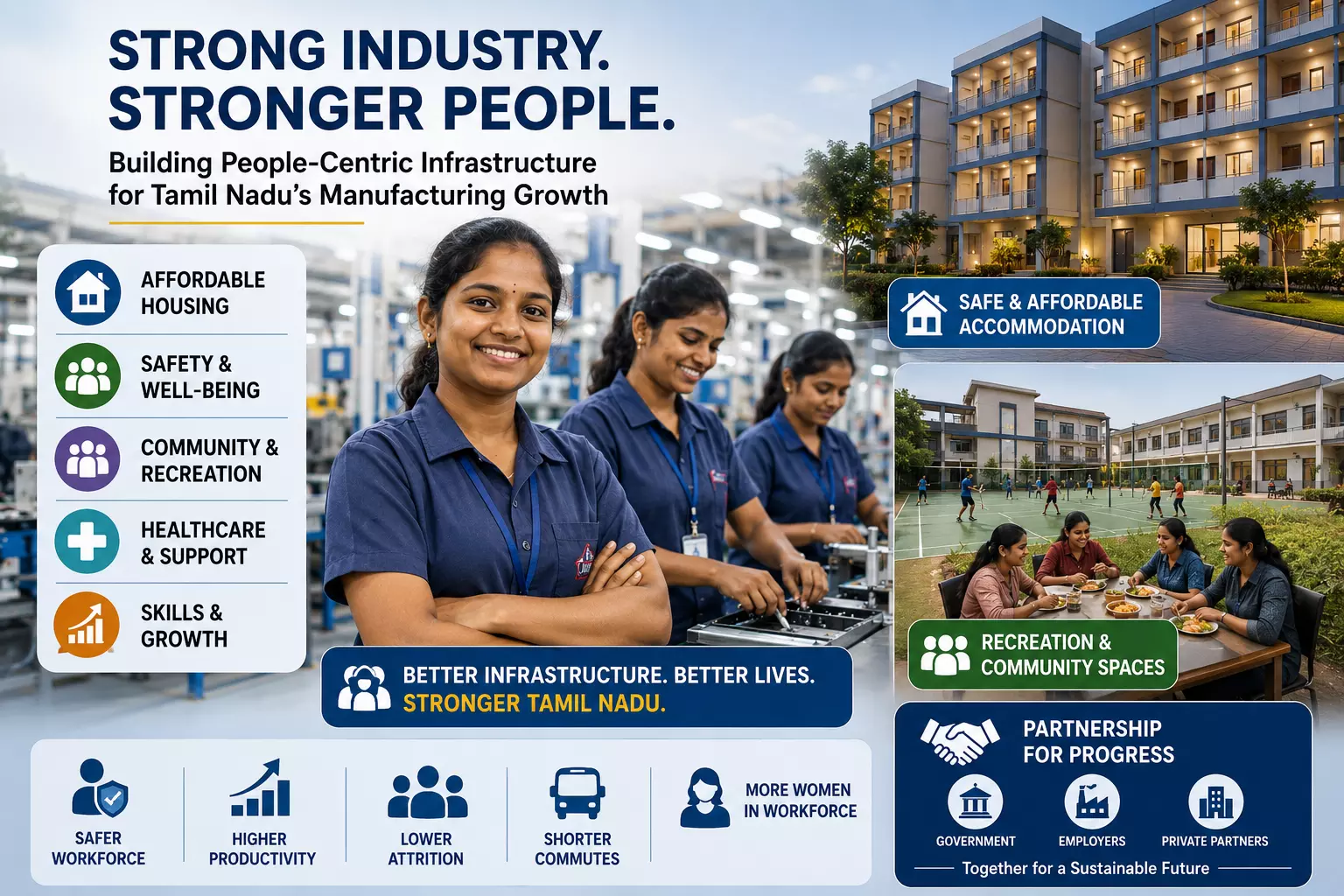
CHENNAI: As Tamil Nadu emerges as one of the country’s leading manufacturing destinations, the private sector is being called upon to play a larger role in creating affordable accommodation, recreation and community facilities for the growing force of guest workers, particularly women, in industrial corridors.
With manufacturing companies across Chennai, Sriperumbudur, Oragadam, Hosur, Coimbatore and Tiruppur increasingly depending on women workers from other states and districts, the availability of decent housing and social infrastructure has emerged as an important factor in attracting and retaining labour.
Industry experts say companies cannot look at workers merely as a source of manpower while leaving accommodation and other essential facilities entirely to governments or individual employers. They argue that a new ecosystem of private workforce infrastructure could ease the pressure on manufacturing companies while providing migrant workers with safer and more affordable living conditions close to their workplaces.
“India’s manufacturing ambitions cannot be achieved by building factories alone. The next decade of manufacturing growth will depend on our ability to build and retain a stable force of guest workers, especially women. Migration is no longer a temporary phenomenon; it is becoming fundamental to India’s industrial growth. We believe workforce infrastructure will become as important as factory infrastructure,” said Sachin Chhabra, co-founder and CEO, Nia.one.
He said the private sector had a major role to play in creating an ecosystem that would provide migrant workers not just accommodation but also a sense of security, community and financial stability.
“By creating continuity, belonging and financial stability for guest workers, we can help manufacturers improve productivity while making migration truly worthwhile for the people who power India’s economy,” he said.
Nia.one has been developing ‘Sram Parks’ in industrial corridors across India, with plans to establish around 80 such facilities. The company is also looking to expand its presence in Tamil Nadu, particularly in the Coimbatore, Chennai, Tiruppur and Hosur industrial belts.
“In the Sriperumbudur-Chennai belt, we have plans to establish at least five Sram Parks. The first one has already been opened in Oragadam,” said Chhabra.
According to him, such facilities could become integrated hubs for guest workers, providing accommodation and other essential services at subsidised rates.
“The government or individual employers alone cannot provide accommodation for hundreds or thousands of workers. Such facilities require a larger ecosystem. Sram Parks can ease the pressure on the management of major manufacturing companies in industrial corridors while also making it easier for women to join and remain in the industrial workforce,” he said.
The need is particularly acute for women guest workers, for whom accommodation is closely linked to safety, mobility and the decision to take up employment away from their hometowns.
A large number of women employed in electronics, textiles, garments and other manufacturing operations are young workers who require affordable and secure accommodation close to their workplaces. Industry observers say the absence of such facilities can discourage women from taking up jobs involving shift work or force them to depend on informal and often expensive housing arrangements.
Beyond accommodation, recreation and community facilities can also play an important role in worker retention. Sports facilities, common areas, healthcare services, childcare, banking and financial services, food outlets and skill-development centres can help create a more supportive environment for guest workers who live away from their families.
Ramya Sampath, chief human resources officer, Saint-Gobain India, acknowledged the rapidly increasing participation of women in the industrial workforce and said companies were under growing pressure to create safer and more supportive workplaces.
“Every management faces pressure to provide a better working environment for employees, particularly as the number of women workers is increasing rapidly. Tamil Nadu’s industries have set an example by developing mechanisms to address women’s concerns at the workplace, including through women’s safety measures,” she said.
She said Saint-Gobain had given special attention to women’s safety by establishing monitoring committees and complaint-redressal mechanisms.
“Accommodation is an important issue for women workers. This is an area where private players can play a crucial role in attracting more women into the workforce. Safe and affordable accommodation close to industrial clusters can give women and their families greater confidence when they take up employment away from their homes,” she said.
The issue assumes greater significance as Tamil Nadu moves towards higher-value manufacturing in sectors such as electronics, electric vehicles, automobiles and advanced engineering. As industrial clusters expand, the demand for workers is expected to grow, putting additional pressure on housing and civic infrastructure around manufacturing hubs.
Industry leaders believe a partnership between the government, employers and private infrastructure providers could offer a more sustainable solution. While the government can facilitate land, connectivity and basic infrastructure, employers can contribute towards worker welfare, and private operators can develop and manage dedicated accommodation and recreation facilities.
Such a model could also benefit manufacturers by reducing employee attrition and absenteeism. Workers living closer to factories would have shorter commutes while companies could potentially reduce the cost and logistical burden of arranging individual accommodation and transportation.
For women workers, in particular, proximity to the workplace could make shift-based employment more feasible. Access to secure accommodation, transport, childcare and recreational facilities could also encourage more families to allow women to migrate for employment.
The growing workforce of guest workers, therefore, presents Tamil Nadu with both an opportunity and a responsibility. The state’s industrial competitiveness will increasingly depend not only on how quickly factories can be established but also on how effectively the workforce required to operate them can be housed, supported and retained.
