Allies or Rivals? Why VCK is Pushing for DMK-TVK Unity Against BJP

Thirumavalavan, a leader at the forefront of fight against communal violence and anti-caste movement in Tamil Nadu, suggested that a united front at national level similar to the Kerala or West Bengal model is needed in Tamil Nadu as well, to build a national alliance against the BJP and its communal politics
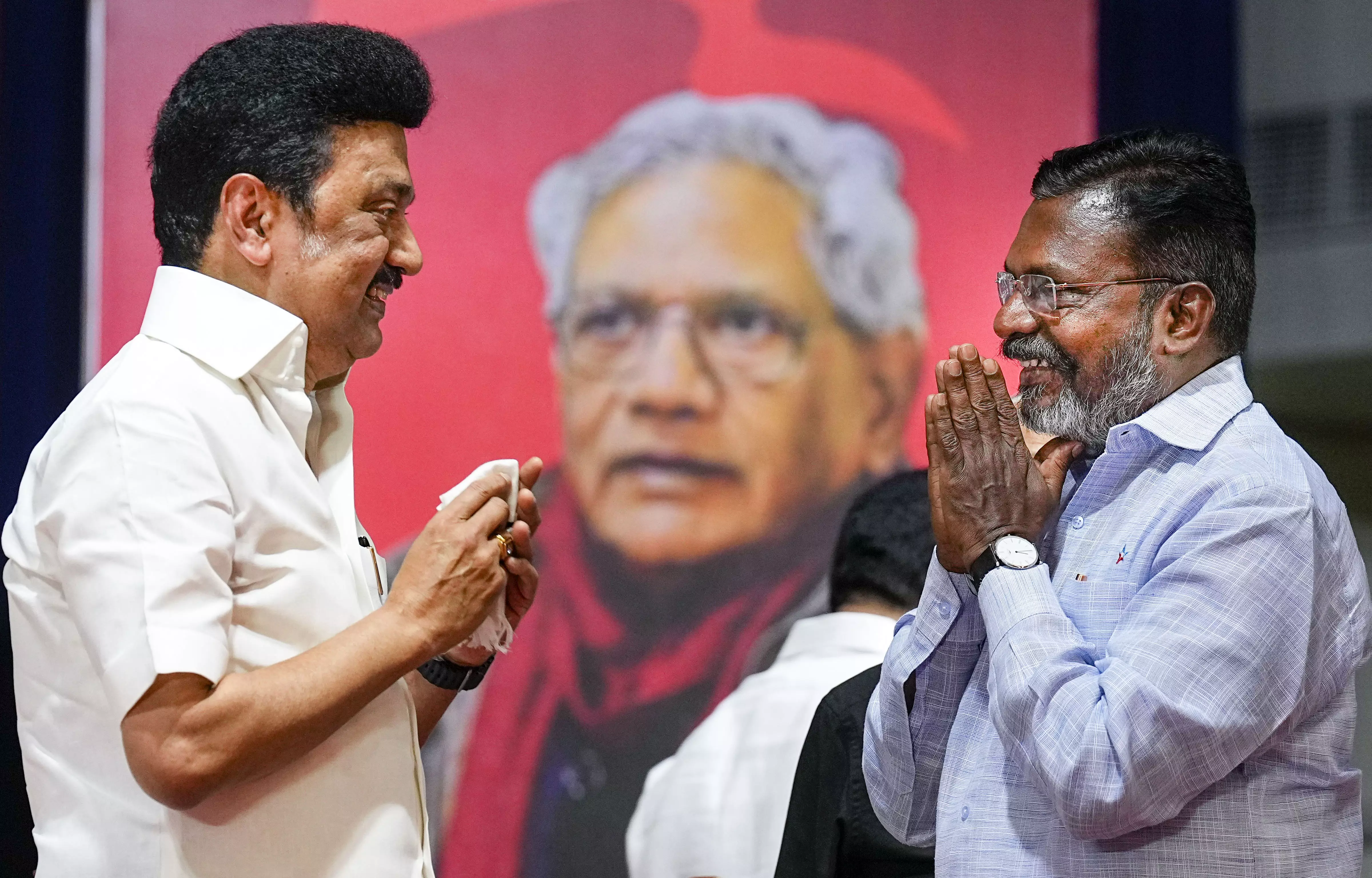
Chennai: With its ties with the DMK coming under strain following Viduthalai Chiruthaigal Katchi(VCK)'s decision to join the newly formed Tamilaga Vettri Kazhagam (TVK) government in Tamil Nadu, VCK chief Thol Thirumavalavan has pitched for a collaboration between the Dravidian major and Chief Minister C Joseph Vijay-led TVK against the BJP at the Centre.
Thirumavalavan, a leader at the forefront of fight against communal violence and anti-caste movement in Tamil Nadu, suggested that a united front at national level similar to the Kerala or West Bengal model is needed in Tamil Nadu as well, to build a national alliance against the BJP and its communal politics.
DMK, short for Dravida Munnetra Kazhagam, a party founded in the Dravidian movement originated in Tamil heartland, has rejected the idea. TVK's political campaigning for the 2026 state Assembly elections were entirely based on anti-DMK rhetoric, along with the kind of welfare-focused promises AIADMK leader MGR espoused.
As TVK went on to win the election and form the government, several parties, including VCK and Congress, which were in alliance with the ruling DMK till then, had announced conditional alliance with the Vijay-led debutante party.
Though the VCK has not officially announced severing its relationship with the DMK, a friction arose between the two parties after the DMK's allies one after the other joined the TVK government, while the left parties extended unconditional support, following DMK's defeat in the April Assembly election.
VCK's Arguements
The ideological debate, however, developed into an open political slugfest with Thirumavalavan on Sunday training his guns on the DMK.
While speaking in Tiruvannamalai and Dharmapuri, he accused the M K Stalin-led DMK of "bad handling" its allies and went to the extent of saying that the DMK had refused to give a share in power and this was the reason for its electoral setback.
"Had the DMK announced that it was ready for a coalition government and had respected the sentiments of its allies by giving them a satisfactory number of seats and constituencies they had asked for, then it might not have suffered such a major setback," the VCK chief said.
He also accused the DMK of "poaching" former VCK legislator Panaiyur Babu in a bid to weaken the Dalit dominated party. "It was done to weaken our party. Even if some VCK functionaries had voluntarily approached the DMK, they should have been turned away. That is political ethics," Thirumavalavan charged.
While speaking in Thanjavur, Thirumavalavan expressed deep concern that the future of Dravidian politics is becoming questionable as the DMK is being isolated and the AIADMK is fracturing. This weakness in regional leadership is being exploited by external forces, specifically the BJP and RSS, which he believes are attempting to gain a foothold in Tamil Nadu by masking their true identity, he argued.
He warned that if these regional parties continue to fail as a strong opposition, it could lead to a political environment similar to Delhi or West Bengal, where ruling powers were eventually undermined or dismantled after being weakened.
"Political parties should be vigilant against the BJP because they are attempting to enter Tamil Nadu politics by wearing a mask or adopting the face of the RSS. If the BJP were to enter with its own genuine identity, it would not be successful in the state," he said.
In Sattur, Virudhunagar district in the state, VCK leader Vanni Arasu justified Thirumavalavan's suggestion, saying the BJP used breakaway groups to manage dissent before eventually absorbing them, and cited that Keshubhai Patel, who served as the Chief Minister of Gujarat, left the BJP following internal conflicts, formed the 'Gujarat Parivartan Party', but later returned to the BJP in 2014.
Uma Bharti left the BJP due to differences of opinion and formed the 'Bharatiya Janshakti Party' to oppose them. She eventually returned to the BJP in 2014 and subsequently served as a Union Minister, he said.
He labelled K Annamalai's 'We the Leaders' as "proxy" for the BJP and claimed that the saffron party was a "malicious force" that acts against the Indian Constitution and the interests of the people.
DMK's response
The DMK, however, refused stating that its leadership will not accept the Viduthalai Chiruthaigal Katchi's proposal.
DMK MP Ganapathy Rajkumar argued that the split-alliance model cannot work in Tamil Nadu and that his party remains firm that it will not share a platform with the TVK that has declared the DMK as a primary political foe.
"In the front, both the DMK and TVK should find a place," the VCK chief had said while speaking to reporters in Ariyalur, recently.
