A Bright Yesterday, a Brighter Tomorrow: CM Stalin

Chief Minister M.K. Stalin projects an alluring picture of economic development and an equitable society in this exclusive e-mail interview to
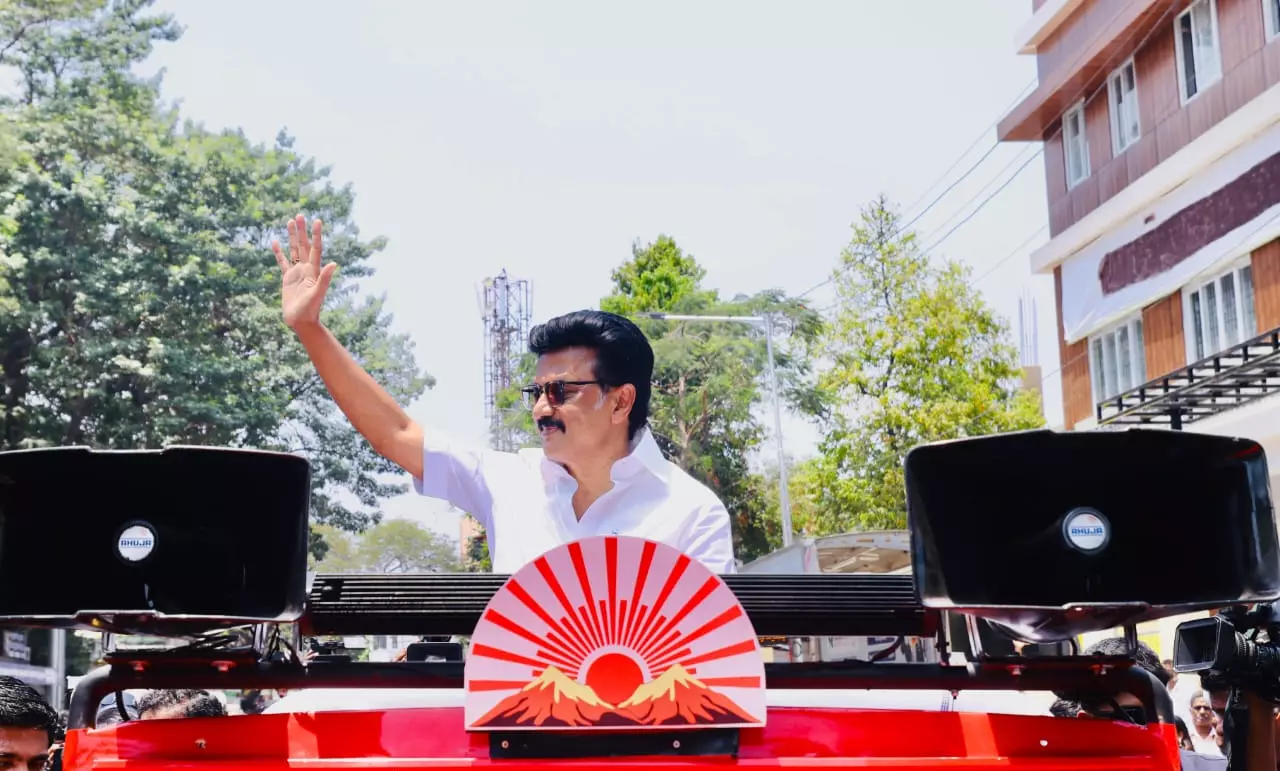
Senior Editor B. Vijayalakshmi. Excerpts from the interview:
Looking ahead, what is your long-term vision for Tamil Nadu’s development over the next decade?
Our primary objective is to transform Tamil Nadu into a one- trillion-dollar economy by the year 2030. To achieve this goal, numerous economic initiatives are being undertaken under the ‘Dravidian Model’ of governance. We released the ‘Vision 2030’ report, which outlines a structured roadmap for achieving our long-term goals. Through Global Investors Meets (GIM) and foreign delegations, we could attract investments exceeding Rs 12 lakh crore. Under ‘Vision 2030’ significant investments are being drawn into the electronics, automotive components, information technology, footwear, and textile sectors. We have set targets such as attracting investments worth approximately Rs 18 lakh crore, boosting exports to $120 billion, and creating 50 lakh new jobs through industrial and infrastructure expansion.
A plan will be implemented to transform Tamil Nadu into one of the world’s top 20 startup hubs by the year 2035. We have set a goal for Tamil Nadu to emerge as a global hub for electric vehicles (EVs), semiconductor manufacturing and electronics production. This vision extends far beyond mere investment and economics. It has been designed to be implemented across all sectors, encompassing education, human resource development, skill enhancement, rural and urban development, the promotion of renewable energy usage, climate change mitigation and modern water management.
We have asserted that it is women who will take the lead in achieving this objective. Just as Tamil Nadu’s economy and industrial growth have scaled new heights under the Dravidian Model’ government, the state will attain an economic standing on a par with global nations within the next decade. Our triumphant journey towards that goal will continue.
With the push for 33 per cent reservation for women in politics, how is your party preparing to empower more women leaders?
The DMK has always been at the forefront of women’s empowerment. Through initiatives such as the ‘Kalaignar Magalir Urimai Thogai’ scheme, which provides a monthly financial assistance of ₹1,000 to women, and the ‘Vidiyal Payana Thittam’ which enables women to travel free of cost on government city buses, we have reduced women’s financial burdens and enhanced their social participation. We are implementing social security schemes for the advancement of women — such as the formation of Women Self-Help Groups, the ‘Pudhumai Penn Scheme’, the promotion of women’s education, the Girl Child Protection Scheme and the Marriage Assistance Scheme.
To ensure equal opportunity for women in employment, it was during Kalaignar’s tenure, specifically in 1989, that the DMK government introduced a 30 per cent reservation for women in government jobs. During my administration, we raised this reservation to 40 per cent. In 1989, the DMK enacted legislation granting women equal rights to ancestral property. Furthermore, without any gender discrimination, we appointed women as temple priests and ‘Oduvars’.
Opportunities have been extended to women even in key positions, such as that of Corporation Mayors. Within the party itself, internal regulations mandating representation for women in party posts are being duly adhered to.
Furthermore, the DMK has consistently championed the cause of providing 33 per cent reservation for women in Parliament and State Legislative Assemblies; treating this as a core policy objective, the party has persistently pressed this demand across various stages and through numerous protests. I wish to state that the Dravida Munnetra Kazhagam is, and has always been a movement that upholds women’s rights.
How do you balance experience and youth when assigning responsibilities within the party?
A careful examination of the candidate list released by the DMK will provide the answer to your question. You will perceive a balance struck between experience and youth. We
have accorded equal importance to both experience and youth. Out of a total of 164 party candidates, approximately 60 are new faces; this constitutes more than one-third of the total candidates. To prioritise the youth and the educated, we have fielded 15 doctors, 17 engineers, 29 lawyers, and 7 Ph.D. holders as candidates.
Among the total number of candidates, 18 are women — a selection that honours the principle of women’s rights. The DMK boasts a cadre of over 1.6 million functionaries. I have personally met and interviewed every individual who sought a nomination to contest in the elections. Among them are both youth and veterans. I am well aware that it is the firm conviction of every DMK cadre that I am fulfilling my duties faithfully — walking the path shown by Kalaignar — as a leader who embraces and carries everyone along.
With rising competition from other states, what are your plans to ensure Tamil Nadu remains an industrial and investment hub?
Tamil Nadu occupies an unshakeable position on India’’s economic map. In terms of Gross State Domestic Product (GSDP), Tamil Nadu stands as India’s second-largest economy, following Maharashtra. Tamil Nadu is the only state in India to have achieved a double-digit growth rate.
With a growth rate of 11.19 per cent — as reported by the Union government — Tamil Nadu stands as one of the fastest-growing states in the country. Tamil Nadu ranks first among all states in India in terms of the highest number of factories. Chennai, known as the ‘Detroit of India’, along with other parts of the state, holds the leading position in automobile manufacturing. Surpassing Gujarat and Maharashtra, Tamil Nadu currently ranks first in India in textile exports. Tamil Nadu also holds the top position in the export of electronic goods. In terms of India’s overall exports, Tamil Nadu ranks third. Tamil Nadu’s per capita income stands at approximately ₹3.62 lakh, which is 1.77 times higher than the national average. Among large states, Tamil Nadu ranks third in terms of per capita income. Tamil Nadu consistently ranks at the forefront in the Social Progress Index and across various indices of NITI Aayog. Tamil Nadu achieved all these accomplishments amidst fierce competition from other states. The state continues to stand out as a hub for industry and investment. This trend will continue!
Your government has emphasised social justice: How do you plan to deepen its impact in the coming years?
The Dravida Munnetra Kazhagam (DMK) movement itself was founded upon the bedrock principle of social justice. The Dravida Munnetra Kazhagam was the pioneering movement that first implemented the 69 per cent reservation policy in Tamil Nadu for Backward Classes, Most Backward Classes, Adi Dravidars and Tribal communities.
It was Kalaignar who sowed the seeds for this initiative. The DMK government constituted a dedicated committee specifically to monitor whether the social justice schemes implemented by the Government of Tamil Nadu are effectively reaching the people. It was the DMK government that, for the first time in India, established a separate ministry dedicated to the welfare of Backward Classes and Minorities. Do you know why we refer to our governance style as the ‘Dravidian Model’. It is precisely because the DMK government consistently champions inclusive growth and social justice as its defining identity. To further reinforce the impact of social justice, and guided by the visionary outlook of ‘Dravidian Model’ the DMK government has formulated various new schemes aimed at education, employment and the upliftment of marginalised communities. As these are implemented — Tamil Nadu will, as always, stand as a guiding light for social justice to India!
You’ve taken strong positions against the Centre. Where do you draw the line between federal assertion and political confrontation?
I am someone who clearly understands the dividing line between ‘governance’ and ‘politics’. Similarly, through its policy stances, the DMK very clearly delineates the boundary between fighting for federal rights and engaging in unnecessary political confrontation with the Union government. Our guiding mantra — ‘Autonomy for the State; Federalism at the Centre’ — is itself founded upon this very distinction.
We are pursuing our struggle strictly within the framework of the Constitution. It has never been our objective to be in confrontation with the Union government. The DMK’s goal is to safeguard the powers vested in the states by the Constitution. Any interference by Governors in the functioning of the state government constitutes an encroachment upon the state’s right to autonomy. The Constitution explicitly stipulates that a Governor cannot run a parallel administration alongside a government elected by the people. The Supreme Court, too, has upheld this stance — firmly placing the onus upon the Governors. How, then, can this be construed as a conflict between the Union government and the state government?
The DMK will never accept, nor will it stand idle and watch Governors overstep their authority and interfere in state affairs, be it in Tamil Nadu or in any other state. Why, even when we were in the Opposition, we fought for it. That is the concern we demonstrate — going beyond mere state autonomy — for the Constitution itself! The DMK’s opposition regarding issues such as fiscal devolution (like GST), educational interventions (like the Neet) and the imposition of Hindi is not merely a political confrontation; it centers on the fundamental rights and welfare of the people of the state. We never compromise on these matters.
It is the DMK’s fundamental principle that a state can progress — and remain strong — only if it possesses fiscal autonomy and administrative freedom; and, consequently, India itself will emerge as a stronger nation. We are conducting protests precisely to uphold that principle. For issues such as the Governor delaying bills, we are approaching the Supreme Court to seek legal remedies. How can a matter that is fundamentally democratic and legal in nature be viewed as a political conflict?
What role do you see Tamil Nadu playing in shaping India’s economic and political future?
Tamil Nadu accounts for merely 4 per cent of India's land area and 6 per cent of its population. However, it contributes approximately 9.4 per cent to India’s Gross Domestic Product
(GDP). This fact alone demonstrates that Tamil Nadu serves as a key growth engine in shaping India’s economic and political future. As Tamil Nadu rises to become a $1 trillion economy by 2030, India’s economy will also grow. In terms of its political future, Tamil Nadu will emerge as a unique and powerful political force within the framework of Indian federalism. Tamil Nadu’s policies — such as inclusive growth, social justice, and women’s empowerment — are regarded as a model for India as a whole. Taking the lead in debates concerning fiscal autonomy and state rights, Tamil Nadu is poised to play a pivotal role in redefining Union-State relations. With a higher education enrollment rate that is double the national average, Tamil Nadu possesses the potential to spearhead India’s knowledge economy. Through a robust industrial infrastructure, high-quality human resources and egalitarian policies, Tamil Nadu will serve as the focal point determining India’s future growth.
How do you envision the future of your party in a rapidly changing political landscape?
The future will be bright only if the past and the present are sound. Look back at the past: the 2019 parliamentary elections, the by-elections held in 22 Assembly constituencies in 2019, the rural local body elections of 2019, the 2021 Assembly elections, the rural local body elections held in 9 districts in 2021, the urban local body elections of 2022, the Erode East by-election and the 2024 parliamentary elections — the DMK has been securing a continuous streak of victories across all these polls. We have achieved this remarkable feat even amidst shifting political landscapes.
The parties that formed the alliance under the leadership of the DMK in 2018 have continued to journey alongside us. For the 2026 Assembly elections, several additional parties have joined our fold. After five years of governance, we face no anti-incumbency sentiment; rather, a wave of pro-incumbency is sweeping across the state today. The ‘Dravidian Model’ will take shape, and the DMK will return to power for a second consecutive term!
What steps are being taken to ensure the party remains relevant to younger voters?
All voters, including young voters, are favourably disposed towards us. I reiterate what I stated at Kalaignar’s memorial on the day the 2021 election results were announced: “Those who voted for us will certainly rejoice; and those who did not will undoubtedly regret their decision, wondering why they failed to cast their vote for us — such will be the caliber of our work.” Over the past five years of our administration, we have proven this to be true. “I regret not having voted for the
DMK. In this election, I will cast my vote for the DMK” — a video featuring someone expressing these sentiments recently went viral. Such is the current reality.
To this extent, the ‘Dravidian Model’ of governance has captivated people from all walks of life. For the younger generation, we have implemented initiatives such as the ‘Naan Mudhalvan’ scheme, ‘Pudhumai Penn’ and the ‘Tamil Pudhalvan‘ scheme. We are also distributing laptops to college students. The magnificent libraries we have established today serve as vital hubs for young people preparing for competitive examinations. This is a government that has successfully
implemented exemplary schemes dedicated to the welfare of the youth. Simultaneously — and regarding the party itself — we ensure that young orators are accorded platform opportunities on s
par with our senior leaders, and we regularly organize grassroots-level forums and youth wing conferences. I witness tangible proof that the DMK stands as a massive movement capable of captivating the youth — not only during my campaign aboard the Chennai Metro but also in the smiling faces of the young crowds that gather around me as I canvass for votes across various parts of the state!
What qualities do you believe young political leaders must have to succeed today?
We must go out to the people. We must work tirelessly for their sake.
