9-judge SC Bench to Hear Sabarimala Women Entry Case From April 7

16 Feb 2026 12:36 PM IST16 Feb 2026 12:36 PM IST
The court directed that parties supporting the review be heard from April 7 to April 9, those opposing it from April 14 to April 16, and rejoinder submissions on April 21
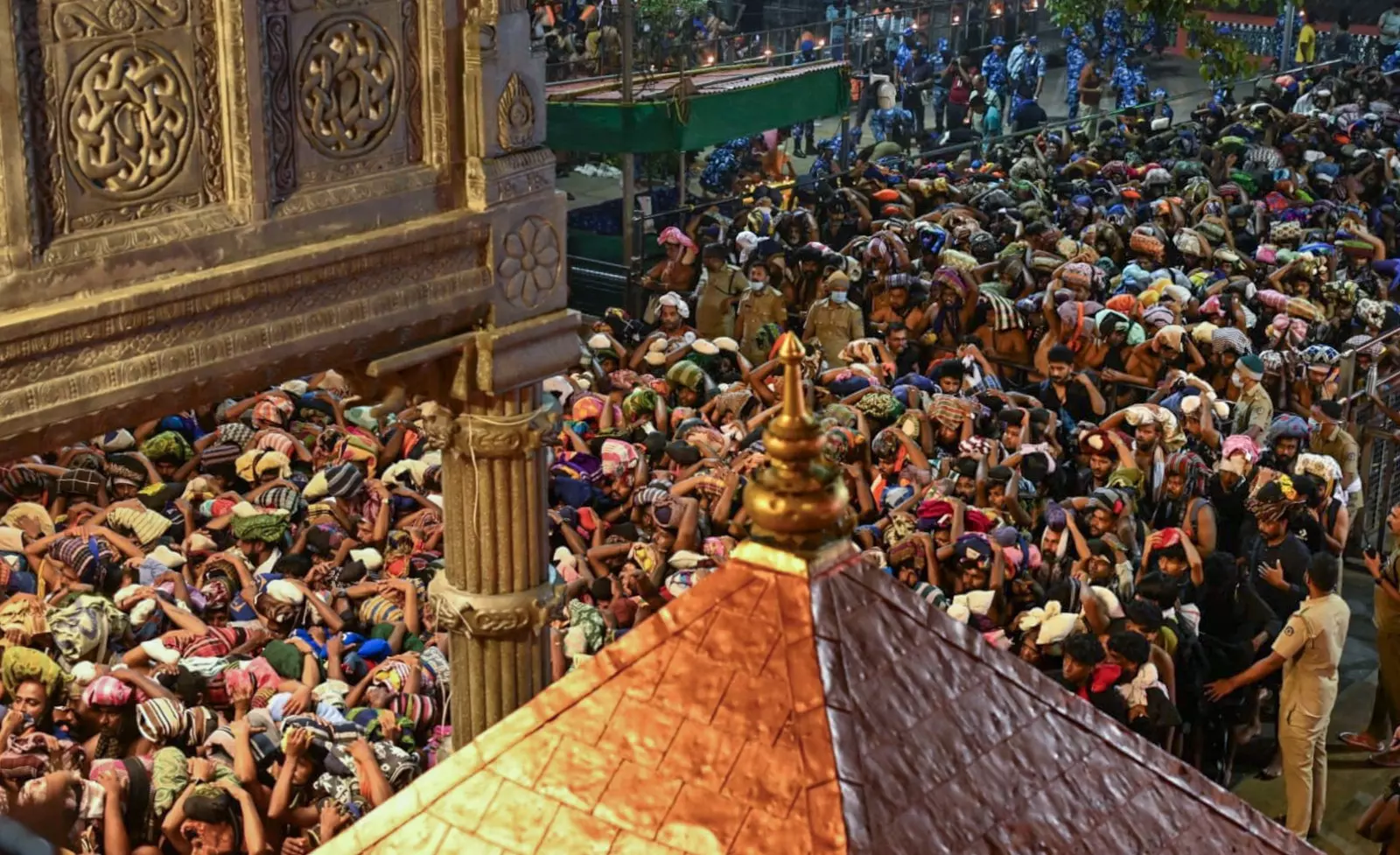
Rush of people to offer prayers at the Sabarimala temple. (PTI)
New Delhi: The Supreme Court on Monday said a nine-judge Bench will start hearing review petitions in the Sabarimala temple entry case from April 7, 2026.
A three-judge Bench comprising Chief Justice of India Surya Kant and Justices Joymalya Bagchi and Vipul M. Pancholi said the composition of the larger Bench would be notified separately through an administrative order.
Solicitor General Tushar Mehta, appearing for the Centre and some states, informed the court, “We are supporting the review. It needs to be reviewed…”.
The court directed that parties supporting the review be heard from April 7 to April 9, those opposing it from April 14 to April 16, and rejoinder submissions on April 21. Final submissions by the amicus are expected to conclude by April 22. Written submissions have to be filed on or before March 14.
The court appointed Krishna Kumar Singh as nodal counsel for parties supporting the review and Shashwati Pari for those opposing it. Senior advocate K. Parameshwar, along with Shivam Singh, was appointed amicus curiae.
The review arises from the September 28, 2018 judgment of a five-judge Bench, which by a 4:1 majority lifted age restrictions on women’s entry to the Sabarimala temple and struck down Rule 3(b) of the Kerala Hindu Places of Public Worship Rules, 1965. In November 2019, a 3:2 verdict kept the review petitions pending and referred broader questions relating to religious freedom to a larger Bench.
Apart from the Sabarimala issue, the nine-judge Bench will also consider petitions concerning entry of Muslim women into mosques, female genital mutilation in the Dawoodi Bohra community and entry of Parsi women married outside the community into fire temples.
The court framed seven broad questions, including the scope of the right to freedom of religion under Article 25, the interplay between Articles 25 and 26, the extent of judicial review in matters of religious practice, the meaning of “morality” under Articles 25 and 26, the expression “sections of Hindus” in Article 25(2)(b), and whether a person not belonging to a denomination can challenge its practices through a public interest litigation.
The Bench said the larger Bench would examine these issues to evolve a judicial policy in matters relating to freedom of religion.
( Source : Deccan Chronicle )

Next Story