Kerala’s “Gentle Giant” Lost: Majestic Tusker “Chillikomban” Drowns in Canal

Well-known wild elephant trapped in strong currents, carcass recovered near Thirumoorthy Dam
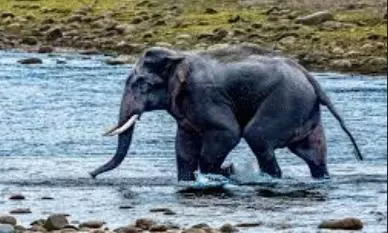
Thiruvananthapuram: ‘Chillikomban’, a well-known wild elephant that roamed the Nelliampathi hills in Kerala, died after being swept away by strong currents in the contour canal of the Parambikulam Aliyar Project (PAP) in Coimbatore district on Saturday.
The tusker became trapped in the PAP contour canal in the Pachathannir forest beat, under the Sethumadai east section of the Pollachi forest range in the Anamalai Tiger Reserve (ATR), around 4 p.m., reportedly while trying to drink water.
Forest Department staff rushed to the scene and found it struggling to breathe in the 20-foot-deep canal amid the strong currents. Rescue efforts with an excavator failed due to its weight and the force of the water.
The elephant was swept away by the strong current, and its carcass was found at the Thirumoorthy Dam on Sunday. Known for its gentle nature, the tusker lived peacefully among the people of the Nelliampathi region and would often wander into Tamil Nadu during musth before returning to its home territory.
The Tamil people named the elephant Sullikomban, meaning “elephant with slender tusks.” This gentle giant loved jackfruit and mangoes, and there were no reported incidents of Sullikomban attacking locals.
Known as a favourite among elephant lovers in Kerala, he earned the name Chillikomban because his tusks resembled reeds. Occasionally wandering into populated areas, he never caused trouble, which made him even more beloved. In the Nelliampathi hills, locals affectionately called him Chillikomban for his distinctive, chilli-shaped tusks and cherished him for his gentle nature and peaceful coexistence with nearby communities.
Kerala’s wildlife lore is filled with tales of iconic wild elephants like Chillikomban, Arikomban of Idukki, and Kabini Komban near Wayanad, each remembered for their unique traits, temperaments, and the way they shaped human-elephant relationships in the region.
Arikomban, known as the “Rice Tusker,” earned his name for raiding ration shops and houses for rice in the Chinnakanal area of Idukki. It had created a scare in the region on several occasions, forcing forest officials to relocate it multiple times.
Kabini Komban, a massive tusker, was often sighted near the Kabini and Wayanad forests.
Human elephant conflicts
Human-elephant conflicts are on the rise in Kerala, driven by the state’s unique mix of dense forests and human settlements.
Nine districts are facing frequent wild elephant attacks, with Wayanad, Idukki, Palakkad, Kannur, and Malappuram being the worst affected, accounting for over 70% of cases. Between 2020 and September 2025, these incidents have led to 111 human deaths and 1,500 injuries.
Kerala is home to an estimated 2,785 elephants, the fourth-highest among states, with a density of about 0.3 to 0.5 elephants per sq km in key habitats like the Periyar Tiger Reserve and the Annamalai-Parambikulam landscapes.