Kerala CM Vijayan Criticizes Centre's Labour Policies, Calls For Resistance

Through the labour policies govt is minimising workers' rights and prioritising corporate interests : Kerala CM P Vijayan
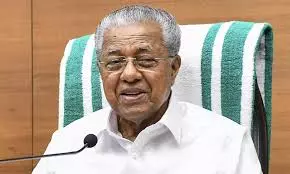
Thiruvananthapuram : Kerala Chief Minister Pinarayi Vijayan on Friday said the central government, through its labour policies is minimising workers' rights and prioritising corporate interests.
He was speaking at the Labour Conclave organised by the state government here against the newly introduced labour code by the Centre.
Vijayan said that the world around us is changing rapidly, with shifts in technology and production methods, but raised the question of who these changes are meant to benefit.
"Are these changes aimed at improving the living conditions of the common people, who form the majority, or at increasing the profits of a minority of corporates?" he asked.
The Chief Minister said the rights of the labour force are being minimised and priority is being given to corporate interests through the policies of the central government.
"It is the duty of a responsible society to express its dissent on this matter in a rational and democratic manner", he said.
Vijayan said his government realises that development models which do not ensure job security and social welfare are not sustainable.
"Development should not be limited to production or corporate profit figures. It should be assessed based on changes in people's living standards. A welfare-based economy defines our development approach," he said.
He said labour laws and rights were not granted at the mercy of any government and were not handed over on a platter.
"We should not forget the historical truth that these rights were earned through blood and sweat as part of anti-colonial movements and prolonged agrarian struggles," he said.
Citing labour agitations in Bombay, Kolkata, Kanpur, Ahmedabad and Kerala, Vijayan said labour movements across India were integral to the freedom struggle.
"These agitations were anti-colonial in nature and had strong political content. That political awareness should give us strength today," he said.
The Chief Minister said labour laws framed after Independence were aligned with the socialist vision enshrined in the Preamble of the Indian Constitution and the concept of a welfare state.
These included the eight-hour workday, minimum wages, bonus, ESI and PF, all of which were achieved through collective struggle, dialogue and legal battles.
Acts such as the Industrial Disputes Act, Factories Act and Minimum Wages Act did not view labour merely as a means of production but recognised workers as citizens with rights, he said.
"These laws, to an extent, placed checks on the limitless profit motives of capitalism and enabled a fairer distribution of economic benefits," Vijayan said.
However, he said the globalisation drive of the 1990s brought structural changes to the labour sector, which were later aggressively implemented by successive governments.
"The laws gradually shifted from protecting citizens to facilitating business interests. This began to adversely affect the lives and rights of workers," he said.
He criticised the sale of shares in public sector undertakings and initiatives such as the National Monetisation Pipeline, saying they led to the privatisation of public wealth.
"We have seen even profit-making PSUs being sold," he said. Vijayan said permanent employment was being replaced by contract jobs, creating insecurity in the labour sector.
"The principle of equal pay for equal work has been discarded. Wage disparities under contract systems have become common," he said, adding that this approach culminated in the introduction of four new labour codes by the Centre.
There is widespread criticism that instead of simplifying labour laws, the new codes dilute labour protections, he said.
"As trade unions have pointed out, under the guise of consolidating 29 labour laws, labour security is being systematically dismantled. This must be viewed seriously," he said.
The Chief Minister said the labour codes were passed in Parliament without adequate discussion with the opposition.
"This itself indicates the intention behind them. It is a planned move to bring the labour sector under corporate control," he said.
Referring to the Industrial Relations Code, Vijayan said the threshold for government permission to lay off workers or shut down establishments had been raised from 100 to 300 employees.
"This means that around 90 per cent of factories and industries can lay off workers without government approval," he said.
He alleged that the new provisions effectively legalise 'the hire and fire' policy, allowing employers to dismiss workers at will. He said the proposed wage board mechanism could undermine minimum wage norms.
Vijayan also criticised provisions that allow the extension of working hours from eight to nine hours, while excluding break time from those hours. While the Social Security Code claims to cover all workers, in practice, it would weaken existing mechanisms.
It will not ensure social security for unorganised labourers and gig workers, he said. According to Vijayan, the new labour laws are anti-worker and would erode the country's worker-friendly environment.
"We have to resist this. Upholding constitutional values and building united democratic resistance, including workers and farmers, has become essential," he said.
Calling it a movement for the future, Vijayan said it was not limited to any particular section.
"This is for future generations and for the survival of India as a democratic republic. History always stands with those who fight. That spirit of resistance must be imbibed as we unite against the corporate-communal alliance," he said.
