Credits Indian tech for success, says India fastest growing major economy
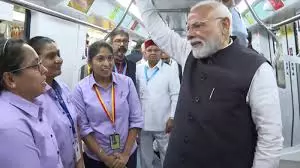
BENGALURU, NEW DELHI: Prime Minister Narendra Modi on Sunday said that Indian technology and the Make in India initiative were key to the success of Operation Sindoor, which, he asserted, brought Pakistan to its knees within a few hours. Speaking after inaugurating and laying the foundation stone for Bengaluru Metro Rail Phase-3 projects worth around ₹15,619 crore, and flagging off 3 Vande Bharat Express trains and inaugurating the Metro Rail Yellow line, worth about Rs 7,160 crore, he said the world witnessed a “new face” of India during the operation, when the country demonstrated its ability to destroy terror hubs deep inside Pakistan.
“The world has seen for the first time India’s new face during Operation Sindoor, where the Indian military demonstrated the ability to destroy terror hubs by targeting them deep inside Pakistan and bringing Pakistan to its knees within a few hours,” Modi said. He acknowledged the significant contribution of the youth of Bengaluru and Karnataka to this achievement and congratulated them for their role in the success.
He dedicated 19.15-km metro route of Bangalore Metro popularly known as Namma Metro.
“India is currently the fastest-growing major economy in the world. In the past 11 years, India’s economy has risen from the 10th position to the top five globally, and is rapidly progressing toward becoming one of the top three economies,” he said.
The Prime Minister also flagged off three Vande Bharat Express trains from Bengaluru, connecting Bengaluru to Belagavi, Amritsar to Sri Mata Vaishno Devi Katra, and Nagpur (Ajni) to Pune. He said these high-speed trains would enhance regional connectivity, reduce travel time, and offer passengers a world-class travel experience.
Noting that Bengaluru is now recognised alongside major global cities, Modi stressed that India must not only compete globally but also lead. He said progress would come only when cities are “smart, fast, and efficient,” underscoring the government’s strong focus on completing modern infrastructure projects.
Modi attributed this momentum to the spirit of “Reform, Perform, and Transform,” driven by clear intent and honest efforts. Recalling that in 2014, metro services were limited to just five cities, he said, “Today, metro networks span over 1,000 km across 24 cities, making India the third-largest metro network globally.”
Before 2014, only about 20,000 km of railway routes had been electrified, he noted, whereas in the last 11 years alone, more than 40,000 km have been electrified.
Highlighting advances in multiple sectors, he said that in 2014 India had only 74 airports, compared to over 160 today. Operational national waterways have risen from three in 2014 to 30 now. In the health and education sectors, the number of AIIMS has increased from seven to 22, and medical colleges from 387 to 704, adding over one lakh new medical seats. The number of IITs has grown from 16 to 23, IIITs from nine to 25, and IIMs from 13 to 21.
The Prime Minister said that as the nation progresses rapidly, the lives of the poor and marginalised are transforming at the same pace. Under the Pradhan Mantri Awas Yojana, over four crore pucca houses have been provided, and the government now aims to construct three crore more. In the last 11 years, over 12 crore toilets have been built, improving dignity, cleanliness, and safety for crores of women.
The Prime Minister expressed happiness over digital transactions happening in the country now and people in villages have access to digital transactions. The country records nearly 50 percent of the UPI transactions of the total UPI transactions going on globally.
“India is emerging as a global artificial intelligence leader,” Modi said and stated ‘semi-conductor is also gaining momentum.”
On the economic front, he said that before 2014 India’s total exports were $468 billion, a figure that has now grown to $824 billion. He emphasised that both Central and state governments are committed to serving the people, and called for collaborative efforts to improve lives.
Modi concluded by highlighting the importance of implementing new reforms, stating that over the past decade, the Central government has consistently worked to advance reforms across sectors.

