Minister Confident Of Tiger Numbers Going Up In The Latest Tiger Estimation In Karnataka

The result of All India Tiger Estimation-2026 will be released in 2027. Tigers in Karnataka were estimated to be about 290 in 2006 when All India Tiger Estimation was taken up in the country.
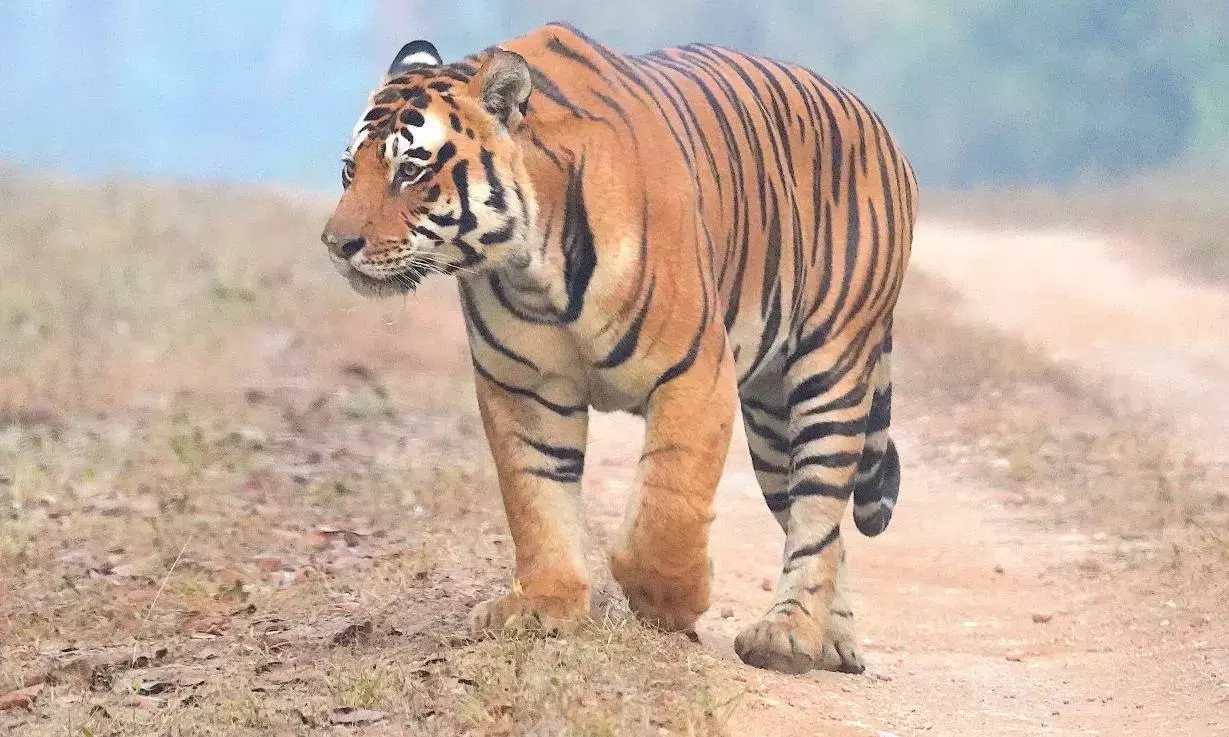
BENGALURU: Going by the number of tigers straying of the tigers especially on the borders of reserves, Minister of Forests and Environment Eshwar Khandre on Monday exuded confidence of Karnataka seeing a considerable jump in tiger population in the latest tiger estimation which began in the State in its tiger reserves and also outside tiger reserves.
Karnataka stands second in the country after Madhya Pradesh in tiger count and current tiger numbers in the State are about 563. The tiger reserves of Karnataka are Bandipur, Nagarhole, Kali, Bhadra and Biligiriranga Hills.
The result of All India Tiger Estimation-2026 will be released in 2027. Tigers in Karnataka were estimated to be about 290 in 2006 when All India Tiger Estimation was taken up in the country. The number of tigers saw a slight rise in 2010 tiger estimation in Karnataka and saw a drastic jump in the tiger numbers in 2014 when tigers were estimated to be around 406. Karnataka tiger population went up significantly in 2018 when tigers were estimated to be around 524.
Over the conduct of Chief Conservator of Forests, Project Tiger and Nodal Officer for Karnataka, All India Tiger Estimation Dr . P. Ramesh Kumar said the tiger estimation is taken-up in 3 phases and phase -1 of the estimation of tiger is carried out using MSTrIPES Ecological App (Android application).
Under the exercise, Carnivore Sign Survey will be carried out for 3-days by walking at least 5-km each day on existing forest road/tracks and the Carnivore Sign Survey is conducted to detect and record presence of carnivores in an area through indirect signs such as dung.
Under Phase-1, he said, Line Transect Survey will be conducted for 4-days by walking on a predetermined 2-km Transact line prepared specifically for tiger estimation and the aim of Line Transect Survey is to estimate herbivore abundance through direct sightings.
The phase-2 of the tiger estimation, Ramesh Kumar said, is conducted at Wildlife Institute of India, Dehradun through Remote Sensing and Geographical Information System (GIS) techniques and the phase-3 includes Camera Trap survey using Cameras including outside tiger serves such as Madikeri Wildlife Division, Mysore Territorial Division, Bhadravathi Division, Canara, Dharwad and Belagavi circles.
