KITU Slams Piyush Goyal’s Remarks on India’s Work Culture

Karnataka IT employees’ union accuses the Union Minister of glorifying excessive working hours and urges the government to protect workers’ rights, weekly holidays and work-life balance.
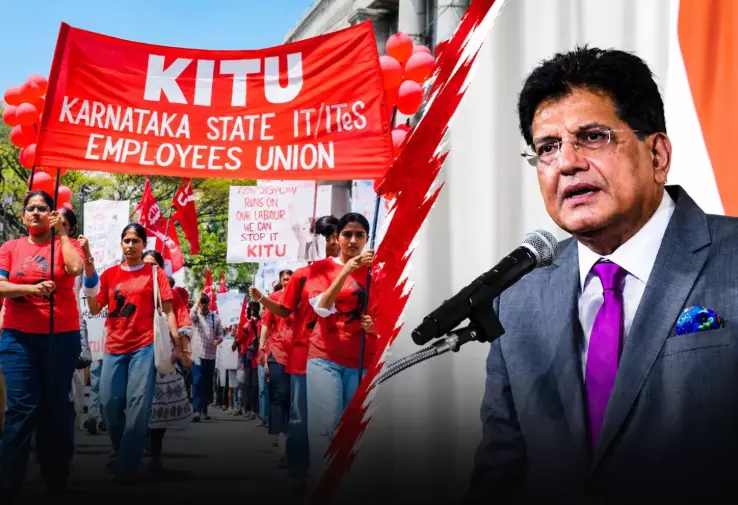
The Karnataka State IT/ITeS Employees Union (KITU) has strongly criticised Union Commerce and Industry Minister Piyush Goyal over his remarks on India’s work culture at the India-Netherlands Business Forum, triggering a debate over working hours, employee rights and work-life balance.
Speaking at the forum, Goyal said, “Nobody in India will tell you it's 5 o'clock. And certainly, no Indian will ever remind you it's the weekend.” His comments were intended to highlight India’s work ethic and its appeal as a business destination.
However, KITU condemned the statement, arguing that it promotes a workplace culture in which employees are expected to remain available to employers beyond regular working hours, including weekends.
In its statement, the union said such remarks risk encouraging corporations to disregard working-hour regulations, weekly holidays and labour protections. It described the glorification of excessive work as a form of “chattel slavery” and maintained that employees should not be treated as resources available to employers at all times.
The union also drew comparisons with earlier calls for longer working hours by corporate leaders, including Infosys co-founder Narayana Murthy and the chairman of Larsen & Toubro (L&T). KITU argued that such expectations place corporate productivity and profits above workers’ health, dignity and personal lives.
According to the union, excessive working hours can contribute to workplace stress, burnout and the deterioration of family and social relationships. It stressed that rest, family time, social participation and personal development are essential to a dignified life, rather than privileges that employers can choose to grant or deny.
KITU called on the government to prioritise workers’ rights, enforce applicable labour laws and uphold international labour standards instead of promoting expectations of continuous availability.
The union also urged workers, trade unions and democratic organisations to oppose what it described as the normalisation of inhumane working conditions. It called for reasonable working hours, weekly rest, work-life balance and the right to disconnect outside working hours.
The controversy has renewed discussion about the balance between economic competitiveness and employee welfare, particularly in India’s technology and services sectors.
