Indigenously Made Radio-Collars Replace African Collars In Hassan

Chief Technology Officer (CTO) of Infiction Labs, Bengaluru Gurudeepa G. explained the African wildlife tracking collars came with sealed batteries while indigenous made radio-collars can undergo repair of battery modules.
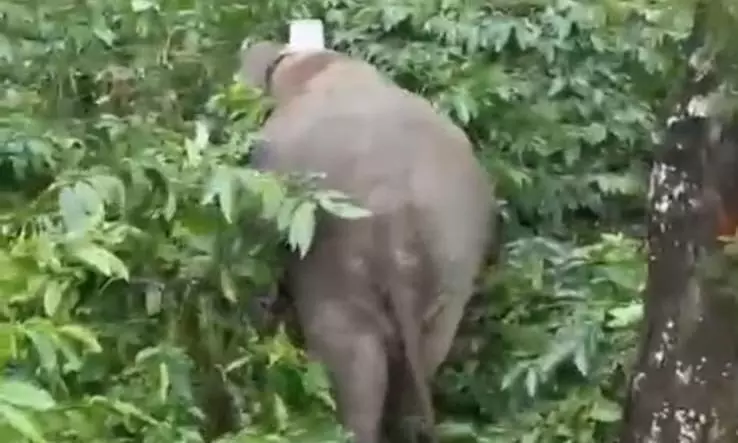
BENGALURU: Indigenously built radio-collar for elephants replace African wildlife tracking collars to track elephant movements in Hassan. The indigenously made ‘KP collars” referred to KP Trackers (Karnataka-Patented Tracking Devices) have been fitted to 2 elephants in April and a lone matriarch elephant on Monday as a man-elephant mitigation measure.
“An African wildlife tracking collars costs Rs 6 lakh while the indigenous made collars are available at Rs 2.8 lakh per piece including a new feature Ultra High Frequency (UHF) in them.”
Speaking on the functioning of the indigenously made KP collars, Saurabh Kumar said one developed data error and the other one is working efficiently. “It is taken-up on a trial basis,” said the DCF.
About 3 years back, a matriarch of an elephant herd ‘Bhuvaneshwari’ was fitted with African wildlife tracking collar which is satellite based and this radio-collar did not function as expected which the task of forest personnel difficult in tracking jumbos, stated Saurabh Kumar and the DCF said in the operation to fit indigenously made radio-collar in Belur range of Hassan on Monday, an elephant from the same herd was identified and fitted with KP collars to track and drive back to forests if they strayed to villages.
Chief Technology Officer (CTO) of Infiction Labs, Bengaluru Gurudeepa G. explained the African wildlife tracking collars came with sealed batteries while indigenous made radio-collars can undergo repair of battery modules. “The indigenous made radio-collars come in modular shape where it is possible to replace batteries,” he added.
“A new feature, Ultra High Frequency, has been added to the indigenously made radio-collar which is absent in African radio-collars. With this new feature, signals can be received by tracking elephants with handheld remote. The signal coverage range could be up to a 1-km radius,” said the CTO of the Labs.
Unlike in African radio-collars, Gurudeepa stated “Data collected on elephants will remain secured within the country since they are stored in Forest Department servers.”
